
.jpg)
Exactly one year ago, most of us were facing the start of Easter 2020 cancelling travel plans and uncertain about what the future would hold.

A year ago, most of the population came across terms that had fallen out of common use, such as "state of emergency", a concept from another era, while also becoming familiar with others like "Temporary Layoff Procedure (ERTE)", which were initially explained rather poorly. In any event, it proved to be an appropriate temporary mechanism, widely accepted by some and hotly debated by others.
Over the past year or so, employer organisations have highlighted that Temporary Layoff Procedure (ERTE) schemes have been "a fundamental mechanism for adapting to such an unexpected situation", acting as "a buffer on expenditure while continuing to protect workers' income" and safeguarding jobs. Trade unions have said much the same, repeatedly stressing that "Temporary Layoff Procedure (ERTE) schemes have saved millions of jobs and hundreds of companies".
The Labour Inspectorate has criticised the continuation of these Temporary Layoff Procedure (ERTE) schemes in sectors with little long-term viability, arguing that it is fundamentally incompatible to use this temporary instrument for companies that are already beyond saving. In some quarters, this situation has been described as "zombie companies", businesses whose demise has been needlessly prolonged despite being known to be unviable and effectively lifeless.
The fact is that, according to figures published by the Ministry of Labour (MTES) and the Public Employment Service (SEPE), drawing on a study conducted by LHH, in January 2021 there were 1,282,944 companies registered with Social Security, employing 13,786,654 workers. In January 2020, the number of companies registered with Social Security stood at 1,318,325, with 1,989,968 workers in employment.
According to these figures and the accompanying table, we are looking at 35,381 fewer businesses and 203,315 fewer people in employment in January 2021 compared to January 2020.

It is true that the enormous flexibility offered by the Temporary Layoff Procedure (ERTE) makes it difficult to distinguish between a structural problem and a temporary, recoverable one within a company. It is equally true that the current pandemic is an unprecedented situation, one that many legal professionals, particularly in the employment field, as well as administrative managers, have been forced to navigate amid continuous regulatory changes, all of which were initially aimed at preserving the majority of jobs.
Regrettably, this situation has continued to drag on, and as of today we face a state of emergency extended until 9 May 2021, with the Temporary Layoff Procedure (ERTE) scheme in place until 31 May 2021, by virtue of Royal Decree-Law 2/2021 of 26 January, reinforcing and consolidating social measures in defence of employment, while awaiting further negotiations between employers' organisations, trade unions and the Ministry of Labour.
It is worth noting that, according to data from the MTES, Public Employment Service (SEPE) and LHH (APG 25/03/2021), in January 2021, 3,858 workers were affected by contract suspensions and working-hours reductions under the framework of the Temporary Layoff Procedure (ERTE), while 1,051 workers had their contracts terminated through collective dismissal. Out of a total of 4,909 workers, therefore, 78.59% were covered by the Temporary Layoff Procedure (ERTE) scheme, and the remaining 21.41% had their employment contracts terminated through collective dismissal.
It should be highlighted that, regarding contract terminations, the figures cited above relate solely to collective redundancy procedures; on an individual level, a great many employment contracts have already been terminated during this period, and more will follow, as many businesses, including, among others, a significant number of Chinese-owned general stores, can no longer sustain their operations. In passing, I was struck to see for the first time yesterday both an employer and an employee, both of Chinese origin, queuing like everyone else under COVID protocols to attend their scheduled appointment before the Mediation, Arbitration and Conciliation Service (SMAC) of the Generalitat de Catalunya (the regional government of Catalonia), where they formalised a mutual termination agreement.
Having noted the above as background context and a point of curiosity for what follows, it is worth highlighting that comparing January 2021 with January 2020, the number of workers affected by Collective Dismissal Procedure (ERE) fell by 1% (4,909 in 2021 versus 4,973 in January 2020).

As noted above, drawing on data from the MTES, Public Employment Service (SEPE) and LHH research, the number of workers affected by Collective Dismissals fell by 58% (1,051 in 2021 versus 2,529 in 2020), while those affected by Contract Suspension and Working Hours Reductions rose by 58% (3,858 in 2021 versus 2,444 in 2020).

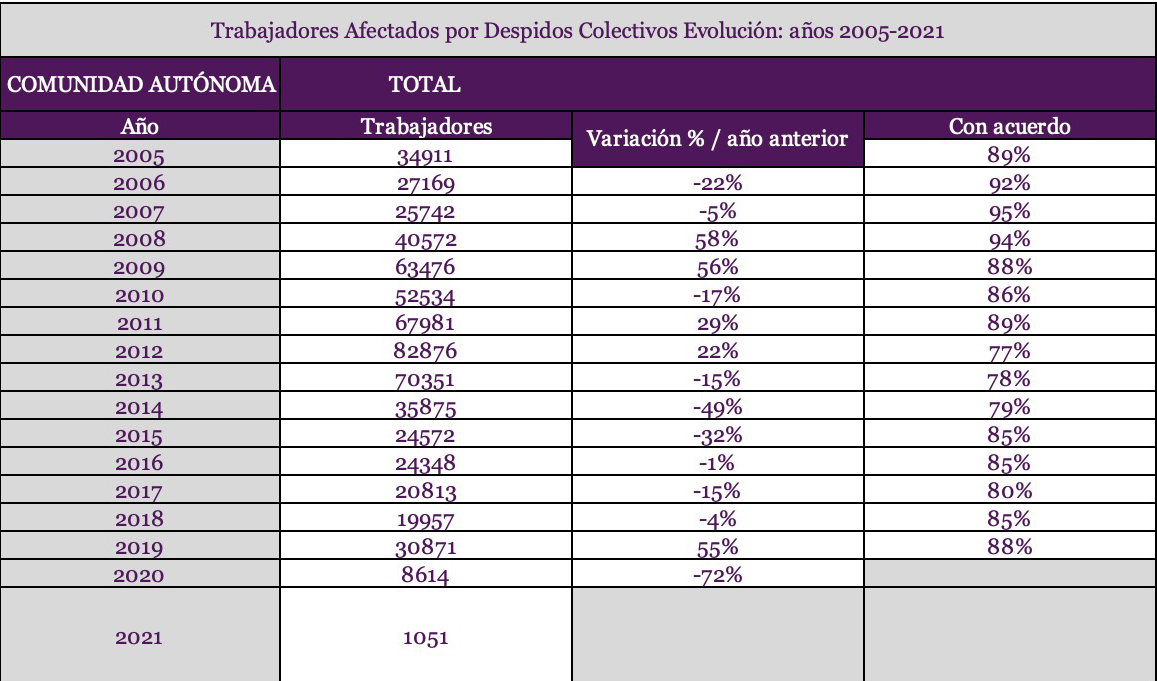
This reduction in the proportion of workers made redundant would be even more pronounced if we took into account the 2019 figures. According to the same sources, Collective Dismissals affected 8,614 workers in 2020 and 30,871 in 2019.
As the study points out, the ease with which many companies were able to access Temporary Layoff Procedure (ERTE) on force majeure grounds, made available in response to the COVID-19 crisis, led businesses that had been planning redundancies to opt, at least temporarily, for this alternative arrangement instead.
However, many companies have since decided to exit Temporary Layoff Procedure (ERTE) arrangements, finding the situation unsustainable, and have begun terminating employment contracts, both on a collective and an individual basis.
FROM TEMPORARY LAYOFFS TO COLLECTIVE DISMISSALS
Unfortunately, we are unable to report on the number of workers affected by Collective Dismissals so far this year, as data on Workforce Adjustment Procedures broken down by company size has not been published since March 2020. We are nonetheless able to present the comparative data available from the MTES, Public Employment Service (SEPE) and LHH.
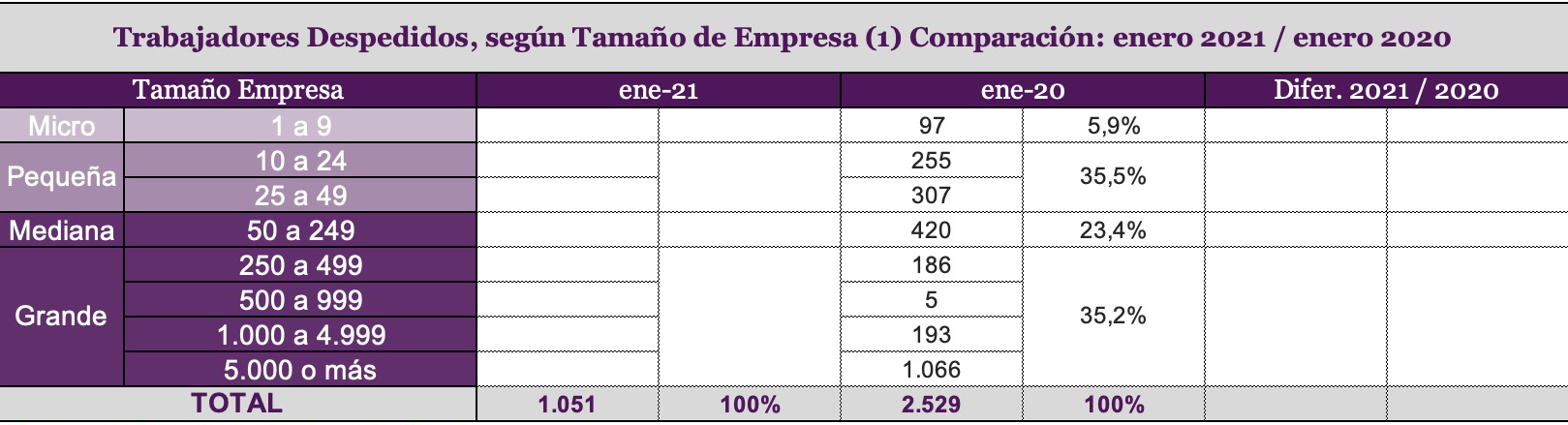
After a year in which a large part of the population discovered what Temporary Layoff Procedure (ERTE) were, this measure is already showing signs of exhaustion. Although further Royal Decree-Law may still be approved, several major companies, including EL CORTE INGLÉS, FORD and NATURGY, will be making thousands of employees redundant in 2021. Others facing mergers, such as CAIXABANK-BANKIA, along with companies from various other sectors which we will address later, will find themselves having to implement Collective Dismissal Procedure (ERE). These must follow strictly prescribed procedures, tailor-made to each situation, or risk serious consequences for non-compliance.
Among those mentioned, according to publicly available information, El Corte Inglés (ECI) approved a Collective Dismissal Procedure (ERE) at its board of directors meeting on 24 February 2021, affecting 3,292 employees. These figures are ultimately expected to be reduced by around 500 workers, subject to voluntary departures not covering the full quota. In all cases, severance pay is set at 33 days per year of service, up to a maximum of 24 months. The company and employee representatives have also agreed a bonus scheme for those who opt voluntarily for redundancy. Employees with between five and ten years' service will receive an additional payment equivalent to 5% of their annual gross salary. Those with between ten and fifteen years' service will receive 10%. Finally, employees with more than fifteen years' service will receive a 20% bonus. In all cases, outplacement support will be provided.
These terms apply solely to ECI's directly employed staff and not to employees in indirect roles, who, if subject to a Collective Dismissal Procedure (ERE) or individual dismissals, will need to establish their own negotiation framework during a consultation period, or, as a last resort, proceed on the basis of 20 days' severance pay per year of service, as provided under the Workers' Statute (together with any additional rights that may apply in the case of a collective dismissal).
Similarly, NATURGY has put to the trade unions a proposal to cut approximately 1,000 positions in Spain, around 18% of its domestic workforce, through a combination of incentivised and voluntary departures.
The energy company's total global workforce stood at approximately 10,540 employees at the close of 2020, having already been reduced in recent years through various agreed departure schemes, in most cases involving early retirement arrangements as well as individual agreements.
It appears that the current workforce reduction proposal has been extended to cover all staff, meaning it is no longer limited to employees closest to retirement age, those over 55, as had been the case previously.
It is worth noting that, of the group's total workforce at the close of last year, approximately 5,318 employees were based in Spain, 27.5% of whom were over 50 years of age, according to figures from the company's Sustainability Report and Non-Financial Information Statement.
Finally, in news that emerged around the Easter period, we turn to the negotiations currently underway at CAIXABANK following its merger with BANKIA, in which the newly merged bank is seeking the departure of at least 8,000 employees, initially through voluntary redundancies. Various media outlets have reported an average cost per departure of around €300,000, which we understand reflects the seniority levels and salary scales typical of the banking sector.
It should be recalled that CAIXABANK previously carried out a Collective Dismissal Procedure (ERE) affecting approximately 7% of its workforce, which impacted 2,023 employees aged over 54, at a cost of €890 million. That Collective Dismissal Procedure (ERE) formed part of the 2019–2021 Strategic Plan, which set out several eligibility criteria with voluntary enrolment and subsequent ratification by employees, organised by group:
• For employees in Group A (born in 1965 or earlier), the agreement provided for a gross compensation equivalent to 57% of the applicable regulatory salary up to the age of 63, payable either as a lump sum or in instalments. Employees who opted for the instalment arrangement would receive an additional gross payment of €18,000 (those born in 1962 or earlier), €23,000 (born in 1963), or €28,000 (born in 1964 or 1965).
Additional entitlements included a special agreement with Social Security and contributions to a CaixaBank occupational pension scheme up to the age of 63, as well as continued access to the bank's collective healthcare insurance policy for employees.
• Workers born in 1966 and 1967 (Group B) would receive compensation equivalent to 57% of their regulatory salary, with an additional gross payment of €38,000 if they opted to receive it in instalments. This group also benefited from a special agreement with Social Security until the age of 63, along with other entitlements.
• For all remaining workers (Group C, born in 1968 or later), the gross severance payment will be equivalent to 45 days' regulatory salary per year of service, subject to a maximum of 42 monthly payments and a minimum of 36. These employees may also apply, at their own cost, to be included as beneficiaries under the relevant health insurance policy. Within this group, those born between 1968 and 1970 may choose to receive their compensation as a single lump sum or in monthly instalments spread over eight years. In the latter case, an additional gross payment of €13,000 will be added for employees with fewer than 10 years' seniority, and €23,000 for those with greater seniority.
Regarding Bankia, it is worth noting that the bank carried out a Collective Dismissal Procedure (ERE) at Banco Mare Nostrum in 2018, affecting 2,000 workers.
Finally, H&M has announced a Collective Dismissal Procedure (ERE) affecting 1,100 employees in Spain. The Swedish fashion retailer will close 30 stores, with a further 94 affected by the redundancies.
But what about the broader landscape of Spanish businesses? The outcome will depend on what the parties freely negotiate, based on their respective positions and current circumstances relative to the need for collective redundancy procedures, with particular attention to what is agreed between the parties during the consultation period, and ensuring that the correct procedure is followed throughout the processing and negotiation of collective dismissals.
According to sources from the Ministry of Labour, the Public Employment Service, and an LHH study, the majority of collective redundancy procedures initiated in recent years have concluded with an agreement:
Building on the above, and drawing on the major negotiations carried out in the sectors referenced earlier, it is clear that in any Collective Dismissal Procedure (ERE), a series of formal requirements must be followed, especially where the aim is to reach a CONSENSUAL OUTCOME, free from "rogue challenges".
That said, there is an important nuance to note. A recent ruling from the Social Chamber of the High Court of Justice (High Court of Justice (TSJ)) of the Balearic Islands, ruling 412/2020 of 18 November 2020, Rec. 179/2020, has, in the context of a Temporary Layoff Procedure (ERTE) WITH AGREEMENT, allowed two affected employees to bring individual claims, ruling in their favour. The court found the dismissal to be unfair, on the basis that the company had no right to dismiss them given that the closure had been caused by the company's own failure to comply with planning regulations, which had paralysed a significant part of the gym's operations. The court permitted the individual claims by reference to its interpretation of ILO Convention No. 158, ratified by Spain in 1985.
Pending the ruling becoming final or any determination by the Supreme Court, we set out below the formal requirements that must be followed in a Collective Dismissal Procedure (ERE).
See the links below for guidance on how a Collective Dismissal Procedure (ERE) or collective dismissal is processed.