

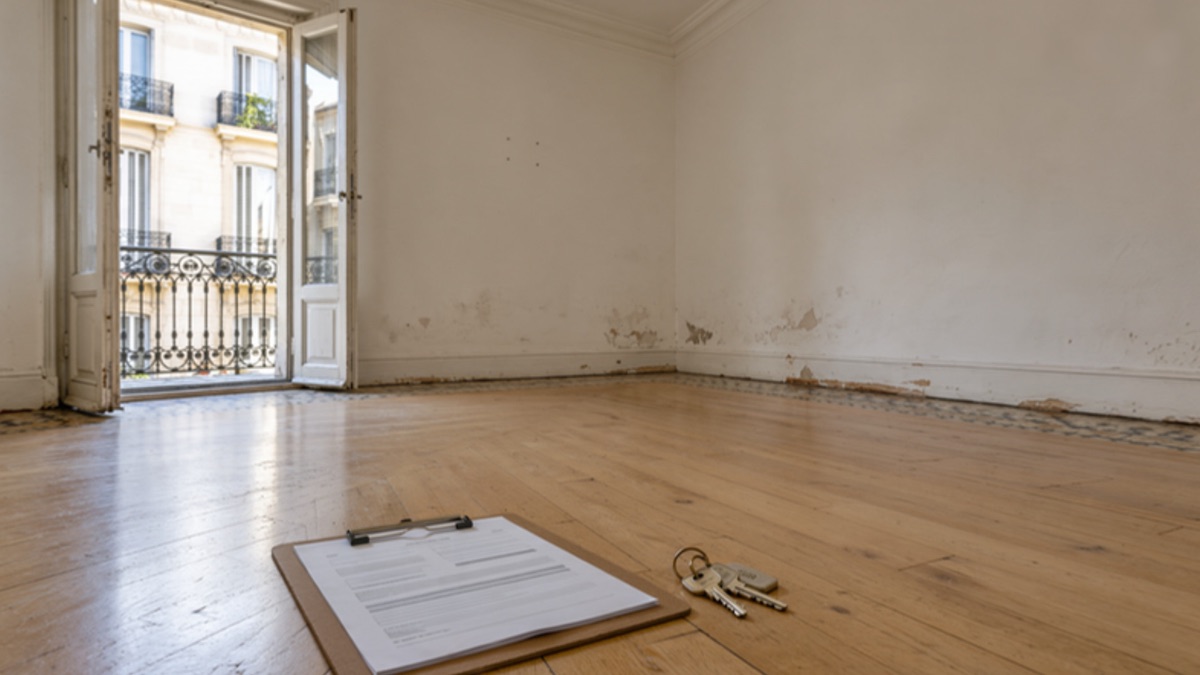
The tenant leaves, the keys are handed back, and the real problems come to light: forced doors, damp caused by misuse, lifted flooring, broken sanitary fittings, tampered installations. The deposit covers part of the cost, and the landlord soon discovers that the cost of reinstatement far exceeds it. At that point, the question shifts from a practical one to a legal one: which types of damage can actually be claimed, what evidence is needed, and through what procedure can they be pursued in court.

The starting point: in what condition must the property be returned?
The basic obligation is set out in the Spanish Civil Code. Article 1561 provides that, upon expiry of the tenancy, the tenant must return the property in the same condition in which it was received, except for anything that has perished or deteriorated through the passage of time or by unavoidable cause.
That provision contains the whole of the subsequent debate. The standard is not to return the property in new condition, but in the condition in which it was received. The provision itself carves out two scenarios: deterioration resulting from the passage of time, and deterioration attributable to an unavoidable cause. Fading paintwork, a worn skirting board, or the natural wear of an element subject to continuous use all fall within that category. A broken window, a door torn from its frame, or tampered installations do not.
The liability rule under Article 1563
Article 1563 of the Spanish Civil Code is the key provision in any legal claim for property damage: the tenant is liable for any deterioration or loss suffered by the rented property, unless they can prove it occurred without fault on their part.
It is worth reading the second part carefully. The rule places the burden of proving absence of fault squarely on the tenant. The landlord bringing a claim must prove that the damage exists and that the property was not in that condition when possession was handed over. From that point, it falls to the tenant to demonstrate that the damage occurred through no fault of their own, for example, due to a pre-existing structural defect, an incident beyond their control, or simply the passage of time as referred to in Article 1561.
This allocation of the burden of proof explains why many cases are won or lost before the claim is even filed, during the documentation stage, when the condition of the property is recorded.
Damage attributable to the tenant versus the landlord's obligations
Article 21 of the Urban Leases Act draws the dividing line. The landlord is required to carry out, without any right to increase the rent as a result, all repairs necessary to keep the property in a habitable condition for the agreed use. However, this obligation has an express exception: it does not apply where the deterioration requiring repair is attributable to the tenant under Articles 1,563 and 1,564 of the Spanish Civil Code.
The same article sets out two further rules that help define the scope of any claim. Minor repairs arising from ordinary wear and tear are the tenant's responsibility. Additionally, the tenant must notify the landlord as promptly as possible of the need for any maintenance repairs, and must allow the landlord or any technicians the landlord designates to inspect the condition of the property directly.
This duty to give notice carries evidential weight. Where serious damage comes to light at the end of the tenancy and was never reported, the tenant's silence will count against them when assessing whether they acted with the requisite care.
What the tenant is and is not liable for
- The tenant must return the property in the same condition in which it was received, upon termination of the tenancy (Art. 1561 CC)
- The tenant is not liable for deterioration or loss caused by the passage of time or by unavoidable causes (Art. 1561 CC)
- The tenant is liable for deterioration or loss of the leased property unless they can prove it occurred through no fault of their own (Art. 1563 CC)
- Takes responsibility for minor repairs arising from ordinary wear and tear of the property (Art. 21.4 LAU)
- Must notify the landlord as soon as possible of the need for any maintenance repairs (Art. 21.3 LAU)
The deposit is not a cap on liability
Article 36 of the Urban Leases Act (LAU) requires, at the time of signing the contract, the payment of a cash deposit equivalent to one month's rent for residential tenancies and two months' rent for non-residential use. This amount represents a minimum statutory guarantee, it is not a cap on the tenant's liability for any damage caused.
The parties may agree on an additional guarantee on top of the cash deposit. For residential tenancies with a duration of up to five years, or up to seven years where the landlord is a legal entity, the value of any such additional guarantee may not exceed two months' rent. For short-term tenancies, it may not exceed one month's rent. The same provision prohibits requiring the tenant to take out rent default insurance or any similar coverage.
Where the cost of repairs exceeds the deposit and any additional guarantee, the route to recovering the difference is a judicial claim for a sum of money against the former tenant. Conversely, where the landlord withholds the deposit without documented justification, it is the tenant who brings the claim.
Interest on late return of the deposit
Any cash deposit balance that must be returned to the tenant at the end of the tenancy accrues interest at the statutory rate once one month has elapsed from the handover of the keys without repayment having been made. This is a material consideration for landlords: withholding a deposit without solid documentary evidence of damage may ultimately result in interest accruing against the party retaining it.
Time Limit
Any cash deposit balance that must be returned to the tenant accrues interest at the statutory rate once one month has passed from the handover of keys without the return having been made (Art. 36.4 of the Urban Leases Act). Retaining the deposit without documentary evidence of damage may result in the landlord being liable for that interest.
The end-of-tenancy document
The consolidated text of the Urban Leases Act provides, in Article 36(7), that upon termination of the contract both parties must record in writing the condition of the property at the time of handover, by means of an end-of-tenancy document signed by both parties.
The consequences for a careless landlord are significant. If that document is not signed, or if it is signed but records no damage, it is presumed, unless proven otherwise, that the property was handed back in a satisfactory state of repair. This is a rebuttable presumption, but it places the burden squarely on the party bringing the claim to dismantle it with solid evidence.
This provision has been subject to a succession of royal decree-laws and a ratification agreement that rendered one of the amendments ineffective. Before building a claim on this basis, it is advisable to verify the wording in force on the exact date the tenancy ended.
Evidence: what actually determines the outcome
A court claim for damage caused by a tenant rests on a comparison between two points in time: the condition of the property when possession was handed over and its condition when it was recovered. Anything that helps establish those two moments has evidential value.
The inventory annexed to the contract, with dated photographs, forms the foundation. The end-of-tenancy record or document signed by both parties, setting out the damage in detail, completes the picture. This is supplemented by correspondence between the parties during the tenancy, particularly communications regarding repairs under Article 21 of the Urban Leases Act, along with a quote or expert report quantifying the cost of reinstatement.
The technical report serves a dual purpose. It quantifies the amount claimed and, crucially, draws a clear distinction between ordinary wear and tear over time, excluded under Article 1561, and damage attributable to the tenant's use of the property. Without that distinction, the amount claimed is exposed to significant reduction.
What else can be claimed beyond repair costs
Article 1101 of the Spanish Civil Code provides that those who fail to fulfil their obligations through fraud, negligence or delay, or who in any way act contrary to the terms of those obligations, are liable to pay compensation for the resulting losses and damages.
On that basis, a claim may extend beyond the cost of repair works where additional losses arising from the breach can be evidenced. Each head of claim must be justified and quantified. Generic items without documentary support are typically excluded from any award.
Which procedure applies
The applicable procedural route is set out in the Civil Procedure Act. Article 249.1.6 assigns matters relating to urban or rural property leases to the ordinary proceedings track, regardless of the amount at stake, subject to two notable exceptions: claims for rent or other sums owed by the tenant, possession claims based on non-payment or expiry of the lease term, and cases where it is possible to assign a monetary value to the subject matter of the proceedings, in which case the applicable procedure is determined by the general rules on quantification set out in the Act.
A claim for damages caused by a tenant is, by definition, a quantifiable monetary claim. Accordingly, the applicable procedure is ordinarily determined by the value of the claim. Article 249.2 reserves ordinary proceedings for claims exceeding fifteen thousand euros and for those whose economic value cannot be calculated, even approximately.
This is why it is essential to establish the correct amount claimed from the outset: it determines the procedural track, the timescales, and the cost of the proceedings.
| Scenario | Rule under the Civil Procedure Act |
|---|---|
| Matters relating to urban property leases | Ordinary proceedings regardless of the amount at stake (Art. 249.1.6) |
| Claims for rent or amounts owed by the tenant, and eviction proceedings for non-payment or expiry of the lease term | Excluded from the general rule under Art. 249.1.6 |
| Subject matter with an assessable monetary value | The proceedings applicable under the general rules of the Act (Art. 249.1.6) |
| claim exceeding fifteen thousand euros or involving an economic interest that cannot be quantified | Ordinary proceedings (Art. 249.2) |
How to structure a court claim
The order in which you approach things matters just as much as the substance. A well-constructed claim starts from a complete, closed file, not the other way round.
Documenting the condition at handover
Retrieve the inventory annexed to the contract, the dated photographs taken at the start of the tenancy, and any handover records documenting possession being transferred to the tenant.
Create a written record at the end of the tenancy
Document the condition of the property at the point of handover in a written record signed by both parties, with a detailed description of any damage or defects.
Quantify damage with a technical report
Obtain a quote or expert report that distinguishes between deterioration attributable to the tenant's use and wear caused by the passage of time or unavoidable circumstances.
Apply the deposit and any additional guarantees
Set off the cash deposit and, where applicable, any agreed additional security, and determine the outstanding balance remaining to be claimed.
Send a formal written demand to the former tenant
Communicate the details of the damage, the amount claimed, and the supporting documentation, ensuring proof of receipt.
File the claim
Establish the amount claimed, determine the appropriate procedural route in accordance with Article 249 of the Civil Procedure Act, and submit all documentary and expert evidence.
In lower-value claims where the damage is evident, a quote has been accepted, and the debtor is traceable and does not dispute the substance of the matter, the case is straightforward and may be resolved through a documented agreement. In such situations, it is possible to submit a settlement proposal with a payment schedule before commencing proceedings. Where the tenant denies responsibility for the damage, attributes the deterioration to ordinary wear and tear, or has become untraceable, the situation changes and the appropriate route is the claim.
Common mistakes made by landlords
The first is carrying out repairs immediately without documenting the damage. Once the property has been restored, the evidence of the damage disappears, leaving only the invoice, which proves an expense was incurred but not its cause or the tenant's liability for it.
The second is including upgrade or improvement items in the claim. Replacing old fittings with superior ones does not constitute repairing attributable damage, and this confusion undermines the claim as a whole.
The third is retaining the deposit without any communication or supporting documentation, overlooking the fact that any outstanding balance due for return accrues statutory interest once one month has passed from the handover of keys.
The fourth is failing to sign any document at the key handover, which may give rise to a presumption that the property was returned in good condition, in accordance with Article 36 of the Urban Tenancies Act.
Defending the tenant as defendant
A tenant facing a claim is not without recourse. Article 1563 of the Spanish Civil Code allows them to avoid liability by demonstrating that the damage occurred through no fault of their own. Article 1561 excludes deterioration caused by the passage of time or unavoidable circumstances. And Article 21 of the Urban Leases Act places the responsibility for repairs necessary to keep the property in a habitable condition on the landlord, unless the deterioration is attributable to the tenant.
These are genuine lines of defence when supported by prior communications about the condition of the property, photographs taken at the start of the tenancy, technical reports on structural issues, or evidence that the damage originated externally. The absence of an initial inventory or a check-out document will generally work in favour of the former occupant.
When to involve a lawyer from the outset
Early legal involvement prevents mistakes that cannot be undone later. A lawyer specialising in tenancy disputes will identify which heads of claim are defensible, how to document the damage before carrying out repairs, what amount to claim, and which procedural route applies under Article 249 of the Spanish Civil Procedure Act.
A lawyer will also assess the realistic prospects of recovery. Obtaining a favourable ruling is one step; enforcing it against a debtor with no known assets is quite another. That assessment should be made before investing in proceedings, not after.
At Conesa Legal, we review the contract, the inventory, the handover documentation and any technical reports, and we bring the judicial claim with the amount and procedure that best fit the specific circumstances of the case.