
.jpg)
The publication of Royal Decree-Law 16/2022, of 6 September, on improving working conditions and Social Security coverage for domestic workers, has repealed the legislation previously governing the working conditions of domestic employees, updating Royal Decree 1620/2011, of 14 November, regulating the special employment relationship for household domestic service and the new regulations require certain adaptations to contracts already in force.

Grounds for termination of domestic worker contracts:
a) By mutual agreement of the parties.
b) By grounds validly set out in the contract.
c) By expiry of the agreed term.
d) By employee resignation.
e) By death, severe disability, or total or absolute permanent disability of the employee.
f) By retirement of the employee.
g) By death, retirement, or incapacity of the employer.
h) By force majeure.
i) By collective dismissal based on economic, technical, organisational, or production grounds.
j) At the employee's initiative due to the employer's breach of contract.
k) By dismissal of the employee.
l) By objective grounds as provided by law.
m) Where the worker is compelled to leave due to gender-based violence.
And additionally...
X+1) Due to a reduction in the household unit's income or an increase in its expenses arising from an unforeseen circumstance.
X+2) Due to a material change in the needs of the household unit that justifies dispensing with the domestic worker's services.
X+3) Due to conduct on the part of the worker that reasonably and proportionately gives rise to a loss of trust on the part of the employer.
Requirements and formalities for terminating a domestic worker's contract:
- Notice must be given in writing
- The intention to end the employment relationship must be stated clearly and unequivocally
- The reason for the decision must be clearly stated.
- A severance payment of 12 days' pay per year of service must be made simultaneously, capped at 6 months' salary.
- A notice period of 7 days must be given where the employment has lasted less than one year; for employment of more than one year, the minimum notice period is 20 days (with 6 hours per week granted to seek new employment, unless compensated in lieu).
Failure to comply with the above requirements means the employer is subject to the regime under the Workers' Statute (unless the shortfall in severance calculation is an excusable error, or unless the failure relates solely to the notice period).
Termination of a live-in domestic worker (one who sleeps on the premises) may not take effect between 17:00 and 08:00 the following day, except in cases of serious breach of the duties of loyalty and trust.
withdrawal from contract, dismissal AND COMPENSATION FOR DOMESTIC WORKERS:
The current compensation rates for withdrawal from contract from a domestic worker's contract are as follows:
- withdrawal from contract: 7 days' pay for contracts entered into on or before 31/12/2011;
- withdrawal from contract: 12 days' pay, capped at 6 months, for contracts entered into from 1/1/2012 onwards;
- objective grounds: 20 days' pay, objective grounds grounds under the Workers' Statute.
- DISCIPLINARY: 33 days' pay, disciplinary dismissal grounds under the Workers' Statute.
The mechanism of withdrawal from contract has been amended in two respects:
- (1) The employer must communicate their intention to withdraw from the employment relationship in writing and in unequivocal terms.
- (2) The compensation has been increased from 6 to 12 days' pay per year of service, capped at 6 months' salary. This increase applies only to contracts entered into after the entry into force of this provision and does not affect contracts concluded beforehand.
Contract termination shall be governed, except in relation to withdrawal from contract or disciplinary dismissal, by the common grounds set out in the Workers' Statute. In other words, the conditions applicable to domestic workers are brought into line with those of all other employees.
disciplinary dismissal of a domestic worker
disciplinary dismissal must be notified in writing, citing one of the grounds provided for under the Workers' Statute. Where dismissal is declared unfair, compensation shall be calculated at 20 days' pay per year of service, up to a maximum of 12 monthly payments. The right to this compensation also arises where the employer fails to comply properly with the notification and justification requirements.
Important: any failure to comply with the formal requirements for withdrawal from contract will give rise to a presumption of dismissal.
Requirements for a domestic worker contract:
The contract must be drawn up in writing whenever it is for four weeks or more, and the employer is required to inform the worker of the working conditions: remuneration (in cash and in kind, where applicable), agreed on-call hours, and arrangements for overnight stays. In the absence of a written agreement, the contract will be presumed to be indefinite and full-time. The Royal Decree allows a period of one year for existing contracts to be formalised in writing and for the information obligations to be fulfilled.
These contracts may be agreed for a fixed term or on an indefinite basis, and the probationary period may not exceed two months.
The remuneration may not fall below the salary Mínimo Interprofesional (pro-rated to the hours worked), with entitlement to two extra payments. As noted above, remuneration in kind may not exceed 30% of total salary. Workers employed on an hourly basis must be paid at least the salary Mínimo Interprofesional applicable to casual workers.
The maximum working week is set at 40 hours of actual work, and on-call presence hours may not exceed 20 per week within any one-month period, unless compensated with rest time. There must be a rest break of at least 12 hours between shifts, and during the working day the employee must be allowed 2 hours for meals, which do not count as working time.
Annual leave amounts to 30 calendar days, which may be split into separate periods provided that at least one of them is a minimum of 15 days.
Find out about our payroll services:
Contact our payroll specialist to have your domestic employee's monthly payslips prepared:

Social Security contributions for domestic employees:
Domestic workers and household employees retain their previous classification as a 'special employment relationship', although many of their working conditions have been brought into line with those of ordinary employees; the most significant change is the new obligation to make Social Security contributions under the General Scheme for all hours worked.
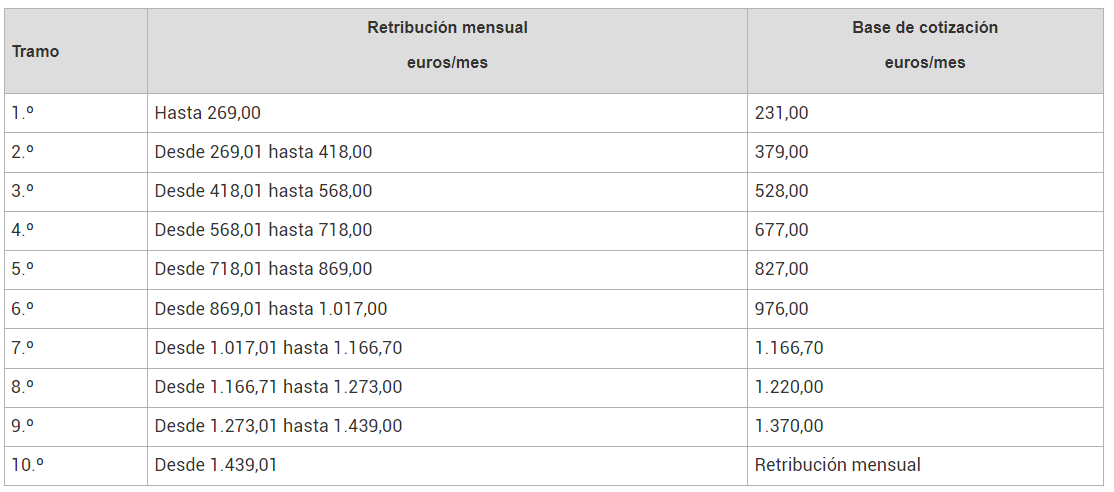
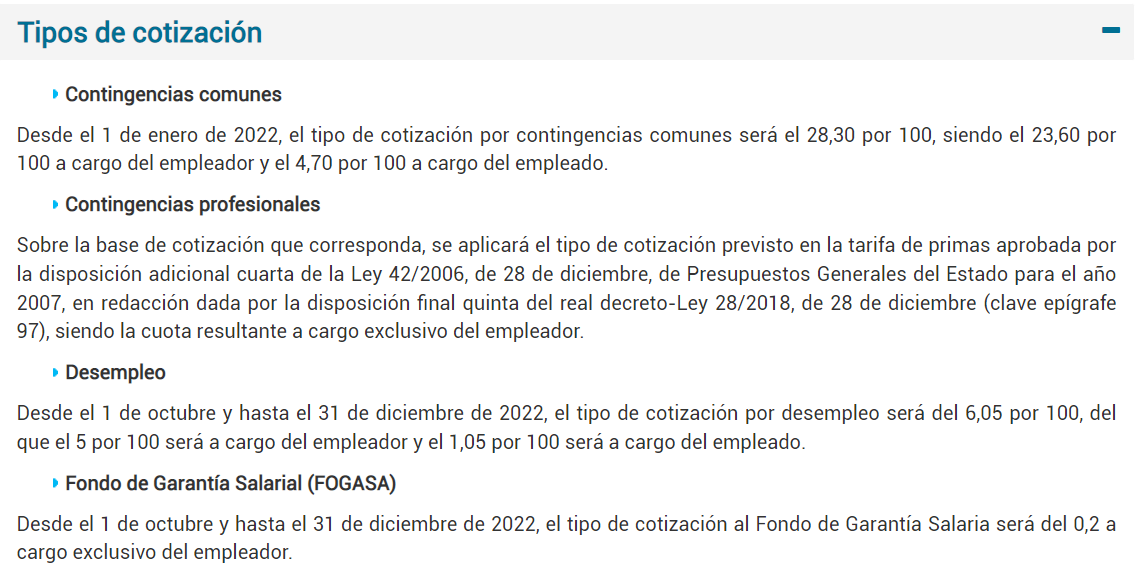
From 1 January 2023, the employer will be the sole party responsible for remitting Social Security contributions.
Other changes affecting domestic employment contracts.
- The non-cause-based annual fixed-term contract has been abolished. Going forward, fixed-term contracts will be subject to standard employment law rules: the Workers' Statute and its supplementary regulations.
- The salary cannot be lower than the national minimum salary (always in proportion to working hours), and benefits in kind cannot account for more than 30% of total salary.
- Salary increases shall be those agreed by the parties and, in the absence of agreement, shall be those set out in the collective bargaining statistics for the month in which the salary is reviewed. The previous rule linking salary increases to the employee's length of service has been repealed.
- Working hours are no longer at the sole discretion of the household employer and must now be agreed mutually.
- Weekly rest is increased to 36 hours and any on-call time agreed upon must be compensated either with pay (at a rate equal to or greater than standard working hours) or with additional rest time. These two measures are already provided for under the Workers' Statute for employees generally.
- Regarding annual leave, it is now the employee who chooses where to spend it, with no obligation to accompany the members of the household.
The employer is relieved of certain administrative obligations; the General Social Security Treasury will now notify the Public Employment Service of new hires and contract terminations directly.
Relationships not covered by the domestic employee regime:
- Professional carers hired to look after persons in a situation of dependency.
- Non-professional carers not linked to a personalised care service who attend to persons in a situation of dependency.
- Live-in or family-based arrangements providing board, lodging, or expense reimbursement, provided these are of a marginal nature.
Important: where a domestic worker provides any service outside the household for any company or business activity of the employer, they will be treated as an employee under the general employment regime and will therefore fall outside the scope of the special employment relationship applicable to domestic employees.
These regulations have been in force since 15 November and, although there is a one-year transitional period to regularise existing contracts, employers must immediately notify the relevant registration to the Social Security General Treasury in order to update the contribution arrangements for domestic workers.