

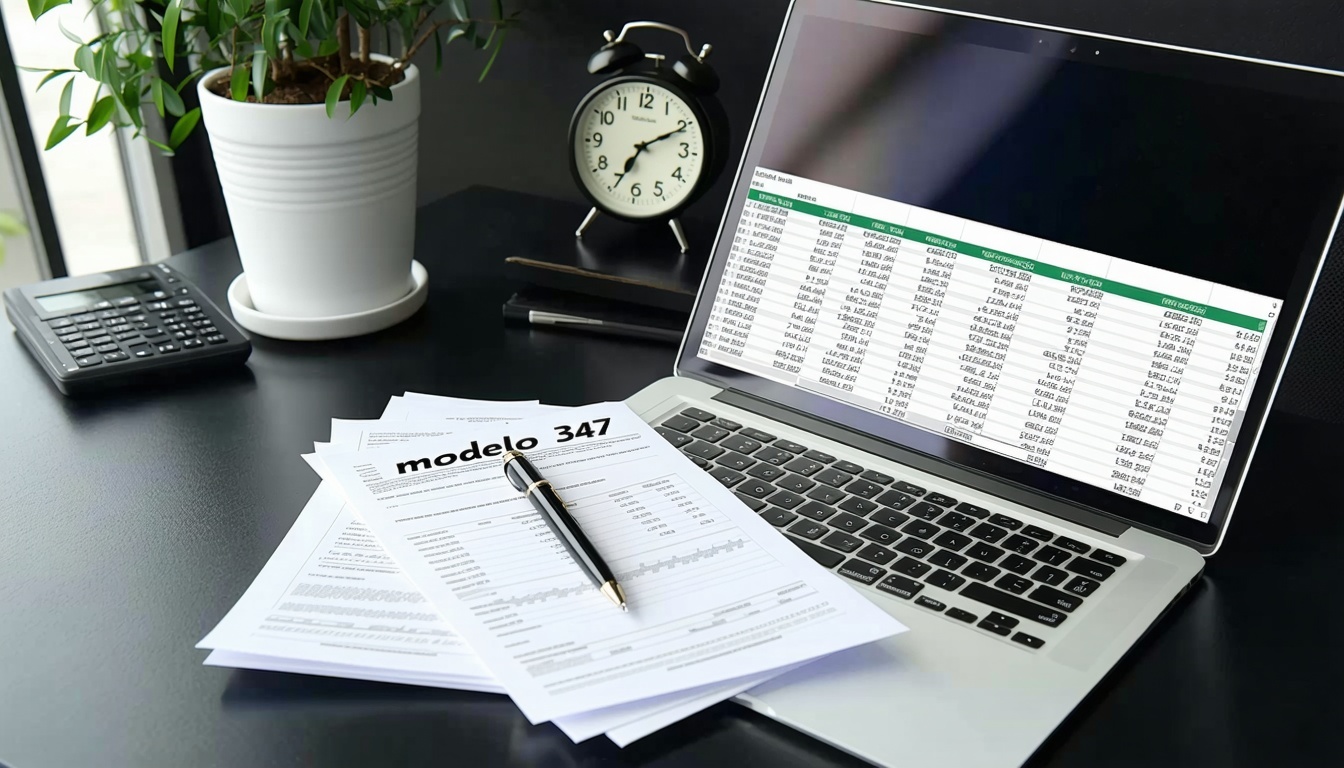
Form 347 in Spain is an annual informational tax return that must be filed by individuals (self-employed workers) and legal entities (companies), both public and private, that have carried out transactions with third parties totalling more than €3,005.06 (VAT inclusive) during the previous calendar year. Its purpose is to report these transactions to the Spanish Tax Agency (AEAT) in order to facilitate tax oversight and prevent fraud. It is commonly known as the "annual return of transactions with third parties".

Who must file Form 347?
- Companies and self-employed workers carrying out economic activities whose transactions with a single client or supplier exceed the €3,005.06 threshold.
- Non-profit and social organisations, such as associations without a profit-making purpose.
- Co-ownership entities and residents' associations, in respect of acquisitions of goods or services exceeding the established limit.
- Entities that manage collections on behalf of third parties, such as professional associations or intellectual property rights management societies.
The following are not required to file Form 347:
- Taxpayers enrolled in the Immediate Supply of Information (SII) system for VAT reporting purposes.
- Individuals and entities assessed under the objective estimation method for Personal Income Tax (IRPF) purposes and under simplified schemes for VAT purposes.
- Those whose annual transactions with any single third party have not exceeded €3,005.06.
- Those whose transactions are already reported under other specific returns, such as Form 180 for rental income.
- Self-employed workers under the flat-rate (módulos) or simplified VAT scheme are not required to file, except where transactions exceed that amount.
- Nor are those operating under the VAT equivalence surcharge regime required to file. This is a special VAT regime applicable to retail traders who sell products without carrying out any transformation of those products.
When must it be submitted?
Form 347 must be submitted during February of the year following the relevant tax year. If, for technical reasons, it is not possible to submit the form electronically via the internet within the prescribed deadline, submission may be made up to four calendar days after the end of that deadline.
How is it submitted?
It is submitted electronically through the Spanish Tax Agency (AEAT) online portal, using a digital certificate, electronic national ID (DNI electrónico) or PIN code (Clave PIN).
What information is required in Form 347?
- Declarant and summary: Personal details and an automatic summary generated from the information you declare in the following section.
- Declared parties: This is where you record transactions for each client or supplier that has exceeded €3,005.06 annually. You must specify the type of transaction, quarterly and annual amounts, etc. It is essential that each client and supplier has their province code included.
- Properties: Only applicable if you are renting out a business premises that meets certain requirements.
Which transactions are included?
- Purchases and sales exceeding €3,005.06 annually per supplier or client.
- Transactions already reported in other tax forms are NOT included (transactions subject to Personal Income Tax (IRPF) withholding, business premises rentals with withholding, intra-EU transactions, imports/exports).
When is Form 347 due?
Form 347 must be submitted during February each year, covering transactions carried out during the previous calendar year. The filing deadline is 28 February.
You can view the 2025 tax calendar here
How should transactions be reported when returns, discounts, rebates or adjustments to the taxable base occur at a later date?
Any adjustments must be reflected in the calendar quarter in which they occurred, provided that the result of those adjustments, taken together with all other transactions carried out with the same person or entity during the calendar year, exceeds €3,005.06.
Can a negative amount be declared in Form 347?
Yes, provided that the annual transaction amount exceeds €3,005.06 in absolute value (regardless of sign). That amount must be entered in the return with a negative sign.
How should the relevant information be included in Form 347 from the time the return is filed?
As a general rule, information must be provided on a quarterly basis, with the following exceptions:
a) Amounts received in cash, which must continue to be reported on an annual basis.
b) Amounts declared by taxable persons carrying out transactions subject to the VAT cash accounting scheme, in accordance with Law 37/1992 of 28 December on Value Added Tax, and by entities subject to Law 49/1960 of 21 July on Horizontal Property (Spain's regime governing owners' communities in multi-unit buildings), who must report all information they are required to declare in their annual return on an annual basis.
c) Amounts declared by taxable persons who are the recipients of transactions included in the VAT cash accounting scheme, who are required to report the information relating to those transactions on an annual basis.
Conclusion
Filing Form 347 is a fundamental obligation for ensuring transparency in commercial transactions with customers or suppliers, and compliance is essential to avoid potential penalties and to regularise one's tax position with the Spanish Tax Agency (AEAT). Preparing the information accurately and submitting it within the prescribed deadlines ensures compliance with current regulations, thereby protecting the taxpayer's interests in the event of tax inspections or audits.
If you have any further questions or need assistance preparing your tax return, please do not hesitate to contact our specialist tax team.