
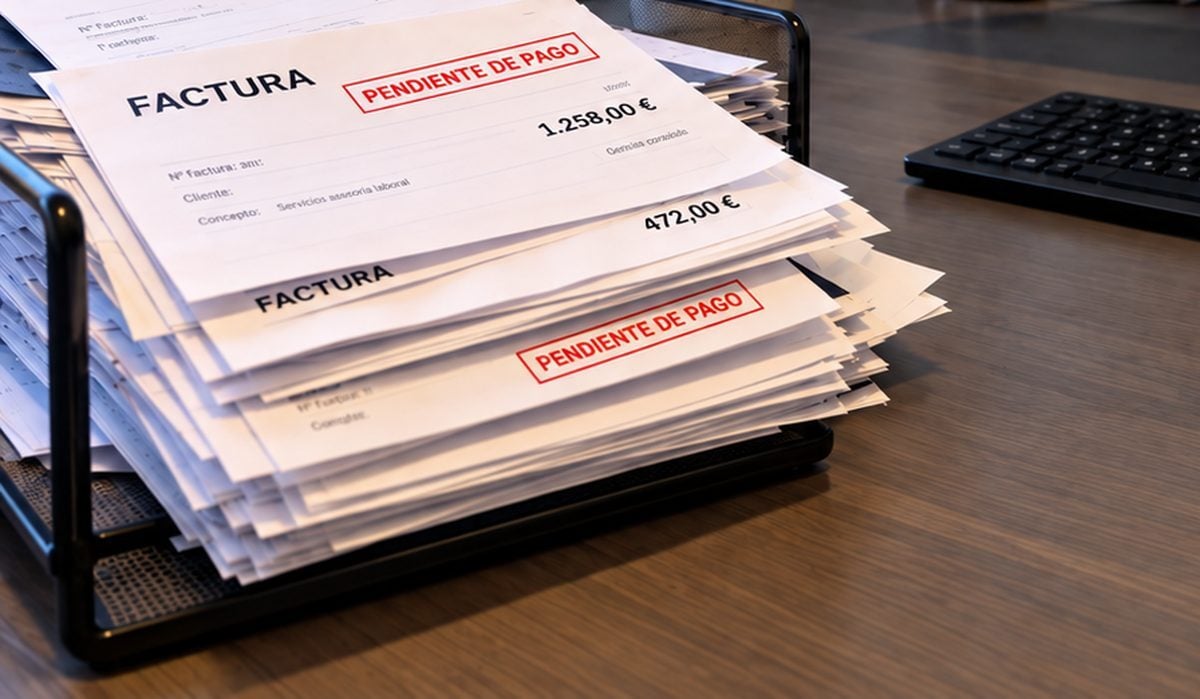
An unpaid invoice, a rent that stops coming in, a loan that is never repaid. Debts arise from all kinds of situations, but in Spain they are all pursued through the same process: confirming that the debt is enforceable, gathering evidence, demanding payment, attempting to reach an agreement, which has been mandatory since 2025, and only then going to court through the appropriate procedure. This guide walks through that process with the deadlines and figures in force in 2026, and links at each stage to the specific content for each type of debt.

First: what type of debt is it?
The process is broadly the same, but each type of debt has its own rules that are worth understanding before taking the first step.
- Invoices between businesses or with self-employed workers. These are governed by the Late Payment Act (Law 3/2004): late payment interest accrues automatically from the due date, without any formal demand, at a high rate, and the creditor is entitled to a fixed amount of compensation for recovery costs. Full details are available on our unpaid invoices claims page.
- Rental arrears. These have a five-year limitation period and can be claimed in the same proceedings as eviction. We explain this on our evictions and tenancy page and in the guide to eviction for non-payment of rent.
- Loans between private individuals. Whether or not there is a written contract, the challenge is one of proof: you must demonstrate that the money was handed over with the expectation of repayment. See our private loan claims page.
- Promissory notes, bills of exchange and cheques. These have their own procedure, the juicio cambiario (summary enforcement for negotiable instruments), which is faster than other routes and allows for preventive attachment from day one.
- Homeowners' association fees. The order for payment procedure (proceso monitorio) has special rules for these claims. See horizontal property (community of owners).
- Debts of a deceased person. These do not disappear on death: they pass to the heirs who accepted the inheritance. See inheritance with debts.
- Professional fees and utility supplies. These have a three-year limitation period, not five. This is the deadline that most often causes claims to be time-barred.
Step 1: confirm the debt is enforceable and has not become time-barred
A debt can be pursued through the courts when it is liquidated, that is, the amount is determined or can be established by a simple calculation, is due, and is enforceable. If the payment deadline has not yet passed, or if the amount depends on something that has not yet been determined, any claim would be premature.
The second thing to check is limitation periods. Here it is worth examining the Civil Code carefully, because the time limits vary depending on the type of debt:
- Five years for personal claims with no specific limitation period, under Article 1964.2, running from the date on which performance could first be demanded. This covers most invoices between businesses and loan agreements.
- Five years for rent payments and any payment due annually or at shorter intervals, under Article 1966.
- Three years for fees charged by lawyers, notaries, expert witnesses and other professionals, as well as supply contracts and sales by traders to consumers, under Article 1967, running from the date on which the services were last provided.
The general limitation period was fifteen years until October 2015. Debts arising before that date are governed by transitional rules and, unless the limitation period was interrupted, are now time-barred.
Limitation periods are not immovable. Article 1973 of the Civil Code provides that the period is interrupted by any out-of-court demand made by the creditor that can be evidenced, by any act of acknowledgement of the debt by the debtor, and by the filing of a claim. Each interruption restarts the limitation period in full. This is why a timely formal notice (sent by certified burofax) can be just as effective as commencing proceedings.
Step 2: Gathering the evidence
Article 217 of the Civil Procedure Act places the burden of proof on the creditor: it is for the creditor to establish that the obligation exists and that it has not been fulfilled. The debtor bears the burden of proving any fact that would extinguish the debt, such as payment or the expiry of the limitation period.
Any means of proof is admissible under Article 299, including digital records. In practice, evidence of a debt is built up in three layers: the source of the obligation (a contract, purchase order, accepted quotation, tenancy agreement or loan agreement); the creditor's performance of that obligation (delivery notes, receipts, invoices, proof of transfer); and the non-payment (bank statements, formal demands, and messages in which the debtor requests more time or does not deny the debt).
A private document constitutes full proof if the other party does not challenge its authenticity, pursuant to Article 326. For order for payment proceedings (monitorio), Article 812 requires that the debt be evidenced by documents signed by the debtor, or bearing the debtor's stamp, mark or any physical or electronic identifier, or alternatively by documents drawn up by the creditor that are customary in that type of commercial relationship, such as invoices and delivery notes. The more complete this file is before the first formal demand is sent, the shorter and more straightforward everything that follows will be.
Step 3: the payment demand
A formal payment demand, typically a burofax (certified recorded delivery letter) with proof of content and acknowledgement of receipt, or a notarial demand, is the act that changes the debtor's legal position. Under Article 1100 of the Spanish Civil Code, once the creditor demands performance the debtor is in default, and under Article 1108 interest begins to accrue from that point at the agreed rate or, failing agreement, at the statutory interest rate. A formal demand also interrupts the limitation period and creates an official record of the date and amount claimed.
In commercial transactions between businesses, the rules are more favourable to the creditor. Article 5 of Law 3/2004 provides that a debtor falls into default automatically upon missing the payment deadline, with no prior notice or demand required. The late-payment interest rate is the agreed rate or, in the absence of agreement, the European Central Bank reference rate plus eight percentage points, pursuant to Article 7. Article 8 further provides for a fixed recovery cost of forty euros, plus any substantiated costs exceeding that amount. Where no payment deadline was agreed, payment falls due thirty calendar days after receipt of the goods or services under Article 4, and any agreed deadline may not exceed sixty days.
A formal demand is also the moment to decide whether to report the debt to a credit reference file. The law permits this under strict conditions, including having previously issued a payment demand; we explain this in how to register data in credit reference files lawfully. And before a debt even arises, prevention costs far less than any recovery process: see how to avoid bad debts.
Step 4: the mandatory attempt at settlement, required from April 2025
From 3 April 2025, no civil claim may be admitted to court without a prior attempt at an agreed resolution. Article 5 of Organic Law 1/2025 makes recourse to an appropriate dispute resolution mechanism a procedural prerequisite for all declaratory proceedings under Book II and the special proceedings under Book IV of the Civil Procedure Act. Debt claims brought by way of order for payment (monitorio), summary proceedings, or ordinary proceedings all fall within scope. Only bill-of-exchange proceedings (juicio cambiario) are excluded.
The law is flexible as to form. The requirement is satisfied by mediation, conciliation, independent expert opinion, a confidential binding offer, or even direct negotiation between the parties or their lawyers, provided it is properly documented. Legal representation is only mandatory for the confidential binding offer, and only where the amount in dispute exceeds two thousand euros, pursuant to Article 6. Where the relationship with the debtor allows, a practical option is to initiate an online out-of-court negotiation via a platform that records the proposal, the response, and the relevant dates.
This step has effects that work in the creditor's favour. The request for negotiation interrupts the limitation period from the moment the attempt to communicate it is recorded, pursuant to Article 7, and if the debtor does not respond within thirty calendar days, the judicial route becomes available. The process is confidential under Article 9, meaning that anything offered in settlement cannot subsequently be used in litigation. Furthermore, Article 394 of the Civil Procedure Act deprives any party who, without good cause, refuses to participate in an appropriate dispute resolution mechanism to which they were invited of their right to costs, even if they win the case.
If an agreement is reached, it is advisable to formalise it in a public deed. This converts it into an enforceable title, meaning that if it is subsequently breached, enforcement proceedings, including asset seizure, can be initiated directly, without the need for a fresh court action.
Step 5: choosing the judicial route
There are four options, and the choice depends on the documentation available and the amount owed.
The payment order procedure
This is the standard route for documented debts. Article 812 opens it for liquid, due and enforceable monetary debts of any amount. The application is submitted to the court in the debtor's place of domicile, pursuant to Article 813, and neither a lawyer nor a court representative (procurador) is required. The court orders the debtor to pay or file a written objection within twenty days, pursuant to Article 815. If the debtor does nothing, a decree is issued and enforcement proceeds automatically, with no possibility of subsequently disputing the debt. If the debtor objects, the matter continues as either a summary or ordinary trial depending on the amount. The full procedure, including its deadlines and potential pitfalls, is set out in the guide to the payment order procedure.
Summary proceedings and ordinary proceedings
Where there is no document suitable for the payment order procedure, or where the debtor raises an objection, the debt is determined through declaratory proceedings: summary proceedings for amounts up to fifteen thousand euros and ordinary proceedings above that threshold, pursuant to Articles 249 and 250. Legal representation is mandatory except in summary proceedings not exceeding two thousand euros. All matters are open to dispute in these proceedings: the existence of the debt, its amount, interest, and any defences raised by the debtor.
Bills of exchange proceedings
This route is reserved for creditors holding a bill of exchange, cheque or promissory note that meets the requirements of the Bills of Exchange and Cheques Act, pursuant to Article 819. Its main advantage is speed: once the claim is admitted, the court orders the debtor to pay within ten days and immediately issues a precautionary attachment order over the debtor's assets for the amount of the instrument plus interest and costs, pursuant to Article 821. This is the only monetary claim procedure that is exempt from the requirement to attempt a prior settlement.
Direct enforcement
If the debt is recorded in a public deed, or in an agreement reached through an appropriate dispute resolution process that has been elevated to a public deed, no court proceedings are required. Article 517 recognises these as enforceable instruments, and attachment of assets can be requested directly. This is why an acknowledgement of debt signed before a notary carries more weight than any subsequent litigation.
Step 6: enforcement and attachment of assets
A ruling, a payment order decree, or a public deed entitles the creditor to apply for enforcement. The court will attach assets in the order and within the limits set by law: salary may only be attached above the minimum wage threshold and in accordance with the scale set out in Article 607; bank accounts, vehicles, real estate, and receivables from third parties may also be seized. If the creditor is unaware of the debtor's assets, Article 590 allows the court to conduct enquiries through banks, public bodies, and registries.
From the date of the ruling, the debt accrues interest at the legal rate plus two percentage points, pursuant to Article 576. The right to enforce a ruling lapses five years after it becomes final, under Article 518, and once enforcement proceedings have been opened, they continue until the creditor is fully satisfied, under Article 570. In other words, if the debtor has no assets today, the enforcement proceedings remain open until assets become available.
When the debtor is insolvent
In some cases, a ruling is not enough because there is nothing to attach. If the debtor is a company in insolvency proceedings, individual claims are stayed and the debt must be filed within the insolvency procedure; the order of repayment is governed by insolvency law, not the civil court. We explain this scenario in our insolvency law section. If the debtor is an individual with no assets, they may apply for protection under the second chance law and obtain discharge of their debts, subject to certain exceptions.
For a creditor that is a company, there is a partial remedy that is often overlooked: recovering the VAT on an unpaid invoice by adjusting the taxable base, subject to the requirements and deadlines we set out in how to reclaim VAT on an unpaid invoice. This does not recover the debt itself, but it stops the creditor from advancing to the Spanish Tax Authority a tax that has never actually been received.
The cost of pursuing a debt, and who pays
The general rule under Article 394 of the Spanish Civil Procedure Act is that costs are borne by the losing party, unless the case raised serious factual or legal doubts, and subject to the exception already noted for parties who refused a prior settlement. For initial payment order applications and oral proceedings involving claims of up to two thousand euros, legal representation is not mandatory, which reduces the cost of smaller claims, though a poorly calculated or inadequately documented application will be rejected, as Article 815 requires the court to review the amount claimed.
We do not publish a fixed fee schedule. What we do, before you instruct us on anything, is tell you whether the debt is recoverable, which route applies to your situation, what you can claim in addition to the principal amount, and provide a written quote for your specific case.
Seven mistakes that make debt recovery more expensive
- Waiting. Every month without a formal demand is a month of interest that will not be claimed, and the limitation period keeps running.
- Sending informal demands. A message or a phone call proves nothing. Use a burofax (certified letter with content verification) or a notarial demand.
- Filing a claim without evidencing an attempt to reach agreement. The claim will not be admitted, and months are lost.
- Requesting an incorrectly calculated amount in order-for-payment proceedings. The court will review the figure and the procedure will stall.
- Forgetting interest and the forty-euro flat fee. In business-to-business debts these accrue automatically, but they still need to be claimed.
- Failing to request an asset search. Without located assets, enforcement remains on paper only.
- Letting enforcement lapse. You have five years from when the ruling becomes final. After that, the debt still exists but can no longer be enforced.
How we handle a debt recovery matter
Before taking any action, we review the debt, the limitation period and the available evidence, and we tell you candidly whether it is worth pursuing and by which route. We then proceed with the formal demand, a documented attempt to reach agreement and, if necessary, the application or claim and enforcement through to collection. You will find detailed information by debt type on our pages covering unpaid debt recovery, evictions and tenancy disputes and private loans between individuals, and an overview of our practice in the civil law area.