
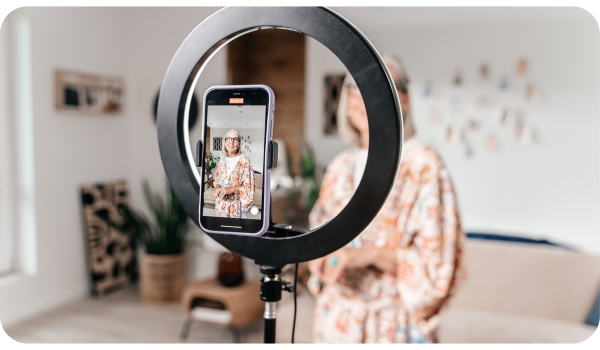
On Tuesday 30 April, Royal Decree 444/2024 was approved, establishing regulations for influencers classified as "users of special relevance" (USR).

The digital world and social media have given rise to a new generation of professionals: influencers. These public figures have transformed marketing and communications strategies, which is why the Spanish government has decided to introduce specific regulations to formalise and govern their activities. Below, we analyse the recently approved legislation of 30 April, incorporated into the Royal Decree, which directly affects influencers classified as "users of special relevance".
What is the Influencer Law?
When people refer to the "influencer law", they are in fact referring to the Royal Decree 444/2024, of 30 April, governing the requirements for classification as a user of special relevance of video-sharing platform services, in implementation of Article 94 of Law 13/2022, of 7 July, on Audiovisual Communication.
This Royal Decree must be read alongside the Law 13/2022, of 7 July, on Audiovisual Communication, as its purpose is to set out in detail the requirements provided therein concerning the definition of "users (natural or legal persons) of video-sharing platform services" (commonly known as "influencers").
Let us explain. Royal Decree 444/2024 has updated Article 94 of Law 13/2022, which defines high-reach influencers as providers of audiovisual media services when they use video-sharing platforms. This designation confers a series of specific rights and obligations upon them, formally integrating them into Spain's media regulatory framework.
Who qualifies as an "influencer" under the Influencer Law?
Not all influencers will be subject to this regulation. What this Royal Decree has done is quantify and clarify two of the requirements for being classified as an "influencer": income and audience reach.
Therefore, to be classified as a "user of special relevance" ("influencer"), the current requirements are as follows:
- The service provided constitutes an economic activity through which its holder earns significant income derived from their activity on video-sharing platform services;
- Income is considered significant where gross earnings accrued in the previous calendar year are equal to or greater than €300,000, derived exclusively from the user's activity across all video-sharing platform services they use.
- This includes income received both in cash and in kind.
- The user of special relevance is editorially responsible for the audiovisual content made available to the public through their service.
- The service provided is aimed at a significant portion of the general public and may have a clear impact on it:
- The influencer must reach, at some point during the previous year, 1,000,000 followers or more on a single service, or 2,000,000 or more in aggregate across all video-sharing services, and
- Across all video-sharing services combined, at least 24 videos must have been published or shared in the previous calendar year.
the right of rectification:
An influencer with a large number of followers (more than 100,000 followers on a single platform or 200,000 across several) will be subject to the obligations of the new Right of Rectification Act (see content here)
Who would not qualify as an "influencer" under the Influencer Act?
Regardless of whether they meet the above requirements, the following entities will not be considered "users of special relevance":
- Educational or scientific institutions where the activity falls within their remit or is of an informational nature.
- Museums, theatres or any other cultural entity presenting their programmes or activities.
- Public authorities or political parties for the purpose of providing information and presenting the functions they perform.
- Companies and self-employed individuals with the aim of promoting the goods and services they produce or distribute.
- Associations and non-governmental organisations for the purposes of self-promotion and presenting the activities they carry out in accordance with their objects.
Obligations of content creators under the Influencer Act
Meeting these requirements will entitle you to be classified as an influencer, but those who wield such influence are responsible for the way in which they exercise it. As such, influencers are subject to certain obligations, set out primarily in Act 13/2022 of 7 July on Audiovisual Communication and Royal Decree 444/2024 of 30 April.
Mandatory Registration for Content Creators
Influencers who meet the above requirements and reside in Spain, or live abroad but hold Spanish nationality, must register in the "State Register of Audiovisual Communication Service Providers". This process must be completed within two months of the law entering into force, or from the date on which the influencer meets the established criteria.
Content Regulation: How to Become a Content Creator?
Compliance with the Principles of Law 13/2022
There are certain principles that influencers must observe when creating their content. In summary, these are as follows:
- Content must respect human dignity and constitutional values.
- Portray an equal and non-discriminatory image of women and men, and must not, directly or indirectly, promote situations of discrimination based on sex, inequality of women, or incitement to sexual or gender-based violence.
- Promote an accurate, respectful, appreciative, inclusive and stereotype-free portrayal of persons with disabilities.
- Adopt measures to support the development of media literacy skills.
- Self-regulation.
Responsible Content Creation
Age-Appropriate Content for Minors
The influencer must provide users with sufficient and unambiguous information regarding the potentially harmful nature of audiovisual content for the physical, mental or moral development of minors, through the use of a content description system, acoustic warning, visual symbol, or any other technical means that describes the nature of the content.
The influencer will also have the following obligations regarding the protection of minors from harmful content:- Place audiovisual programmes and content that may include scenes of pornography or gratuitous violence in separate catalogues.
- Being part of the co-regulation code provided for in Article 98.2 of Law 13/2022.
- Providing parental control mechanisms or digital coding systems.
The right to create commercial content, subject to certain conditions
Influencers have the right to broadcast audiovisual commercial communications, but these must be clearly distinguished from regular content through optical, acoustic and/or spatial means.
"Audiovisual commercial communications" encompasses: audiovisual advertisements, self-promotion, sponsorship, product placement, teleshopping, home shopping services, audiovisual commercial communication services and catalogues, promotional slots supporting European culture, and public service or charitable announcements.
In line with the principles of the law, any audiovisual commercial communication that violates human dignity, promotes discrimination against a group of people or a member of a group, encourages behaviour harmful to safety, or promotes conduct seriously harmful to the environment, or uses the image of women in a degrading or discriminatory manner, is prohibited.
Audiovisual commercial communications that encourage behaviour harmful to health are also prohibited, such as advertising for tobacco products, electronic cigarettes, and medicines, products or practices that claim health benefits but do not comply with the relevant health promotion legislation.
Alcohol advertising is permitted during certain hours of the day, but must promote moderate consumption, must not be directed at children, and must not present a misleading or unrealistically positive image of the effects of alcohol.
Other areas subject to specific advertising regulations include:
- Gambling
- Institutional advertising.
- Environmental protection.
- Personal safety.
- Banking and financial services.
- Food products.
- Political participation and electoral campaigning.
Audiovisual commercial communications must not cause physical, mental or moral harm to minors, nor engage in the following conduct:
- encouraging young people to make purchases or pressuring their parents to buy on their behalf
- exploiting the trust children place in people they are close to
- depicting children in dangerous situations without justified cause
- inciting violence or discrimination, reinforcing harmful stereotypes, or promoting a negative body image
Failure to comply with the rules set out in this legislation may result in fines ranging from €10,000 to €1.5 million, depending on the severity of the infringement and the influencer's annual turnover.
LEGAL COMPLIANCE CHECK AND DATA PROTECTION SERVICES
We carry out a full legal compliance check, reviewing your website and all your data protection obligations:

Tax Obligations for Content Creators
It is important to note that influencers are now subject to increasingly rigorous tax scrutiny. They are required to declare all income and may be subject to audits to ensure compliance with their tax obligations.
In recent years, for example, many influencers have relocated to Andorra in order to significantly reduce their tax burden, paying far less tax than they would in Spain. Under the new regulations, however, the country of residence no longer determines where digital professionals must pay tax; they will be required to meet their tax obligations in their home country regardless of where they live.
We have prepared a tax calendar so you never miss a tax filing deadline throughout the year:
TAX CALENDAR: FOR COMPANIES AND THE SELF-EMPLOYED
Article 3 of the General Audiovisual Communication Act (LGCA) sets out the circumstances under which a person will be considered 'established in Spain' and therefore required to comply with the new law. Among the most notable cases are the following:
- The activity was first launched in Spain and maintains a link with the Spanish economy, even if the individual does not work in Spain or in any other EU Member State.
- The individual uses an uplink to a satellite located in Spain.
- The influencer uses satellite capacity belonging to Spain.
This means that the influencer's place of residence will no longer be the determining factor for whether this law applies to them. Instead, anyone who has some connection to Spain and its economy will be considered established in Spain. This appears to suggest that even those who record and publish content for Spanish consumers will be affected.
It is safe to assume that if an influencer earns significant income, they will be required to register with the Spanish Tax Authority under the new audiovisual law. This entails registering under the Economic Activities Tax (IAE). The appropriate activity heading (epígrafe) should be selected, whichever best corresponds to the activity in question, and specified when completing Form 036 or 037. Form 037 is the more commonly used option for the self-employed. Registration with Social Security is also required.The relevant activity headings (epígrafes) for influencers (business activities):
- * 751: "Advertising professionals, public relations and related activities"
- * 844: "Advertising and public relations services"
- * 899: "Other miscellaneous services"
- * 961.1: "Motion picture production"
- * 973.1 "Photographic services"
Importantly, it is possible to be registered under more than one epigraph at the same time.
Influencers must issue invoices when the client is a company or a professional. If the influencer is providing a service, they are required to issue an invoice.
Self-employed individuals may deduct expenses if the company's activity is related to those expenses, such as self-employment fees, phone, internet connection, etc., though this depends on each influencer's specific circumstances.
The most relevant tax forms to submit are the following:
- Form 303: A tax settled on a quarterly basis. It covers input and output VAT (sales and purchases).
- Form 349: Intra-EU companies must register with the ROI (the Register of Intra-Community Operators). For example: Facebook. If VAT is not applied, Form 303 must still be submitted marked as "VAT NOT SUBJECT TO TAX".
Form 349 is submitted either monthly or quarterly, depending on turnover volume. - Form 130: These are advance instalment payments of Personal Income Tax (IRPF) made to the Spanish Tax Authority in respect of your activity, in effect, prepayments of Personal Income Tax (IRPF), also submitted quarterly. The amount equals 20% of your net income (revenue minus expenses). If more than 70% of your invoices are issued to Spanish companies or self-employed clients, you are not required to submit this form, as the withholding will already have been paid via those invoices.
- Form 100: The Spanish Tax Authority applies a 15% withholding on the taxable base for professionals; however, if you have just registered, the rate is 7% for the first year and the two following years. This applies to both companies and domestic professionals.
- Form 111: This must be submitted if you have employees and apply withholding to their payslips, or if you hold supplier invoices that include withholding.
- Form 115: This must be submitted if you pay rent for business premises. The landlord must apply a 19% withholding on the rental invoice. This percentage must be paid to the Spanish Tax Authority each quarter.
- Form 347: If you invoice a client, or a supplier invoices you, for more than €3,005.06 in a calendar year, this form must be submitted once a year, in February.
TAX ADVISER FOR INFLUENCERS
Consult with our tax advisers in Barcelona.
Conclusions
Spain's new influencer law is a significant step towards regulating a profession that has grown exponentially in recent years. By formalising these activities, the aim is to protect both consumers and influencers themselves, ensuring a safer and more transparent digital environment. With clear rights and defined responsibilities, influencers will be able to operate within a legal framework that respects both their influence and their impact on society.
Other related services:
Defamation lawyers:
Find out what options you have if you are affected by online or offline defamation that damages your reputation: