.jpg)
Nullity on grounds of fixed-term contracts entered into in breach of the law
The ruling 951/2021, of 29 September, of the Supreme Court, declares the nullity of a collective dismissal on the basis of fraud in connection with fixed-term contracts that the company had terminated upon expiry of the agreed term or completion of the work or service.

Article 51.1 of the Workers' Statute restricts the drip-feeding of dismissals within 90-day periods where the purpose is to avoid triggering a collective dismissal. In such cases, it is necessary to take into account terminations carried out for reasons not inherent to the individual employee, such as the expiry of fixed-term contracts, provided their number was at least five.
Employees may therefore, individually or collectively, as they did in this case, challenge their dismissal by alleging the nullity of the termination on the grounds that it was not conducted within the framework of a collective dismissal.
Nullity of a collective dismissal followed by the transfer of the company to a third party
Sodeoil, the company operating a petrol station, opened a consultation period on 13/06/2012 announcing the collective dismissal of all staff employed at that station, with the decision formally adopted on 4/7/2012. A business succession then followed.
On 1/8/2012, the same company entered into a sublease of the business with Campsared, which continued operating the petrol station, the shop, and related activities. All material assets were transferred to enable the continuation of the business, but without the workforce.
In its ruling 1179/2014, of 18 February 2014, the Supreme Court found that there had indeed been a 16.33% decline in turnover, but that given the manner and timing of the transfer, this constituted a case of business succession within the meaning of Article 44 of the Workers' Statute.
It is worth recalling that Article 44 provides that a change of ownership of a company, workplace, or productive unit does not in itself extinguish the employment relationship, and that it obliges the incoming employer to assume all employment and Social Security rights and obligations, making them jointly and severally liable with the transferor for any obligations arising prior to the transfer that remain unsatisfied.
The Supreme Court held that the succession between Sodeoil and Campsared involved an economic entity that retained its identity, understood as an organised set of resources whose purpose is to carry out an economic activity, and that, given the manner and timing of the transfer, the workers had been dismissed through a Collective Dismissal Procedure (ERE) designed to effect that transfer free of employment liabilities, to the benefit of the successor entity (Campsared).
There was no doubt as to the transfer, given that Campsared immediately assumed all the patrimonial and material assets of the petrol station operation, albeit without the workers, who had been dismissed beforehand, without justification and in clear breach of the law.
It was therefore on account of the manner and timing of the process, less than one month elapsed between the decision to terminate employment contracts and the sublease of the business to a third party, that the Supreme Court declared the collective dismissal null and void and held that Campsared was obliged to reinstate the workers in their former positions.
In fact, the company should have informed workers' legal representatives, with adequate prior notice, of the change of ownership, in accordance with Article 44.6 of the Workers' Statute, setting out the planned date of the transfer; the reasons for it; the legal, economic and social consequences for employees; and any measures envisaged in relation to the workforce.
Initiating the consultation period in a collective dismissal procedure without providing that information constitutes sufficient grounds to declare the dismissal decision null and void, in accordance with Article 124.11 of the Labour Jurisdiction Act.
One might ask what would have happened had more time elapsed between the collective redundancy procedure and the transfer of the business. In all likelihood, the 20-day period within which workers may challenge the nullity of the measure would have expired, but in any event, the new transferee would remain jointly and severally liable for all debts of the transferor for a period of three years, including any liabilities arising from compensation payments.
Null collective dismissal for failure to comply with procedural requirements:
The Royal Decree 608/2023 is a regulation designed to develop the RED Mechanisms for Flexibility and Employment Stabilisation. It was enacted on 12 July 2023, with the aim of preserving employment during cyclical or sector-specific crises.
Among the most significant provisions of this legislation is the regulation of the procedure applicable to the RED Mechanisms, ensuring the participation of social partners and establishing a fund to finance the social protection of workers covered by the mechanism, as well as exemptions for companies.
A lesser-known but highly significant provision of this legislation is the amendment to the Regulation governing collective dismissal (Collective Dismissal Procedure (ERE)) and contract suspension and working-hours reduction procedures (Temporary Layoff Procedure (ERTE)), originally established by Royal Decree 1483/2012 of 29 October.
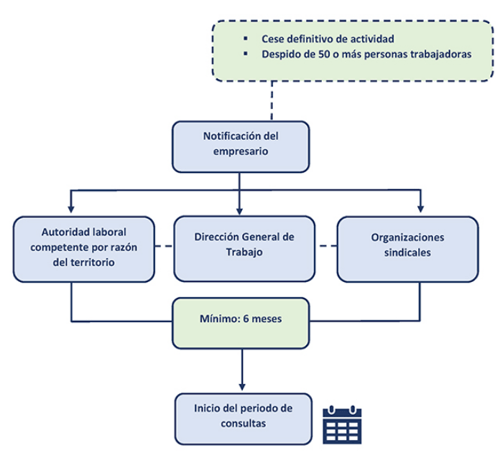
This amendment means that companies wishing to close one or more workplaces and dismiss fifty or more employees must notify the competent labour authority and the Ministry of Labour and Social Economy, through the Directorate-General for Labour. Such notifications must be submitted electronically and at least six months in advance of initiating the collective dismissal procedure. If it is not possible to meet this advance notice requirement, the company must provide reasons for the failure to comply.
In addition, the company must send a copy of the notification to the most representative trade union organisations and to those representative of the sector to which the company belongs, both at national level and in the autonomous community where the workplaces subject to closure are located.
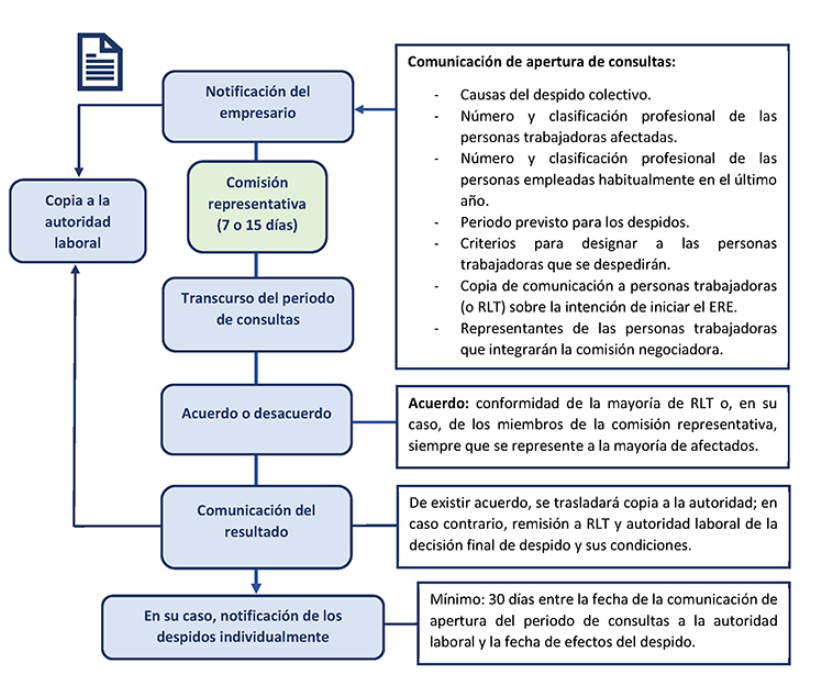
This reform is significant because it changes the way in which employees are informed of potential job losses. Previously, the process began with a dual notification, to employees and trade unions, regarding the intention to carry out dismissals. Now, prior to the consultation period, an electronic communication must be submitted six months in advance where the conditions for workplace closure and permanent cessation of activity are met.