
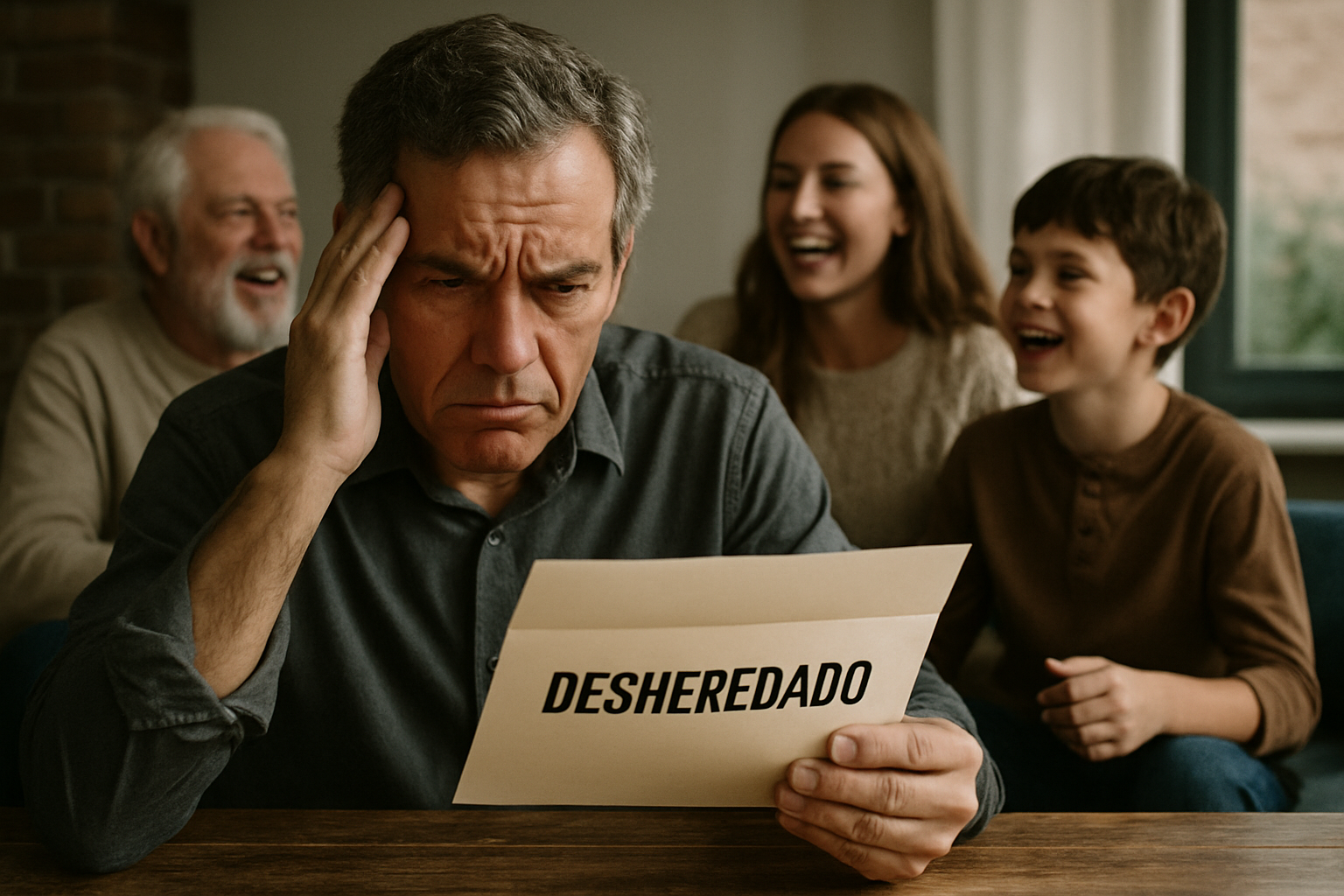
Imagine receiving the news that you have been disinherited by your parents. It is an emotional blow that raises many questions: Is this even legal? Can a parent really leave a child with nothing?
Here we explain what it means to be disinherited, the legal grounds on which it can happen, and what options are available to you if you find yourself in this situation.

Can a child be disinherited?
Spanish law protects children through what is known as the legítima, a reserved portion of the estate of which they cannot normally be deprived. As a general rule, children are forced heirs of their parents and are entitled to a significant share of the family estate. That said, it is possible to disinherit a child, but only in exceptional circumstances defined by law. In other words, a parent cannot simply cut a child out of an inheritance on a whim or following a minor dispute. There must be a serious, legally recognised ground for a disinheritance to be valid.
In other words, disinheriting a child means depriving them of their forced share, that is, removing the minimum entitlement that the law reserves for them in the estate. If a testator attempts to exclude a child without a legally recognised ground, that disinheritance will be considered unjust or invalid, and the child will be entitled to claim their share of the estate. Let us therefore examine which legal grounds justify leaving a descendant without their portion of the inheritance.
Legal grounds for disinheriting a child (causes of disinheritance)
The law sets out an exhaustive list of grounds on which a forced heir, such as a child, may be disinherited. These grounds involve serious situations that irreparably break the family relationship. The main legal grounds for disinheriting a child include, among others:
- Refusing to provide maintenance or care to a parent: if a child, without legitimate justification, refused to provide the financial support or care they were legally obliged to give their parents when needed, they may be disinherited. This refers to the failure to fulfil the duty to assist parents in times of need (for example, complete abandonment during a parent's serious illness).
- Serious mistreatment of the parent: this includes physical or psychological abuse, or serious verbal insults directed at the father or mother. For example, physically assaulting or threatening a parent, or repeatedly and gravely insulting and humiliating them, are clear grounds for disinheritance.
- The suspension or deprivation of parental authority, whether of the parent who is a forced heir over the child responsible, or of the child who is a forced heir over a grandchild of the deceased, in both cases where such suspension or deprivation is attributable to the person who has been stripped of that authority.
- Having incurred a ground of unworthiness to inherit: these are extreme situations, generally involving criminal conduct against the testator or their family. For example, having attempted to kill a parent, having caused them serious physical harm, having falsely accused them of a serious offence, or having maliciously prevented them from making a will, are all grounds of unworthiness that permit disinheritance. These grounds apply to any forced heir (including children) and are designed to penalise conduct that is particularly disloyal or criminal within the family sphere.
It is important to note that these grounds must be recognised by law and must have occurred before the will was executed. Vague reasons or unfounded personal grievances are not sufficient. The seriousness of the ground is key: the law aims to prevent injustice and to ensure that a fleeting argument does not leave a child disinherited without justification.
Is a breakdown in family relations or abandonment a valid ground?
A very common question is whether a lack of relationship between parent and child (for example, years without contact or communication) can justify disinheritance.
In Catalonia, unlike the rest of Spain, the law expressly includes a sustained absence of family relations as a ground for disinheritance, provided it is solely attributable to the child. This means that under Catalan law it is clearly established that a child who has completely neglected their parents and severed ties with them without justification may be disinherited. Even so, even under Catalan law, the breakdown in relations must be manifest, sustained, and without justification on the child's part.
How is disinheritance carried out? (Formal requirements)
Where a legal ground exists and a parent decides to disinherit their child, certain formal steps must be followed for the disinheritance to be valid:
- In a will and with an express statement of grounds: The disinheritance must be set out in a valid will. That document must identify the disinherited child and clearly state the legal ground relied upon. Generic or indirect wording is not sufficient; the specific reason should be set out in detail.
- No partial disinheritance: It is not possible to disinherit someone "partially" or conditionally. Disinheritance always means depriving the child of all of their forced share. It is either complete disinheritance or none at all.
Read our article on inheritance without a will (intestate succession)
What happens if I have been disinherited? Consequences for the excluded child
When a child is disinherited, they lose their right to the forced share and are excluded from that parent's estate. In principle, they would receive nothing from the estate, and they also lose any right to financial support from that parent's inheritance.
However, does this mean all is lost for the disinherited child? It depends on the circumstances:
- If the disinheritance was valid and justified, the child is definitively excluded. For example, if serious mistreatment was genuinely proven, or one of the other legal grounds applied, the will is executed accordingly and the child will not receive their forced share.
- If the disinheritance was unjust or lacked a genuine basis, the child may contest the will. They would need to bring court proceedings to claim their forced share, arguing that the stated grounds for disinheritance are not well-founded. Contesting means asking a judge to declare the disinheritance void for failing to meet the legal requirements.
In the event of a legal dispute, the law sets out an important rule: when a child contests their disinheritance, it is the heirs seeking to uphold it who must prove that the alleged grounds are true. In other words, the burden of proof falls on those claiming that the child committed abuse, abandonment, refused to provide support, and so on. If they fail to demonstrate this sufficiently, the disinheritance will not stand.
What does the child gain if the challenge succeeds? Essentially, they recover their forced share (legítima). The invalidated disinheritance is treated as if it never existed, and the child regains their right to the portion of the estate that the law guarantees them. That said, the rest of the will, for example, bequests to other individuals or the distribution of remaining assets, remains in force insofar as it does not affect the child's forced share. In other words, only the minimum legal entitlement (the legítima) is restored.
On the other hand, if the testator and the child were reconciled after the events that gave rise to the disinheritance, the law provides that the disinheritance ceases to have effect. Reconciliation, whether express or implied, forgives the offence and extinguishes the right to disinherit on that ground.
Finally, as noted above, the descendants of the disinherited child take their place in the estate. This means that if a parent disinherits their child, but that child has children of their own (the testator's grandchildren), those grandchildren would be entitled to inherit the forced share that would have passed to their disinherited parent. The only exception would be if the testator also had grounds to disinherit those grandchildren, which would be an entirely separate matter. This prevents the wrongdoing of one person from unjustly penalising the next generation.
Conclusion: Being excluded from an inheritance through disinheritance is a painful experience, but the law sets clear limits to prevent abuse. If you are a parent considering disinheriting a child, make sure you have a legitimate legal ground and that everything is properly documented in your will. If you are a child who has been unjustly disinherited, you should know that the law is on your side when it comes to claiming what is rightfully yours. At Iusfamilia, our inheritance and family law specialists can advise you in either situation, providing the legal and personal support you need to navigate a disinheritance dispute.