

For a Spanish company, hiring international remote talent is no longer simply a matter of "global recruiting", it is a question of operational legal structure. The right decision is not just choosing between employee, freelancer or EOR; it means determining where the work is habitually performed, which minimum employment law protects the worker, which Social Security regime applies, whether registration or contribution obligations arise, whether there is a risk of permanent establishment, whether withholding obligations exist, and whether the individual's immigration status permits them to work from or in Spain. Within the EU, Social Security, the law applicable to the contract and tax treatment do not always point to the same country.

The most costly mistake is rarely "overpaying", it is deploying a legally incoherent model. Typical risks include the reclassification of a contractor as an employee, illegal staff secondment where an EOR or third party is used without the appropriate legal fit, failure to register or make contributions, incorrect application of collective bargaining agreements or remote working rules, inadvertent creation of a permanent establishment, and mishandling of international HR data transfers.
The practical rule for COOs and Heads of People is straightforward: before issuing an offer, you must map the country of work, immigration status, contractual model, Social Security, tax treatment and data handling. If that map is not finalised, the hire is not ready to be signed. In EU contexts, the analysis must run through Regulations 883/2004 and 987/2009; in Spain, through the Workers' Statute, the Remote Working Act, the General Social Security Act (LGSS), the Personal Income Tax (IRPF)/non-resident income tax/Corporate Income Tax rules and, where applicable, immigration and data protection law.
If your company is looking to hire someone who will work from another country, or someone who will work from Spain for a foreign entity, the critical point is not a "well-drafted" contract, it is the prior audit of the model. That is where Conesa Legal adds real value: international employment audits, contracts, EOR advisory, international tax and immigration law.
Hiring remote talent outside Spain or from Spain: two distinct scenarios
Before choosing between an employee, contractor, employer of record (EOR) or subsidiary, it is worth distinguishing two situations that are often confused.
1. A Spanish company hiring someone who works outside Spain
This scenario arises when a Spanish company wants to bring on talent who will regularly perform their work from another country, for example, a developer based in Portugal, a marketing manager in Mexico, or a sales profile in the United Kingdom.
In this case, the company must review the applicable employment law, the Social Security rules in the country of work, any relevant bilateral agreement, tax risk, data protection obligations, and, where the role involves commercial or management functions, the potential creation of a permanent establishment in the foreign country.
2. A foreign or Spanish company hiring someone who works from Spain
This second scenario arises when the individual will regularly work from Spain, even if the company is based outside Spain or the contract has been signed with a foreign entity.
The analysis shifts significantly here: Spanish employment law may apply, along with obligations to register and make contributions to Spanish Social Security, tax residency considerations, Personal Income Tax (IRPF) or Non-Resident Income Tax (IRNR), the risk of a permanent establishment for the foreign company, and immigration obligations if the individual is not an EU/EEA national.
The key question, therefore, is not simply where the company is located, but where the person actually works.
What should a Spanish company review before hiring remote talent abroad?
Applicable employment law: which country protects the remote employee?
Under Spanish employment law, the starting point remains Article 1 of the Workers' Statute: an employment relationship exists when a person provides paid services on behalf of another and within that other party's organisational and management structure. This criterion is decisive in distinguishing an employment contract from a commercial arrangement or self-employment. Labelling someone a "freelancer" is not sufficient if, in practice, the hallmarks of dependency and working for another's account are present.
Where the relationship has an international dimension, the law governing the contract is not simply a matter of what the parties agree. The Rome I Regulation permits a choice of law, but that choice cannot deprive the employee of the mandatory protections that would apply under the law that would govern the contract in the absence of such a choice. Where no choice has been made, the employment contract is governed, as a general rule, by the law of the country in which or from which the employee habitually carries out their work; the fact that they work temporarily in another country does not, in itself, alter that connecting factor. For a company, this means that a contract drafted under Spanish law does not automatically override the application of mandatory employment rules in the country from which the person habitually works.
Where the employment relationship is subject to Spanish law and is performed remotely, Law 10/2021 applies. This legislation requires a remote working agreement to be concluded in writing before work begins, and sets out mandatory minimum content, covering equipment, expenses, working hours, organisational unit, the designated remote working location, data protection and information security. It also establishes that any costs arising from remote working must be met or reimbursed by the company. Furthermore, an employee's refusal to switch to remote working, or a company's exercise of its right to revert to on-site working, does not in itself constitute valid grounds for terminating the employment relationship.
For transnational postings within the EU, the posted workers framework applies alongside Rome I. Host country authorities publish the minimum working conditions that must be observed, and the European system requires employers to verify which conditions of the host country apply during the posting. For Spain, the Ministry of Labour sets out the cases covered by transnational posting rules and the obligation to guarantee Spanish working conditions in those situations regulated by the legislation on postings to Spain.
International Social Security: A1 certificates, postings and working in multiple countries
Within the EU, the fundamental rule is that a person is subject to the legislation of a single Member State for Social Security purposes. This rule prevents double contributions, but requires correct identification of the competent state. Regulation 883/2004 also establishes specific rules for temporary postings and for individuals working in two or more Member States.
Where a company temporarily sends a worker from one Member State to another for an anticipated period of no more than 24 months, and without replacing another individual, the legislation of the home state may be retained. In practice, this is evidenced by the A1 document. The European Commission and Your Europe confirm that the A1 certificate proves that the employee remains covered by the home country system and is not required to make contributions in the host country during a qualifying posting. In Spain, the General Social Security Treasury (TGSS) administers these arrangements, and form TA.300 is part of the operational process for international postings.
Where an individual habitually works in two or more Member States, a different analysis applies. For employed workers, Regulation 883/2004 refers to the legislation of the state of residence if a substantial part of the activity is carried out there; if not, to the legislation of the state where the principal employer's registered office or place of business is located. Spanish Social Security follows this logic and applies it to multinational working arrangements. For habitual cross-border telework within countries that have signed the 2023 European Framework Agreement, there is also a flexibility mechanism based on Article 16 of Regulation 883/2004, which allows coverage to be maintained in the employer's state in certain cases where telework from the state of residence accounts for less than 50% of working time.
Outside the EU, the analysis depends on whether a bilateral agreement or other applicable international instrument exists. Spanish Social Security maintains an official list of bilateral agreements and country-specific forms; countries included are, among others, the United States, Mexico, Peru, Colombia, Chile, Uruguay and the Dominican Republic. Where a bilateral agreement applies, form TA.300 is typically required alongside the relevant country's bilateral form. Where no applicable instrument exists, or the individual does not fall within its personal scope, the concept of deemed active registration may come into play, regulated by Order ISM/835/2023, for workers posted abroad by companies carrying out their activities in Spain.
Spanish taxation, double taxation and the risk of permanent establishment
For personal income tax purposes, the Spanish tax residence rules continue to rest primarily on spending more than 183 days in Spain during the calendar year, or on having the main centre or base of activities or economic interests located in Spain. This is critical in remote hiring arrangements: a person who is "only in Spain for a few months" may end up being treated as a Spanish tax resident, and a person employed under a foreign contract may continue to generate Spanish tax obligations if they are actually working from Spanish territory. The Spanish Tax Agency (AEAT) also allows individuals to apply for tax residence certificates to evidence their status to other countries.
For non-residents, the Non-Resident Income Tax Act (IRNR) treats employment income as arising in Spanish territory where it derives, directly or indirectly, from personal activity carried out in Spain. This is highly significant in two scenarios: the foreign company that engages a person working from Spain, and the Spanish company that pays for work actually performed in Spain by non-residents. Furthermore, the same Act defines a permanent establishment in Spain as arising where an entity has, on a continuous or habitual basis, installations or places of work in Spain from which it carries out all or part of its activity, or acts through an agent authorised to enter into contracts on its behalf on a regular basis.
In corporate taxation, Law 27/2014 defines a permanent establishment abroad for Spanish entities in very similar terms: fixed installations or places of business, or an authorised agent with authority to conclude contracts acting on a habitual basis. In practice, this provides a useful guide to the reverse risk: if a foreign company organises part of its activity in Spain through an individual with a stable presence and material functions, an urgent analysis is required as to whether a permanent establishment exists in Spain under domestic law and the applicable tax treaty.
Spain's network of double taxation treaties is extensive, but it does not eliminate the need for careful analysis: the Ministry of the Spanish Tax Authority indicates that Spain has 103 signed treaties and 99 currently in force. Accordingly, when hiring individuals connected with the United Kingdom, the United States, Mexico, India, or most Latin American countries, the right question is not "is there a treaty?" but rather which article of the treaty applies to employment, to tax residence, and to any potential permanent establishment, and how it interacts with domestic withholding obligations.
Where the individual relocates to Spain, there is also the possibility of examining the special regime under Article 93 of the Personal Income Tax Act (LIRPF) for individuals taking up residence in Spanish territory. In certain cases, this allows taxation under non-resident income tax rules during the year of the change of residence and the following five years. It is not an automatic or universal solution, but it is a factor that COOs and People Ops teams should map from the offer stage when hiring senior international talent.
Immigration, EOR arrangements, contractors and data protection: risks that must be considered together
On immigration, the primary distinction is between EU/EEA nationals and third-country nationals. EU citizens may work in another EU member state without a work permit. For third-country nationals in Spain, access to work depends on the type of authorisation that applies. For standard employment contracts, the Ministry of Inclusion sets out the initial temporary residence and work authorisation for employed persons; for internationally mobile profiles or digital nomads, Law 14/2013 and the ONE Platform provide specific pathways.
Under the international telework framework set out in Law 14/2013, Article 74 bis allows nationals of non-EU countries to reside in Spain and work remotely for companies based outside Spain. Where the arrangement is one of employment, the visa holder may only work for companies located outside Spanish territory; where it is a professional services arrangement, working for a company in Spain is permitted, provided that work does not exceed 20% of the individual's total activity. This distinction is particularly important for founders and HR leads who mistakenly assume that the "digital nomad visa" can be used interchangeably for any type of structure.
Regarding the EOR model, it is important to be legally precise: EOR is not a standalone legal category under Spanish law. In practice, it is typically structured through a local entity that acts as the formal employer and provides services to the client. The risk arises when that structure becomes nothing more than the supply of labour. Article 43 of the Workers' Statute restricts the temporary secondment of workers to authorised temporary employment agencies, and classifies a secondment as unlawful, among other scenarios, where the service contract is limited to placing workers at the client's disposal, or where the supplying entity has no genuine organisational structure and does not exercise real employer functions. The consequences may include joint and several liability with Social Security, as well as the employee's right to become a permanent employee of either the supplying or the receiving entity.
At the same time, the contractor model is not an automatic safe harbour. The Self-Employed Workers' Statute recognises the TRADE status (economically dependent self-employed worker) for self-employed individuals who derive at least 75% of their income from a single client, but imposes strict requirements, including that they do not carry out their activity in a manner indistinguishable from the client's own employees, and that they have their own relevant infrastructure where applicable. In other words, TRADE status is a strictly defined category, not a vehicle for disguised outsourcing of employment.
In the area of data protection, international hiring arrangements typically engage two layers of compliance. The first is employment-related: the employing company acts as data controller in respect of its workers' data, while external providers, such as payroll, HRIS, time-tracking or ticketing platforms, typically operate as data processors. The second is international: when HR data flows to countries outside the EEA, the GDPR and the Spanish Data Protection Agency (AEPD) require verification of the applicable transfer basis, adequate safeguards, and, where necessary, standard contractual clauses or another recognised transfer mechanism. For remote teams, Law 10/2021 on remote working also requires that the remote working agreement include specific instructions on data protection and information security.
What should a foreign company check if the person works from Spain?
This is one of the scenarios that creates the most real-world friction. Even if the company is based outside Spain or the contract was signed with a foreign entity, if the person habitually works from Spain, Spanish employment, Social Security, tax and immigration obligations may be triggered.
Spanish employment law and remote work
If the person habitually provides services from Spain, the contract may be subject to Spanish mandatory employment rules under the Rome I Regulation, regardless of any governing law clause the parties may have agreed. Where work is performed remotely under Spanish law, the remote working agreement and expense reimbursement requirements set out in Law 10/2021 must be properly documented.
Registration, contributions and Social Security in Spain
On the Social Security side, if the situation falls within the scope of Spanish regulations, it will be necessary to review the company's employer registration and the worker's affiliation and enrolment. The absence of a legal entity in Spain does not automatically exempt the company: where there is structural activity performed from Spanish territory, the obligation to register and make contributions may fall under the Spanish system.
Tax residence, Personal Income Tax (IRPF)/IRNR and permanent establishment
From a tax perspective, work physically carried out in Spain may generate income sourced in Spanish territory: it will be taxed under Personal Income Tax (IRPF) if the individual is a Spanish tax resident, or under IRNR (Non-Resident Income Tax) if they are not. In addition, a stable presence involving significant functions may expose the foreign company to permanent establishment risk in Spain, a question that must be assessed on a case-by-case basis.
work permit and immigration status
If the individual is an EU or EEA national, they generally do not require a work permit. If they are a national of a third country, their legal authorisation to work from Spain must be verified: international remote working arrangements do not cover every structure, and working from Spain for a foreign company does not automatically mean doing so is legally permissible.
Although the two scenarios are distinct, many of the risks are the same: worker misclassification, incorrect Social Security contributions, tax residency, permanent establishment, work permits, incomplete contracts, and cross-border data handling. It is therefore advisable to assess each risk separately before settling on an engagement model.
Key risks when hiring foreign remote talent into a company
Employment risk: bogus self-employment, dependency and unlawful labour supply
The primary employment risk is misclassification. If the company controls working hours, availability, working methods, tools, reporting lines and de facto exclusivity, the risk of a "contractor" being treated as an employee increases substantially. In Spain, the conceptual threshold is set by Article 1 of the Workers' Statute, and the TRADE status (economically dependent self-employed worker) only applies in very narrowly defined cases of economic dependence without organisational subordination. In a company, this risk escalates when the supposed freelancer uses a corporate email address, appears on the org chart, has a direct line manager, takes part in performance reviews and operates as a structural part of the product or engineering team.
There is also an employment risk when an EOR or an intermediary entity is used without a genuine employer structure in place. Article 43 of the Workers' Statute does not merely prohibit the bare supply of labour, it also identifies the typical indicators: the absence of any genuine business activity on the part of the transferring entity, lack of its own resources, and the absence of real entrepreneurial functions. For a tech company, this is critical when "all decisions flow" from the parent company or end client, and the formal employer does nothing more than invoice an administrative fee.
For individuals who habitually work in Spain, it is also necessary to review the applicable collective bargaining agreement, working time records where required, remote working arrangements, expense reimbursement, and standard employment rights. The Labour Inspectorate and enforcement regulations treat as serious infringements, for example, failure to register as an employer in Spain or failure to guarantee certain conditions for employees posted to Spain. The risk of dispute tends to materialise most acutely in the context of terminations, salary claims, or regularisations following a funding round, due diligence process, or internal complaint.
Tax risk: residence, withholding and permanent establishment
The tax risk has three layers. The first is the individual's tax residence: spending more than 183 days in Spain, or having one's main economic interests based there, changes the entire analysis. The second is source: work physically performed in Spain may generate income sourced in Spanish territory even where the employer is a foreign entity. The third is the risk of permanent establishment for the company, particularly where the individual in Spain has a fixed place of business for carrying out the activity or habitually exercises contracting powers on behalf of the company.
In practice, the most common mistake is assuming that the absence of a legal entity in Spain eliminates all Spanish obligations. That is not the case. There may be no permanent establishment and yet questions of employee tax residence, income source, withholding obligations, or the interaction with tax treaties may still arise. Conversely, there may be a foreign contract and a choice of foreign law, yet if the economic and operational reality is organised from Spain, the debate over permanent establishment or the country of employment does not disappear. The network of double taxation treaties (DTTs) reduces the risk of double taxation but does not replace a factual analysis.
Social Security risk: contributing in the wrong country or failing to contribute where required
In Social Security, the risk is not simply "paying twice", it is contributing to the wrong country's system or failing to contribute where required. Within the EU, if the logic of posting or multi-state activity is incorrectly applied, the A1 certificate may not be valid, and the employee's country of residence may claim affiliation and contributions. Outside the EU, the issues are even more operational: bilateral agreement, country-specific form, maximum duration, personal scope, and, where no applicable agreement exists, the need to assess whether the employee can be assimilated into the Spanish registration system or whether the destination country's mandatory rules apply.
For foreign companies with employees working in Spain, the risk is twofold: registration and contributions in Spain if the situation falls within the Spanish system, plus the possibility of a review by the Inspectorate where services have been provided on a structural basis without proper affiliation. The General Social Security Treasury (TGSS) makes clear that employer registration is mandatory before the start of any activity, and that employers must notify registrations, deregistrations and changes to employee data.
Immigration risk: working from Spain does not always mean working lawfully in Spain
In immigration matters, the most common operational mistake is conflating "residing in Spain" with "being authorised to work in Spain". An EU national does not require a work permit in another EU member state; a third-country national may well require the appropriate authorisation, even where they hold a foreign employment contract. It is also common to apply the "digital nomad" label to cases where it does not fit: under the employment strand of the international remote work scheme, the holder may only work for companies based outside Spain. Where the reality is an engagement to work in Spain for a Spanish company or under a different structure, an alternative immigration route will need to be explored.
Employing foreign nationals without prior work authorisation constitutes a very serious infringement under the LISOS (Spain's Labour Infringements and Sanctions Act). This is not a theoretical risk, it is a clear trigger for immediate legal advice if the company already has people working in Spain with uncertain or incomplete documentation.
Contracts, intellectual property and HR data in international remote teams
On the contractual side, the most common mistake is using domestic templates for international working arrangements. In cross-border remote settings, contracts should address at minimum: governing law, jurisdiction or forum where applicable, habitual place of work, mobility policy, reversibility of remote working, schedules and availability, equipment and expenses, confidentiality, IP, information security and data processing. Under Spanish remote working law, some of this content is mandatory where Law 10/2021 applies.
On personal data, the risk is significant when the HR tech stack includes global payroll, HRIS, ATS, document management, device management or support services hosted in third countries. The Spanish Data Protection Agency (AEPD) notes that international data transfers involve flows to recipients located outside the EEA and require a review of appropriate safeguards; furthermore, in the employment context the company remains the data controller vis-à-vis the employee. Where a vendor has access to payroll or personnel file data, a data processing agreement and due diligence in vendor selection are essential.
Choosing the right model: employee, contractor, EOR or subsidiary
Hiring remote talent by country: EU, UK, LATAM, United States and India
Hiring remote talent in the EU from Spain
Where the employee will habitually work from the Member State in which they reside, the relevant minimum employment law will tend to be that of that country under Rome I, and Social Security may follow the state of residence if a substantial part of the activity is carried out there. If the company merely posts the worker temporarily and the relevant conditions are met, it may be possible to maintain the home-country Social Security under an A1 certificate for a foreseeable maximum of 24 months. In cases of habitual cross-border teleworking between signatory states, there may be scope for flexibility under the Article 16 framework agreement, but this should not be assumed: the signatory status of the country, the percentage of remote working and the applicable procedure must all be verified. The specific answer depends on the EU country in question, which should be confirmed before settling on a model.
Hiring remote talent in the UK from Spain after Brexit
The EU coordination rules that applied before 1 January 2021 no longer apply as a general matter. The European Commission clarifies that, beyond the cases covered by the Withdrawal Agreement, coordination is now governed by the EU–UK Trade and Cooperation Agreement Protocol. Spanish Social Security maintains specific procedures for the UK, including forms such as E/UK.1 and TA.300 in certain posting scenarios. The UK is also treated as a third country for immigration and data transfer purposes, although the specific immigration status of the employee in question is not addressed here.
Hiring remote talent in Latin America from Spain: why the specific country matters
The most common mistake here is treating "Latin America" as a single country. It is not. Social Security, tax obligations, and employment law all depend on the specific country involved. Spanish Social Security has published bilateral agreements with several countries in the region, including Mexico, Peru, Colombia, Chile, Uruguay, the Dominican Republic, Ecuador, Paraguay, and Venezuela, and the Ministry of Spanish Tax Authority maintains the network of double taxation treaties. Where the specific country has not been identified, the correct professional conclusion is that the answer depends on the country: you must review the employee's country of residence and work, the existence of a bilateral agreement or multilateral instrument, the duration of the posting, and local employment law before deciding between a local employment contract, a contractor arrangement, or an Employer of Record (EOR) solution.
Hiring remote talent in the United States from Spain
Spain and the United States have a Social Security agreement, and Spanish Social Security confirms that a certificate issued by the General Social Security Treasury (TGSS) attests that a posted employee remains subject to Spanish legislation and is exempt from contributing to US Social Security in the cases covered by the agreement. A double taxation treaty also exists between the two countries. That said, employment and payroll regulations in the US vary by state, meaning this analysis must be tailored to the specific US state in which the individual works.
Hiring remote talent in India from Spain
On the tax side, Spain has a double taxation treaty with India; however, based on the official Spanish documentation reviewed, it cannot be confirmed with the same degree of certainty that an equivalent bilateral Social Security instrument is in place, which means the Social Security treatment must be assessed on a country-by-country basis before deciding on a model. In practice, India requires particularly careful scrutiny of the employment model, permanent establishment (PE) risk, local payroll, and data protection requirements.
Employee, contractor, EOR or subsidiary: comparison table for hiring remote talent
The table below combines legal criteria and operational criteria. Costs are expressed as indicative relative ranges, not as official rates, as they depend on the country, salary, seniority, provider, benefits, exchange rate and corporate structure. Where no country/salary data is available, the actual cost must be estimated case by case.
| Model | When it typically fits | Advantages | Risks and limitations | Key obligations | Indicative relative cost |
|---|---|---|---|---|---|
| Direct employee via Spanish entity | Where the individual works for the Spanish parent company and the country of work permits that structure, or where there is a well-documented temporary posting | Direct control, unified culture, stronger IP and confidentiality protections | May trigger local employment law, local social security contributions or PE if work is performed regularly outside Spain | Review Rome I, Regulations 883/2004 and 987/2009 or bilateral agreement, A1/TA.300 where applicable, tax and PE | €€–€€€ |
| Local contract in the country of work | Where the individual works habitually in a different country and full local compliance is required | Reduces local employment and payroll friction | Requires a local partner, entity or equivalent structure; greater management complexity | Local contract, local payroll, local Social Security, local tax | €€€ |
| Contractor or freelancer | Genuinely independent services, project-based, with no structural integration | Flexibility and lower initial direct cost | High risk of reclassification as employment if dependency or economic subordination exists; not a suitable solution for core roles subject to managerial direction | Check Workers' Statute, Self-Employed Workers' Statute, IP, confidentiality, DPA if data is accessed | €–€€ |
| EOR | Where rapid hiring in a foreign country is needed without setting up a subsidiary | Speed and simpler operations | Not a standalone legal category; if poorly structured, may border on unlawful labour supply or co-employment issues | Provider due diligence, clear division of responsibilities, master services agreement, GDPR, local employment law review | €€€ |
| Subsidiary or branch | Ongoing hiring, a sizeable team or genuine expansion | Greater local control and scalability | High fixed costs, corporate and tax compliance obligations | Incorporation, corporate governance, payroll, tax, employment and data | €€€€ |
The legal rationale underpinning this table rests on five pillars: the substantive concept of employment relationship under the Workers' Statute, the strict delimitation of the TRADE/self-employed status, the prohibition on unlicensed labour supply except through authorised temporary employment agencies, the EU or bilateral Social Security coordination rules, and the potential exposure to permanent establishment risk and to income sourced in Spain or abroad depending on the circumstances.
Decision flowchart for hiring remote talent without creating employment or tax risks
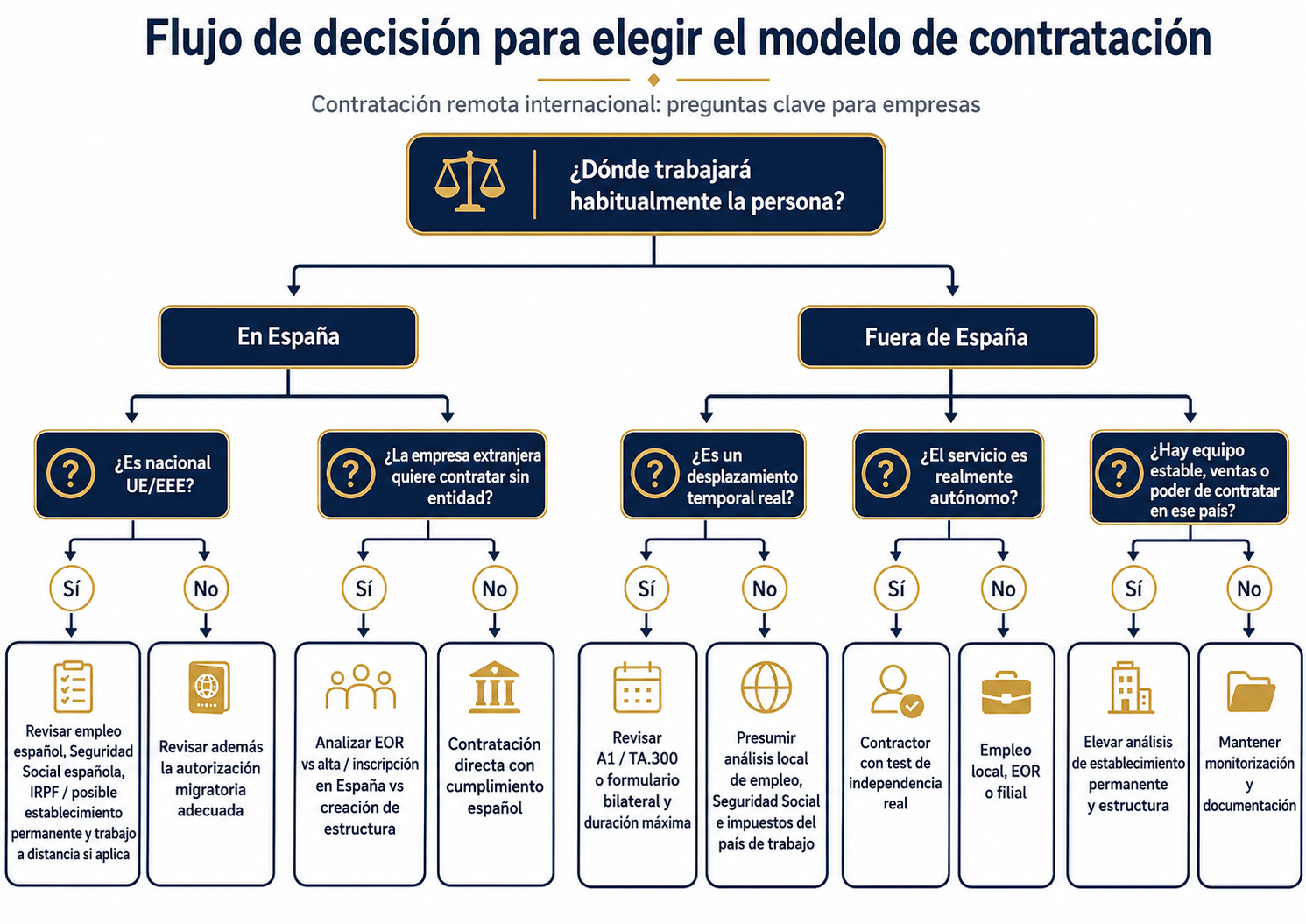
This flowchart captures what the rules actually say: the country of habitual work determines the applicable employment law; the competent country for Social Security purposes is determined by its own set of rules; taxation follows residence, source and permanent establishment; and immigration requirements can fundamentally undermine the viability of a given model even where the employment law aspects appear resolved.
Legal checklist before hiring international remote talent
Checklist for COOs and Heads of People before making an international offer
Before extending an international offer, it is advisable to work through the following sequence:
| Stage | What needs to be verified | Why it matters |
|---|---|---|
| Before the offer | Country of residence and country of habitual work; nationality; expected duration; role and responsibilities; hiring authority; data access | Determines applicable employment law, immigration requirements, Social Security obligations and permanent establishment exposure |
| Before signing | Engagement model: employee, contractor, EOR or subsidiary; governing law; whether there will be cross-border travel or multinational activity | Prevents signing up to the wrong contractual template |
| Before start date | Employer registration and enrolment where required; A1/TA.300 or bilateral certificate; remote working agreement; equipment and expenses inventory | Registration and documentation cannot be sorted out retrospectively |
| First month | Documented record of health & safety and data protection instructions; DPA with suppliers; proof of tax residence and applicable tax treaties where relevant | Reduces the risk of audit, data breach and double taxation |
| Ongoing monitoring | Changes of country, days of physical presence, proportion of remote work, line manager, reporting line, commercial functions and contract-signing authority | A model that is compliant today may cease to be so within three months |
| Departure or change | Termination, deregistration, certificates, final tax withholdings, IP assignment, return of equipment and revocation of access rights | This is typically the stage at which disputes and contingent liabilities come to light |
This sequence aligns with the obligations to register the company and notify new hires to Social Security, with the formal requirements for remote work arrangements, and with the need to properly document any posted-worker or multi-state work regime where applicable.
Legal timeline: what to review before, during and after hiring international remote talent
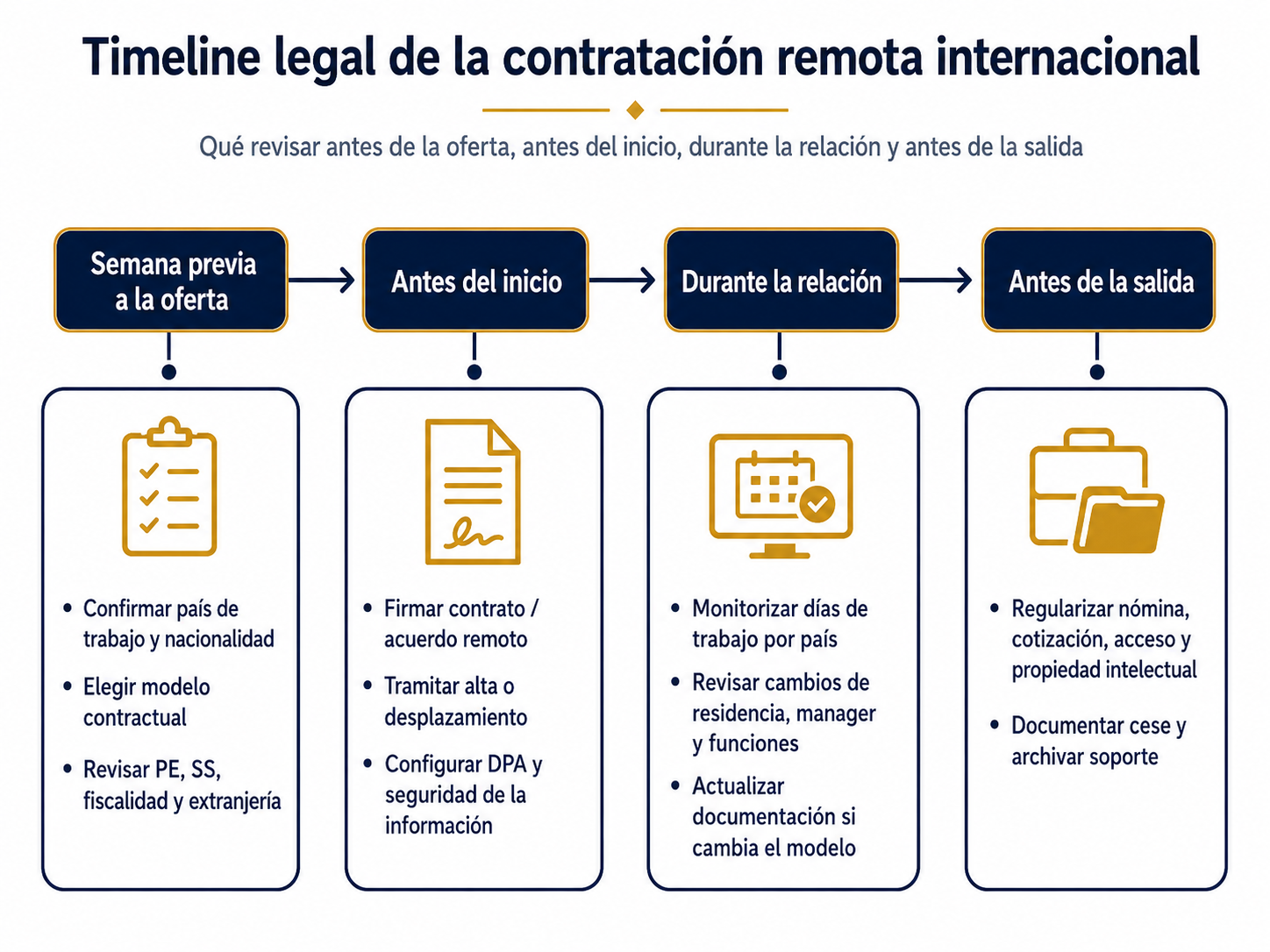
In international remote arrangements, the most dangerous variable is not the initial contract signing, it is the undocumented change in practice: someone working "temporarily" in Portugal or Barcelona who, six months later, is habitually based there; a contractor who moves into a team leadership role; or a sales profile who acquires authority to conclude contracts. These shifts alter the position under Rome I, Social Security and permanent establishment rules.
Key clauses in international remote talent contracts
Contracts with an international dimension should include, as a minimum, clauses covering country and habitual place of work, international mobility and obligation to notify changes of residence, applicable law and jurisdiction without prejudice to mandatory protective rules, working hours, availability and time-recording where applicable, equipment and expense reimbursement, confidentiality and IP, information security, data protection, prohibition on unauthorised subcontracting or delegation in contractor agreements, and documentary cooperation for certificates of coverage, A1 forms or bilateral social security forms. Where Law 10/2021 on remote work applies, part of this content ceases to be merely "advisable" and becomes a legal requirement.
In EOR or vendor agreements, the critical annex is the one covering the actual allocation of employer functions: who directs the work, who sets objectives, who holds disciplinary authority, who manages health and safety, who acts as data controller, what security instructions are imposed, and how to ensure the arrangement does not amount to a simple supply of labour. This point is particularly sensitive in light of Article 43 of the Workers' Statute.
Warning signs before hiring or regularising foreign remote talent
Urgent legal advice is needed in any of the following situations: a foreign company already has someone working from Spain without a clear formal registration; a contractor invoices monthly in a way that mirrors an employment relationship and reports to an internal manager; an EOR is acting as a mere payroll administrator while the client retains full management control; an individual has changed their country of residence without notifying the relevant parties; there is significant commercial activity or contract-signing taking place from Spain or another country; the team uses HRIS, payroll or IT systems outside the EEA without having reviewed data transfer arrangements; or there is genuine uncertainty regarding a work permit. All of these situations simultaneously engage the Workers' Statute, Social Security, tax law, immigration law, and GDPR.
If your company is facing any of these scenarios, the sensible next step is not to "request a template", it is an international employment audit. Conesa Legal can assist across five interconnected areas: preliminary auditing, contracts, EOR advisory, international taxation, and immigration.

Frequently asked questions about hiring foreign remote talent in Spain
FAQs on international remote hiring for companies
Can a Spanish company hire a remote employee in another country without a local subsidiary?
Yes, but not always in the same way. Options include direct employment, temporary posting, contractor arrangements, an Employer of Record (EOR), or a local entity structure. The right choice depends on the country where the work is habitually performed, the applicable Social Security rules, and the risk of creating a permanent establishment (PE).
Can I engage someone who works exclusively for my startup as a freelancer?
Only if the arrangement is genuinely independent. Where there is organisational dependency and work performed on behalf of another party, a commercial contract will not neutralise the risk of the relationship being reclassified as employment.
What happens when a foreign company hires someone who works from Spain?
The applicable employment law, potential Social Security registration and contributions in Spain, tax residency, and the risk of permanent establishment all need to be assessed. This is not a situation that should simply be handed off to an international payroll provider without prior legal analysis.
Does an EOR eliminate all risks?
No. It can simplify operations, but in Spain a poorly structured EOR arrangement may amount to unlawful labour supply if the setup is no more than the placement of workers at another party's disposal.
What documentation do I need to temporarily post an employee from Spain to another country?
It depends on the applicable framework. Within the EU, the A1 certificate is typically required; in Spain, the General Social Security Treasury (TGSS) processes this through form TA.300. Where bilateral social security agreements apply, the destination country's specific forms must also be obtained.
Does working from Spain for a foreign company require a permit?
EU nationals generally do not require a work permit to work in another EU member state. However, nationals of non-EU countries who intend to work from Spain must obtain the appropriate authorisation; the international remote work visa does not cover every situation.
Who bears the costs of remote working when Spanish law applies?
The company must cover or reimburse expenses related to equipment, tools and means connected to remote working.
Is a data protection review required for international remote hiring?
Yes. The company acts as data controller in respect of employment data and, where data flows outside the EEA, must review international transfers and data processing agreements.
Key official Spanish sources
- Spanish Official Gazette (BOE): Workers' Statute, Law 10/2021 on Remote Working, General Social Security Act (LGSS), Personal Income Tax (IRPF) Act, Non-Resident Income Tax Act (IRNR), Corporate Income Tax Act and Law 14/2013 on Support for Entrepreneurs.
- Social Security: posted workers and the A1 certificate and bilateral agreements (form TA.300 and rules on activity in multiple Member States).
- Ministry of Inclusion, Migration and Social Security: employed work and mobility of foreign nationals and the ONE Platform for international remote working.
- Spanish Tax Agency (AEAT) and Ministry of Finance: tax residence certificate and double taxation treaties.
- Spanish Data Protection Agency (AEPD): international data transfers and data protection in the employment context.
Hiring international remote talent? Review the model before you sign
If your company is considering hiring remote talent outside Spain, regularising existing arrangements, or allowing part of your team to work from Spain for a foreign entity, the best investment is not to rush to sign, it is to reduce the cost of getting it wrong. Conesa Legal can support you with a business-focused approach: international employment audit, contract drafting and review, EOR advisory, international tax and immigration. For a company, that upfront review is almost always far less costly than a subsequent regularisation, an inspection, or a due diligence process with open contingencies.