
.jpg)
PRIVATE INVESTIGATORS, VIDEO SURVEILLANCE, fair dismissal AND THE RIGHT TO PRIVACY:
The High Courts of Justice within the employment jurisdiction had been ruling that video surveillance evidence was inadmissible on the grounds that it violated employees' right to privacy, even where the employee was caught stealing. In our view, this reflected a mistaken interpretation of data protection law.
The correct approach is to apply the proportionality test:
- Does the measure serve a legitimate purpose?
- Is it suitable and appropriate for that purpose?
- Is it necessary, interfering with the rights concerned only to the minimum extent required?
- Is it proportionate?

NEW ruling 17/11/2020 High Court of Justice (TSJ) of Andalusia (Seville): NULLITY of dismissal of a security guard found watching films and falling asleep in his booth.
This ruling declares the nullity of the dismissal of a security guard who was recorded by a hidden camera installed in the control room where he worked. He was caught asleep and removing his shoes, but the evidence was obtained unlawfully, in breach of his right to privacy. Neither the employee nor his colleagues were aware that the device had been installed. The company should have posted a notice indicating that a camera was in operation in that area. The Court rules that the dismissal is null and void, as the employee changed his clothes in that room; accordingly, the evidence is inadmissible because it FAILS the necessity requirement, given that it infringes the employee's right to privacy on that basis.

HOW TO RECORD AN EMPLOYEE IN A DISMISSAL CASE?
In this situation, we see only THE FOLLOWING VIABLE OPTIONS for private investigator video surveillance evidence to be admissible:
1.- Include a CLAUSE in the employment contract.
There is a growing trend, much like the American approach, towards putting everything in writing and agreeing on it in advance.
Since the employment relationship is a living arrangement, we have been gradually incorporating and adapting clauses as new situations arise that, whether by law or case law, need to be reflected in the contractual terms.
If you need assistance with contractual clauses, please do not hesitate to contact us.

2.- The private investigator must be PRESENT for each and every video recording.
We believe that if the investigator is personally present throughout the operation and records only the sanctionable conduct, even if repeated, a short video or set of photographs taken by the investigator, accompanied by their own statement, would not infringe any right to privacy.
3.- Use PARALLEL EVIDENCE:
In the case at hand… two is better than one. There is no such thing as too much evidence here. It is always better to use every available form of evidence rather than relying on a single source.
4.- Post STICKERS throughout the workplace warning that video recordings may be used against employees.
If employment contracts have already been signed and the company does not wish to issue an internal policy document on conduct rules (an increasingly useful tool…), we provide below a sample video surveillance notice with suggested wording that could help persuade a court to admit the evidence while finding no breach of privacy rights.
Even if you do not currently have cameras installed, displaying the sticker may still prove useful, because you never know when you might need a private investigator.
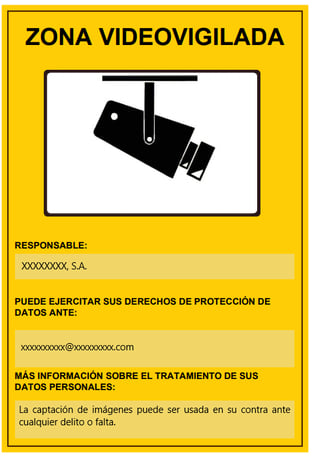
5.- As noted above: applying the PROPORTIONALITY test when preparing evidence.
Case law of the European Court of Human Rights – López Ribalta case:
Very recently, on 17/10/19, the European Court of Human Rights issued a new ruling in which it upheld the validity of CCTV footage installed by the company Mercadona in one of its supermarkets. The case involved the company dismissing several employees who had been stealing products in collusion with customers of the same supermarket.
The ruling can be accessed via the following link:
USING A PRIVATE INVESTIGATOR TO RECORD AN employee:
Even where the evidence is gathered by a private investigator, courts had been relying on data protection legislation to hold that there had been no prior notice that recording was taking place.
In the Mercadona case, we had serious doubts as to whether evidence that was valid before the criminal courts would also be accepted in the employment jurisdiction. Although the López Ribalta ruling clarifies a great deal for Spanish judges, certain precautions must still be taken in employment matters, and above all, any evidence obtained by a private investigator must be gathered in a way that does not infringe the employee's right to privacy. Even when the employee has been stealing.
The rulings referred to can be downloaded via the following links:
ruling High Court of Justice (TSJ) Santa Cruz de Tenerife, 27/03/2017
ruling High Court of Justice (TSJ) Madrid, 10/07/2019
OTHER RULINGS OF INTEREST:
- ruling Casino La Toja – Constitutional Court, 10/04/2000: The Court held, again, that evidence cannot infringe the right to privacy. In this case, private conversations between the croupier and a customer had been recorded, which violated the confidentiality of those exchanges, despite there being grounds to suspect that the croupier was committing theft.
- ruling TC 39/2016 on the scope of information required when notifying employees of workplace video surveillance. The Court denied the appeal brought by an employee accused of theft.
Given the shifting nature of case law in this area, we are at your disposal should you need to ensure full legal compliance when installing cameras, or when drafting and preparing a private investigator's report.