
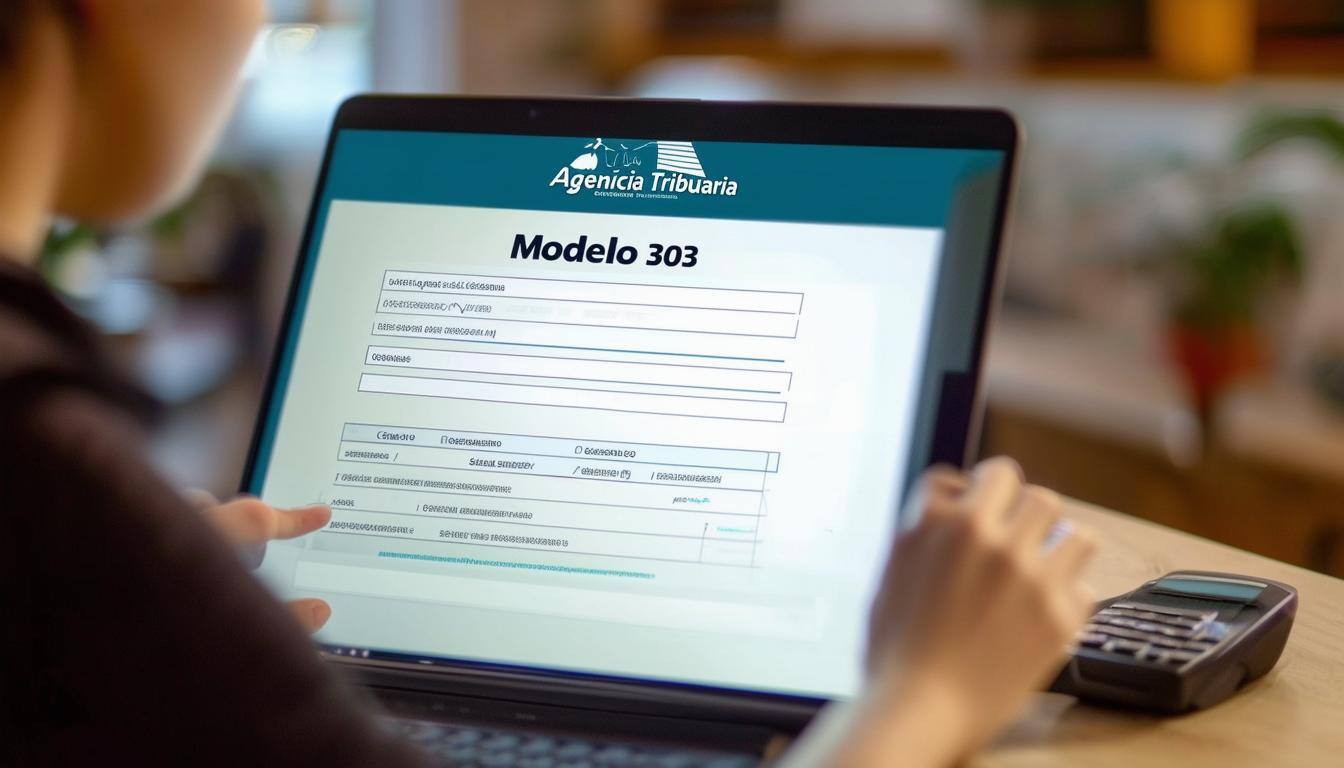
The Form 303 is a key document for the quarterly VAT return in Spain. It is used by both self-employed workers and companies to correctly declare and settle Value Added Tax (VAT). The main uses and benefits of this form are set out below.

How to submit Form 303
Form 303 must be submitted exclusively online. Paper submissions have not been accepted since 1 January 2023.
Prerequisites
To access the system you will need:
- A recognised electronic certificate
- Or the Cl@ve system (for individuals only, with certain exceptions)
EU citizens may use their national digital identification (eIDAS), but must hold a Spanish identifier such as a national ID (DNI), Foreigner Identity Number (NIE), or Tax Identification Number (NIF).
Step-by-step submission
- Go to the Spanish Tax Agency (AEAT) electronic portal.
- Navigate to the "VAT Self-Assessment" section.
- Log in using your digital certificate or Cl@ve PIN.
- Select the option "Continue with Form 303 Submission".
- Choose one of two methods: File upload:
- Upload a TXT file generated by your accounting or management software.
- This is the most secure and automated method.
- Online form:
- Complete the form directly on the Spanish Tax Agency (AEAT) website.
- Check that all details are correct.
- Confirm and submit the return.
Filing deadlines
- Quarterly: 1–20 April, July and October, and 1–30 January for the fourth quarter.
- Monthly: 1–30 of the month following the reporting period.
If you opt for direct debit and the return results in a payment due, the deadline is 5 days earlier than the dates stated above.
Important considerations
- Includes intra-EU acquisitions.
- Specifies transactions subject to reverse charge.
- Reflects changes in taxable bases and tax amounts.
- Separates intra-EU and non-EU expenses.
Please note that Form 303 is mandatory for any professional or business owner carrying out activities subject to VAT, regardless of the outcome of the return or the type of company.
Quarterly VAT return
The Form 303 is filed on a quarterly basis with the Spanish Tax Agency (AEAT). Companies and self-employed workers must use it to report on:
- Output VAT, i.e. the VAT charged to customers on sales and services.
- Input VAT, i.e. the VAT paid to suppliers on the purchase of goods and services required for the business.
This form is mandatory even in quarters with no economic activity, and must be submitted within the deadlines established by law.
Self-assessment of the tax
The Form 303 enables the self-assessment of VAT, which is calculated by deducting input VAT from output VAT. The possible outcomes are:
- Amount due: If output VAT exceeds input VAT, the difference must be paid to Spanish Tax Authority.
- Carry-forward: If the result is negative, the balance may be offset against future returns.
- Refund: In the final quarter of the year, if the balance is negative, a refund may be requested from Spanish Tax Authority.
It is important to keep a clear record of all VAT transactions in order to avoid errors in this self-assessment.
Meeting tax obligations
Filing Form 303 is mandatory for almost all self-employed workers and companies in Spain, as it ensures that taxpayers comply with their VAT obligations. Furthermore, those who fail to submit this form on time may face financial penalties.
Tax oversight
This form serves as a control tool for the Spanish Tax Agency (AEAT), which can verify that the VAT collected has been correctly declared and paid. Companies and self-employed workers act as collectors of VAT on behalf of end consumers, and through Form 303, they remit this tax to the public treasury.
What are the main differences between Form 303 and other VAT self-assessment forms?
There are several forms used for VAT self-assessment in Spain, but Form 303 is the most common. Below, we compare it with other VAT forms:
Comparison with Form 310
- Form 310 applies to the simplified VAT scheme, whereas Form 303 applies to the standard scheme.
- Form 310 is based on a simplified flat-rate module system, whereas Form 303 requires a full breakdown of all transactions.
- Under Form 303, all input VAT expenses may be deducted, unlike Form 310, where deductions are capped by the applicable modules.
Other key differences
- Form 303 is mandatory for most companies and self-employed workers, whereas other forms such as Form 310 or Form 390 apply only in specific cases.
- Form 303 allows you to calculate and settle the VAT due or refundable each quarter, unlike annual filing forms.
- Form 303 requires a breakdown of output and input VAT by tax rate, which is not required under simplified forms.
Most common mistakes when completing Form 303
Submitting Form 303 incorrectly can lead to errors that result in penalties. The most common mistakes include:
Identification and period errors
- Selecting the wrong quarter when filing the return.
- Entering an incorrect Tax Identification Number (NIF) or Tax Identification Number (CIF), which can result in duplicate declarations.
Errors in VAT calculation
- Failing to properly break down the VAT rates applied.
- Incorrectly applying tax rates to products or services.
- Failing to correctly apply the VAT pro-rata rule where required.
Accounting errors
- Omitting deductible expense invoices.
- Failing to correctly carry forward the VAT credit balance from previous quarters.
Filing errors
- Submitting the return late, which may result in surcharges.
- Failing to request a refund in the final quarter when entitled to do so.
- Incorrectly assuming that a payment on account can simply be made up to the 20th of the voluntary filing period.
Failing to seek professional advice when doubts or complex situations arise
It is important to review all information carefully before submitting the return, as errors can have negative consequences such as penalties or tax audits. If a mistake is made, it is possible to submit a supplementary or corrective return to rectify it, but it is always preferable to avoid errors from the outset.

How is the VAT liability calculated in Form 303?
Calculating the VAT liability in Form 303 follows a straightforward process:
Calculating output VAT
- Add up all VAT charged to clients throughout the quarter.
- Break this down by applicable VAT rates (standard, reduced, and super-reduced).
Calculating input VAT
- Add up all VAT paid to suppliers on received invoices.
- Include only the VAT on deductible expenses related to the business activity.
Determining the result
- Subtract the input VAT from the output VAT.
- If the result is positive, the amount due is paid to the Spanish Tax Authority.
- If the result is negative, a credit balance is generated to be carried forward to subsequent quarters.
It is essential to verify that all invoices are correctly recorded and that the appropriate VAT rates have been properly applied.
What happens if I do not submit Form 303 on time?
Failing to submit Form 303 on time can have serious consequences:
Financial penalties
-
If you submit the form late on your own initiative, surcharges will apply depending on the length of the delay:
- A fixed 1% surcharge plus an additional 1% for each month of delay.
- If more than 12 months have passed, the surcharge increases to 15%.
-
If Spanish Tax Authority formally requests the return, the penalties will be significantly higher.
Other consequences
- Possible tax inspections by Spanish Tax Authority
- Difficulty obtaining certificates of being up to date with tax obligations
- Problems accessing public subsidies or entering into contracts with public authorities
Final recommendations
- Submit Form 303 as soon as possible, even if the deadline has already passed
- If you have had no activity during the period, you must still submit the form, ticking the "no activity" box
- Consider requesting a payment deferral if you are experiencing financial difficulties
- Seek professional advice to avoid errors and ensure compliance with your tax obligations
If in doubt, the best course of action is to obtain professional advice to ensure full compliance with your tax obligations.