

.jpg)
Measures under Royal Decree-Law 24/2020, of 26 June
NEW COVID-19 RESTRICTIONS OR CONTAINMENT MEASURES:
THE NEED TO DEMONSTRATE IMPACT ON BUSINESS ACTIVITY
The Spanish Labour and Social Security Inspectorate, in response to queries raised by various provincial inspection offices, has produced an informational note aimed at providing guidance on the preparation of Temporary Layoff Procedure (ERTE) on grounds of force majeure due to a resurgence of COVID-19, and at harmonising the criteria applied by the different officials involved in drafting the reports that the regulations assign to the Labour and Social Security Inspectorate (hereinafter ITSS).
As on previous occasions, the purpose of this note is to ensure that the actions taken by the various territorial units of the ITSS are consistent across the country. This consistency requires that the reasoning set out in their reports be coherent, without prejudice to the fact that the assessment of the specific circumstances of each case remains the responsibility of the individual official, who retains full technical and functional autonomy.
All of this relates to the regulation of Temporary Layoff Procedure (ERTE) on grounds of force majeure arising directly from a loss of activity due to COVID-19, as provided for under Article 22 of Royal Decree-Law 8/2020, of 17 March, on urgent extraordinary measures to address the economic and social impact of COVID-19; and, in particular, Royal Decree-Law 24/2020, of 26 June, on social measures for the reactivation of employment and industrial activity.
As we noted in a previous article, pending a new regulatory framework, Royal Decree-Law 24/2020 remains applicable until 30 September.
The regulation itself sets out the circumstances in which force majeure may be considered to exist for these COVID-19 resurgence Temporary Layoff Procedure (ERTE): where it is not possible to carry out business activity due to "new restrictions or containment measures" (Additional Provision 1).
Accordingly, as set out in section 4 "Grounds for the Measure", sub-section 2 of the ITSS informational note, it is expressly stated:
"It should be noted that the regulation itself, without specifying their precise nature, draws a distinction between "restrictions" and "containment measures", thereby differentiating between the two. In this regard, restrictive decisions may be adopted that involve an express prohibition, or that limit activities in a general or specific manner, impose confinement, etc., or measures may be adopted that, while not prohibiting an activity outright, may subsequently require a series of controls to prevent the spread of a virus, such as quarantines or specific diagnostic testing. Accordingly, these restrictions or containment measures are general or indeterminate in nature, given the wide range of possible measures that may be adopted in the future to address the pandemic and prevent the spread of the disease.
Therefore, in view of this general nature, any type of restriction or containment measure should in principle be considered a valid ground for a temporary layoff procedure, provided it directly affects the activity of a workplace, and this is duly evidenced by the company.
In particular, as the ITSS itself specifies:
1.- This refers to workplaces.
2.- It is immaterial which authority adopts the restriction or containment measure. What matters is that it has competence to do so.
3.- The cause must be external and beyond the employer's control.
4.- And its effect must prevent, in whole or in part, the continuation of work.
Evidence and PROCEDURE in the Temporary Layoff Procedure (ERTE) RESURGENCE, ETOP GROUNDS OR force majeure:
Regarding the procedure to be followed, this will be in accordance with the provisions of Article 47.3 of the Workers' Statute (hereinafter TRLET), as well as Article 51.7 TRLET, to which the former refers, and its implementing regulations set out in Royal Decree 1483/2012, of 29 October, approving the Regulations on Procedures for collective dismissal and for the Suspension of Contracts and Reduction of Working Hours.
This means that, in these cases, the Labour Inspectorate report once again becomes mandatory, and must be issued as promptly as possible, given that the standard resolution deadline applies, five days from the date on which the application is entered in the register of the competent authority responsible for processing it.
While it is accepted that containment measures, regardless of their nature (whether measures adopted by the competent authority, such as possible establishment closures or restrictions on opening hours, or measures adopted by authorities outside the scope of a particular workplace, e.g. travel restrictions, quarantine requirements imposed by third countries, or other restrictions on travellers arriving from Spain, which may have a significant impact, particularly on the hospitality, transport and related industries), may be cited by the company to justify a reduction in its activity, it must be borne in mind that force majeure, as the grounds for a temporary employment regulation procedure, must be duly substantiated.
The company must therefore demonstrate, in the most objective and specific manner possible, a direct link between:
- the cause (the restrictions or containment measures), and
- the consequence (the impossibility of carrying on the business activity).
As the Labour Inspectorate's Note makes clear, not every reduction in activity will be directly linked to the measures adopted to curb the pandemic. It is our view that, on this occasion, Temporary Layoff Procedure (ERTE) applications based on force majeure will be subject to greater scrutiny. Accordingly, we must properly substantiate and compile the documentation required for approval by the Labour Authority, following the Labour and Social Security Inspectorate's report. We place the full benefit of our experience and expertise at the disposal of both existing and new clients.
Please do not hesitate to contact us:

Finally, please note that if you are currently subject to a Temporary Layoff Procedure (ERTE) (whether or not it is COVID-19-related), it is not necessary to withdraw from that Temporary Layoff Procedure (ERTE). The two procedures are compatible, and in all cases you must update the grounds of the Temporary Layoff Procedure (ERTE) as provided under Additional Provision One.2 (Royal Decree-Law 24/2020), so that a new Temporary Layoff Procedure (ERTE) on force majeure grounds due to a resurgence of infection can be authorised.
Royal Decree-Law 24/2020, of 26 June
Royal Decree-Law 24/2020, of 26 June, on social measures to reactivate employment, protect self-employed workers, and strengthen the competitiveness of the industrial sector, is the result of a social dialogue agreement, the Second Social Agreement in Defence of Employment, reached between the Government and the social partners. Its objective, as set out in the Explanatory Memorandum, is:

"to modulate the extraordinary and exceptional measures set out in Royal Decree-Law 8/2020, of 17 March, and in the First Social Agreement in Defence of Employment, whose validity expires on 30 June 2020, extending their underlying spirit while adapting them to the current situation. The rationale is based on the persistent effects of the health crisis on the normal functioning of businesses and their capacity to provide services in full, the uneven nature of the recovery, and the possibility that certain restrictions on activity for public health reasons may be reinstated on a limited basis."
With that said, regarding the measures introduced, we will set out the most broadly applicable ones affecting the employment sphere, organised by topic:
Temporary Layoff Procedure (ERTE)S ON force majeure GROUNDS APPLIED FOR BEFORE 27 JUNE 2020:
Temporary Layoff Procedure (ERTE)s based on force majeure are automatically extended until 30 September 2020, but only where they were applied for before 27 June 2020 (the date on which this new Royal Decree-Law entered into force).
Requirements:
- Employers must progressively reinstate the affected employees subject to temporary employment regulation measures, to the extent necessary to carry out their business activity, giving priority to adjustments in the form of reduced working hours.
- When all employees have been reinstated, employers must notify the labour authority of the full withdrawal from the authorised temporary employment regulation procedure, within 15 days of the date on which that reinstatement takes effect.
Without prejudice to the foregoing, any withdrawal by these companies and entities from the temporary layoff procedures shall be carried out upon prior notification to the Public Employment Service (SEPE) of any changes to the data contained in the initial collective application for access to unemployment protection.
Prohibition on overtime, outsourcing and new recruitment:
No overtime may be worked, no new outsourcing of activities may be established, and no new hiring, whether direct or indirect, may be arranged during the application of the temporary layoff procedures referred to in this article. This prohibition may be waived where the employees covered by the procedure who provide services at the workplace affected by the new hires, direct or indirect, or outsourcing arrangements, are unable, due to training, skills, or other objective and justified reasons, to carry out the functions assigned to those positions, provided that the company has first informed the employees' legal representatives accordingly.
Such actions may constitute infringements by the affected company, by virtue of proceedings initiated for that purpose, where applicable, by the Labour and Social Security Inspectorate.
TEMPORARY LAYOFF PROCEDURES (ERTES) ON ECONOMIC, TECHNICAL, ORGANISATIONAL AND PRODUCTION GROUNDS (ETOP)
ETOP-based ERTEs arising from Covid-19 initiated from 27 June 2020 through to 30 September 2020 shall benefit from the following:
Special provisions:
- They may be initiated while a Temporary Layoff Procedure (ERTE) on grounds of force majeure is still in force.
- If initiated after the conclusion of a Temporary Layoff Procedure (ERTE) on grounds of force majeure, the effective date shall be backdated to the date on which that procedure ended.
- Temporary Layoff Procedure (ERTE) procedures already initiated and in force as at 27 June 2020 shall continue to apply on the terms set out in the company's final notification and until the end date specified therein.
Prohibition on overtime, outsourcing and new recruitment:
No overtime may be worked, no new outsourcing of activities may be established, and no new hiring, whether direct or indirect, may be arranged during the application of the temporary layoff procedures referred to in this article. This prohibition may be waived where the employees covered by the procedure who provide services at the workplace affected by the new hires, direct or indirect, or outsourcing arrangements, are unable, due to training, skills, or other objective and justified reasons, to carry out the functions assigned to those positions, provided that the company has first informed the employees' legal representatives accordingly.
These actions may constitute infringements by the affected company, by virtue of proceedings initiated for that purpose, where applicable, by the Labour Inspectorate and Social Security.
Do you have any questions?
Contact me via the image below:

New CONTRIBUTION measures
The exemptions in force up to this point were as follows:
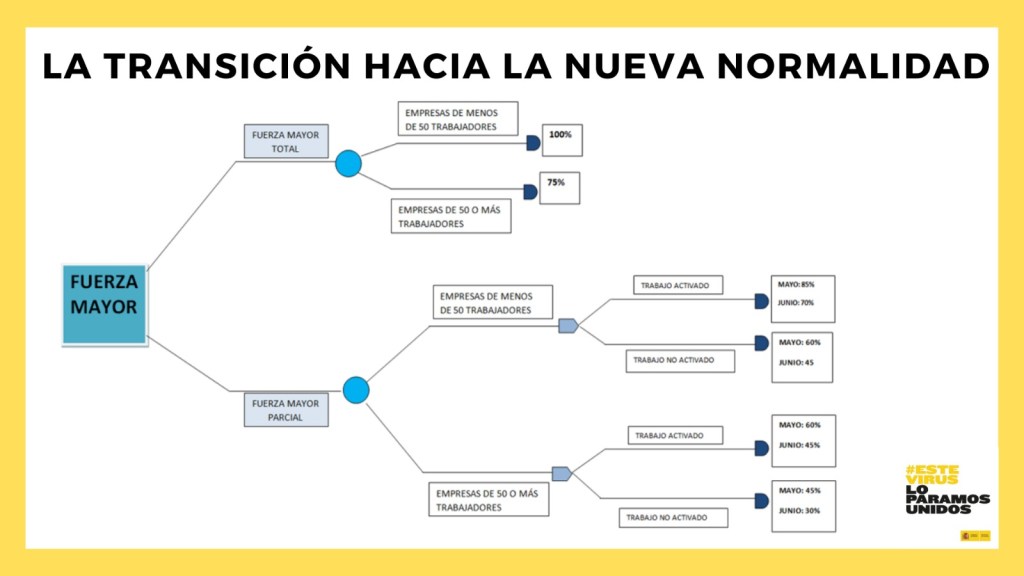
From 27 June 2020 onwards, several scenarios apply affecting force majeure ERTEs and ETOP ERTEs:
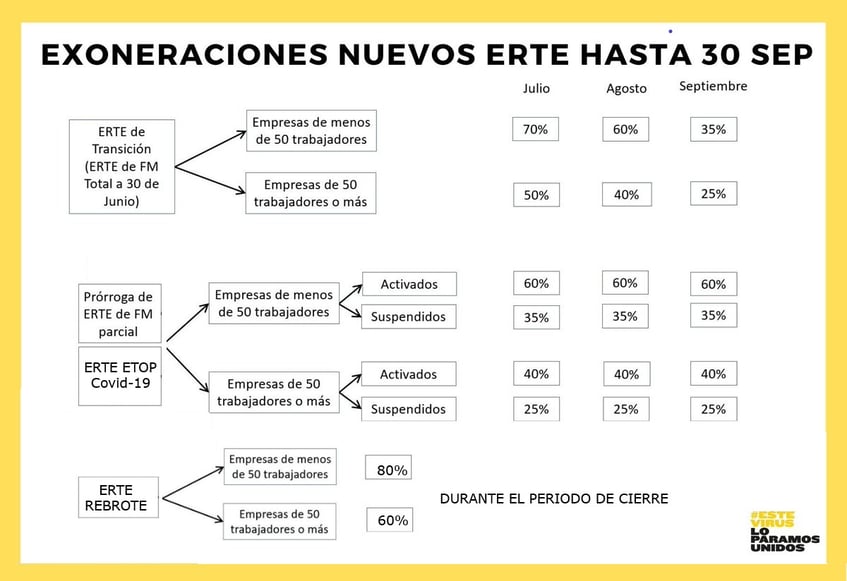
FULL Temporary Layoff Procedure (ERTE) (WHERE 100% OF THE WORKFORCE REMAINS AFFECTED)
For FULL Temporary Layoff Procedure (ERTE) schemes where workers continue with their activities suspended from 1 July 2020 onwards: the percentages set out in the first section of the scheme will apply, as detailed below:
A) company with fewer than 50 workers, continuing with activities suspended from 1 July 2020, with the following periods and percentage reductions in working hours:
- 70% of contributions accrued in the month of July
- 60% of contributions accrued in the month of August.
- 35% of contributions accrued in the month of September
- 50% of contributions accrued in the month of July
- 40% of contributions accrued in the month of August
- 25% of contributions accrued in the month of September
Where a company resumes its activity after 1 July, the contribution exemptions applicable from that point until 30 September 2020 will be those set out in the following section:
Temporary Layoff Procedure (ERTE) – PARTIAL force majeure:
Companies under a PARTIAL Temporary Layoff Procedure (ERTE) force majeure (applied for before 27 June 2020) will be exempt from paying the employer's Social Security contribution and joint collection charges, at the percentages and under the conditions set out in the following breakdown:
- Active workers from 1 July 2020:
- company with fewer than 50 workers or equivalent as at 29/02/2020:
- 60% – July, August and September
- company with 50 or more workers or equivalent as at 29/02/2020:
- 40% – July, August and September
- company with fewer than 50 workers or equivalent as at 29/02/2020:
- Inactive workers from 1 July 2020:
- company with fewer than 50 workers or equivalent as at 29/02/2020:
- 35% – July, August and September
- company with 50 or more workers or equivalent as at 29/02/2020:
- 25% – July, August and September
- company with fewer than 50 workers or equivalent as at 29/02/2020:
Temporary Layoff Procedure (ERTE) – ETOP GROUNDS DUE TO COVID-19:
Temporary Layoff Procedure (ERTE) procedures based on ETOP grounds due to COVID-19 submitted before 27 June 2020, or arising from a Temporary Layoff Procedure (ERTE) on force majeure grounds that has ended, carry the same exemption percentages as PARTIAL Temporary Layoff Procedure (ERTE) procedures.
- Active workers from 1 July 2020, based on the periods and proportions of working hours performed:
- company with fewer than 50 workers or equivalent as at 29/02/2020:
- 60% – July, August and September
- company with 50 or more workers or equivalent as at 29/02/2020:
- 40% – July, August and September
- company with fewer than 50 workers or equivalent as at 29/02/2020:
- Inactive workers from 1 July 2020, based on the periods and proportions of working hours performed:
- company with fewer than 50 workers or equivalent as at 29/02/2020:
- 35% – July, August and September
- company with 50 or more workers or equivalent as at 29/02/2020:
- 25% – July, August and September
- company with fewer than 50 workers or equivalent as at 29/02/2020:
Temporary Layoff Procedure (ERTE) – NEW OUTBREAK:
The NEW OUTBREAK Temporary Layoff Procedure (ERTE) applies to companies and organisations that, from 1 July 2020 onwards, are prevented from carrying on their activities due to the adoption of new restrictions or containment measures, in respect of workers assigned to the affected workplace, and up to 30 September 2020:
- company with fewer than 50 employees or equivalent workers as of 29/02/2020:
- 80% of the employer's Social Security contribution accrued during the closure period.
- company with 50 or more employees or equivalent workers as of 29/02/2020:
- 60% of the employer's Social Security contribution accrued during the closure period.
In this case, the exemption will apply to the payment of the employer's contribution provided for in Article 273.2 of the consolidated text of the General Social Security Act, approved by Royal Legislative Decree 8/2015 of 30 October, as well as to contributions relating to jointly collected items.
In both cases, when companies and entities resume their activity, the measures set out above will apply from that point until 30/09/2020.
EMPLOYMENT SAFEGUARD MEASURES (ART. 6 ROYAL DECREE-LAW 24/2020)
- Companies that have initiated a Temporary Layoff Procedure (ERTE) (ETOP) Covid-19 procedure and benefit from the exemptions provided herein will also be subject to the employment safeguard clause.
- For companies benefiting for the first time from the extraordinary measures relating to Social Security contributions following the entry into force of this Royal Decree-Law, the 6-month commitment period referred to in this provision will begin to run from 27 June 2020.
UNEMPLOYMENT PROTECTION:
- The unemployment protection measures provided for in paragraphs 1 to 5 of Article 25 of Royal Decree-Law 8/2020 of 17 March will apply until 30 September 2020 to workers affected by the temporary employment regulation procedures governed by Articles 22 and 23 of Royal Decree law 8/2020 of 17 March, and to those referred to in paragraph 2 of the first additional provision of this regulation.
- However, the extraordinary unemployment protection measures set out in Article 25.6 of Royal Decree-Law 8/2020 of 17 March, applicable to permanent seasonal workers and those performing fixed, periodic work on fixed recurring dates, will remain in force until 31 December 2020.
- The unemployment benefit Managing Authority will, automatically, extend until 30 September 2020 the maximum duration of entitlements recognised by virtue of suspension or reduction of employment procedures, Temporary Layoff Procedure (ERTE) on grounds of force majeure or ETOP, governed by Articles 22 and 23 of Royal Decree-Law 8/2020 of 17 March, initiated before 27 March 2020.
- Companies that fully withdraw from a Temporary Layoff Procedure (ERTE), or that reactivate workers, are required to notify the managing body of those workers' removal from unemployment benefit, prior to it taking effect.
- In the case of Temporary Layoff Procedure (ERTE) ETOP procedures under Article 23 of Royal Decree Law 8/2020 of 17 March, where the company's decision is notified to the Labour Authority after 27 June 2020, the company must submit a collective claim for unemployment benefits on behalf of the workers, as follows:
- a) Using the form available on the website or electronic office of the Public Employment Service (SEPE).
- b) Within a deadline of 15 days, as set out in Article 268 of the consolidated text of the General Social Security Act.
- c) The grounds and effective date of the legal unemployment situation must in all cases appear on the company certificate, which shall be considered a valid document for verification purposes.
- Both for Temporary Layoff Procedure (ERTE) cases based on force majeure initiated before 27 June 2020, and for COVID-related ETOP Temporary Layoff Procedure (ERTE) cases notified to the Labour Authority after 27 March 2020, for the purposes of adjusting unemployment benefits, where periods of activity and inactivity alternate within a given calendar month, as well as in cases of reduced working hours, and where both situations are combined (days of inactivity and days of reduced hours), the company must report this information:
- The notification shall be made at the end of the month in arrears.
- Through the activity periods reporting function of the certific@2 application.
- The information shall cover the days worked in the preceding calendar month.
- In the case of days worked on reduced hours, the hours worked shall be converted into equivalent full days of activity.
To do so, the total number of hours worked during the month shall be divided by the number of hours that constituted the worker's standard working day prior to the application of the reduced hours arrangement.
- The notification referred to in the preceding paragraph is without prejudice to the company's obligation to notify the Managing Body, prior to it taking effect, of any removals from and changes to the suspension and reduced working hours measures, under the terms established by law.
- The Labour Inspectorate and Social Security will have access to this data.
If you need more information, please get in touch with us:
-1.jpg?width=92&name=shutterstock_1459857380%20(2)-1.jpg)
If you would like to speak with specialists in Collective Dismissal Procedure (ERE) ETOP proceedings: