
.jpg)
Article 28.2 of the Workers' Statute requires companies to maintain a pay register, with the aim of ensuring transparency in the structure of remuneration within companys, kept in an accurate and up-to-date manner, and enabling appropriate access to companies' pay information.
Find out more here in this link about the current gender pay gap from our HR collaborators

In addition, Articles 5 to 8 of Royal Decree 902/2020, of 13 October, on equal pay between women and men set out the obligations relating to the Pay Register and the Pay Audit.
What is the purpose of the pay register
The Pay Register is designed to prevent pay disparities rooted in gender discrimination, which would constitute a breach of the fundamental right and principle of equality.
Companies with fewer than 50 employees that, upon completing the Pay Register, identify a difference of 25% or more in the average remuneration between genders, must include within it a justification demonstrating that such a difference is attributable to reasons unrelated to the sex of the employees.
Who is required to maintain a pay register
All companies, regardless of their size, are required to maintain a Pay Register.
What is the Pay Register
The Pay Register is the document that records salary data for all staff, including senior management, through documented compilation of averaged and itemised data.
How to compile the Pay Register
The Pay Register must be drawn up after consulting the employees' legal representatives at least ten days in advance. The same requirement applies to any subsequent amendments.
If there are no employee representatives, the company must compile it unilaterally.
What the Pay Register must contain
The Pay Register must... taking the total payroll or the average of remuneration paid...
... break down and distribute...
- by gender
- by professional groups
- by professional categories or positions that are equivalent or of equal value
... and include in the Register the average figures...
- for base salaries
- for salary supplements, including variable pay and annual bonuses
- for non-salary benefits received by staff
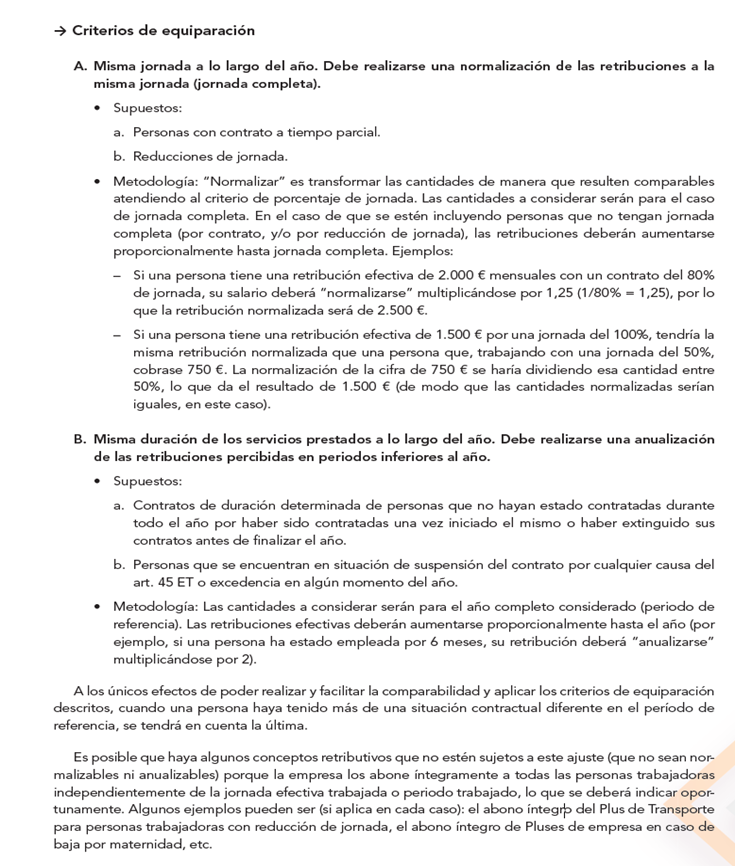
Salary components that can be normalised and annualised in the pay register:
Within the equality plan, salary components in the pay register must be either normalised or annualised:
- Normalising means converting amounts so that they are comparable on the basis of the proportion of working hours.
- Annualising means converting amounts so that they are comparable on the basis of equivalent components in respect of services rendered over the course of a year.
Example:
Who can access the Pay Register and how
Access to the Pay Register through employee representatives
Employees have the right to access their company's pay register in full, through their legal employee representatives.
CAN EMPLOYEE REPRESENTATIVES ACCESS SALARY DATA FROM THE EQUALITY PLAN OR THE PAY AUDIT?
Accessing the pay register without employee representatives
Where there are no employee representatives, the company is not obliged to provide averaged figures for the actual amounts recorded in the pay register. Instead, the information must be limited to the percentage differences in the averaged pay of men and women.
This information must also be broken down:
- by type of remuneration
- by the applicable classification system
Obligation to publish the salaries of men and women in companies with more than 100 employees:
The new Directive of the European Parliament and of the Council, to strengthen the application of the principle of equal pay for men and women for equal work or work of equal value through pay transparency measures and enforcement mechanisms, requires companies with more than 100 employees to publish on a regular basis the salaries paid to both men and women in equivalent roles.
The objective of this Directive is to narrow the gender pay gap, which as of 2023 stands at 13% to the detriment of women.
In addition, companies will be required to:
- carry out the pay assessment jointly with employee representatives,
- the Directive provides that employees may request from their employer information about their own salary level and the average pay provided to other employees performing the same work
- companies will be required to disclose the salary they intend to pay when advertising a vacancy or when interviewing a prospective employee,
- companies may not ask candidates about their salary history.
- Workers who have been discriminated against on grounds of gender will be entitled to compensation, including the retroactive recovery of salary and any bonuses or other remuneration.
How often must the Pay Register be prepared?
All companies must produce the Pay Register once per calendar year.
If there are any material changes to any of the elements included in the pay register, it must be updated and amended to ensure that its purpose continues to be met, namely, to guarantee transparency in the composition of remuneration, in an accurate and up-to-date manner, and to ensure appropriate access to companies' pay information.
Difference between the Pay Register and the Pay Audit
See the following link for an overview of the differences between the Pay Register and the Pay Audit.

Equality plan pricing and quotes
Conesa Legal offers a full service for preparing the Pay Register, including an assessment of the data gathered and an analysis of any potential justification where pay gaps are identified, demonstrating that such differences are not attributable to the sex of the workers concerned. Request a quote using the link below:

Do you need help with payroll compliance?
If you are looking for efficiency and professionalism in managing your payroll obligations, speak to our specialists: