
.jpg)
It is common knowledge that foreign nationals without a work permit (undocumented) regularly work in domestic settings, carrying out cleaning duties or caring for elderly people, giving rise to an unregistered employment relationship.

We strongly recommend regularising the situation of any domestic employees providing cleaning or elderly care services, because, even without the relevant documentation, all the rights and obligations arising from this special employment relationship, domestic workers and household staff, remain fully in force.

This means there is an obligation to make Social Security contributions. Furthermore, the Law on Infringements and Sanctions in the Social Order (LISOS) and Organic Law 4/2000 of 11 January on the rights and freedoms of foreign nationals in Spain both provide for penalties against the household employer, both for failure to make the required contributions and for employing a foreign national without the appropriate authorisation.
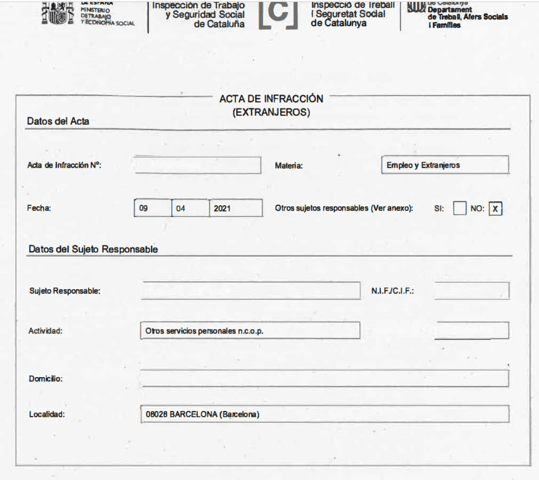
Proving arraigo (residence by social/family/employment ties) before the Court:
Problems arise when the head of household loses confidence in the domestic worker, or when the employer or head of family falls ill or passes away and the worker's services are no longer required.
One of the defining features of everything related to residence and work permits in immigration law is the constantly shifting criteria for proving the requirements needed to obtain those permits, compounded by the chaotic process surrounding the submission of the relevant applications.
In this context, for just over a year now, the Immigration Office has been requiring foreign workers to prove arraigo (residence by social/family/employment ties) by providing evidence of judicial conciliation proceedings (conducted before the employment tribunal, not through an administrative conciliation record issued by bodies such as CEMAC or Mediation, Arbitration and Conciliation Service (SMAC)).
It is precisely when a dismissal occurs that the foreign national asserts their rights before the Court, seeking recognition of the employment relationship in order to subsequently obtain a residence permit and work permit.
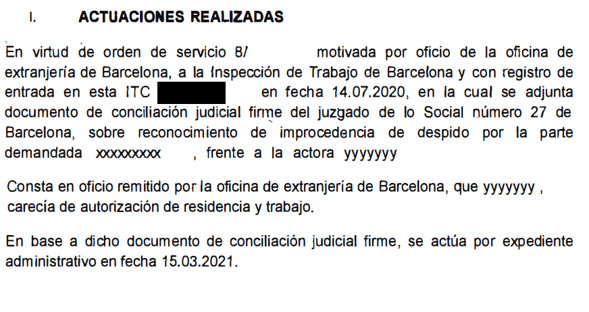
Referral of the conciliation record to the LABOUR INSPECTORATE:
We are now seeing for the first time, and only very recently, that the judicial conciliation record is being forwarded to the Immigration Office, which in turn refers it to the Labour Inspectorate.
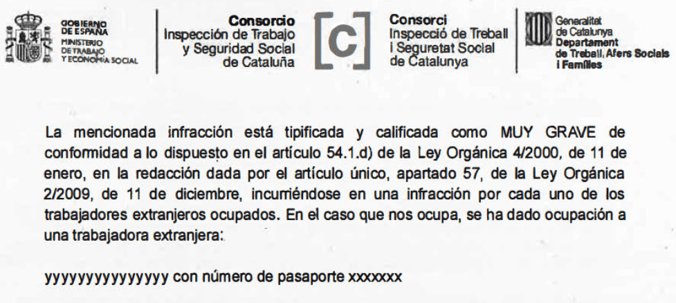
€10,000 fine imposed by the Labour Inspectorate for hiring a foreign national without authorisation:
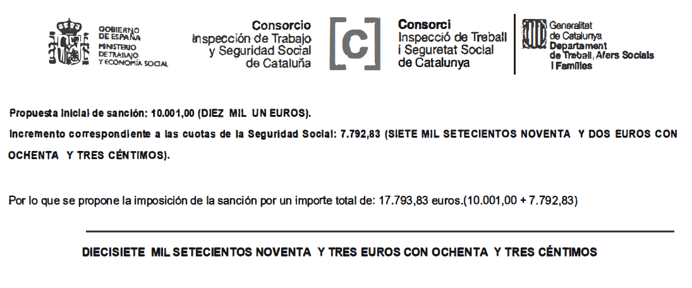
The Labour Inspectorate is invoking Articles 36.1, 36.4 and 54.1(d) of Organic Law 4/2000 of 11 January on the rights and freedoms of foreign nationals in Spain and their social integration, to impose a €10,000 penalty on the employer, in addition to demanding payment of outstanding Social Security contributions.
The following document contains the proposed €10,000 penalty notice.
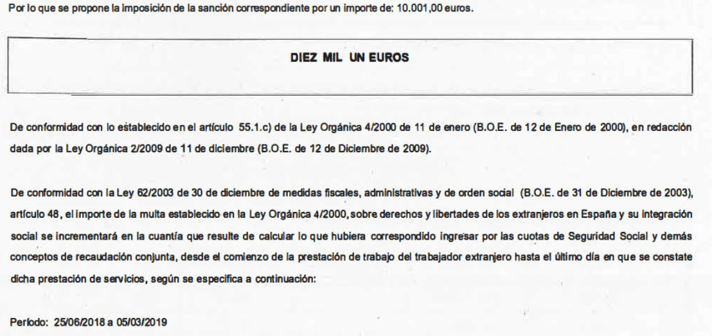
SOCIAL SECURITY CONTRIBUTIONS FOR THE LAST 4 YEARS WITH A 20% SURCHARGE
In addition, the Labour Inspectorate is claiming a further €7,792.83 in unpaid contributions, bringing the total amount claimed from the employer in this case to €17,093.83
Regularising the situation of domestic workers:
It has always been difficult to defend the household employer against claims brought by domestic workers. When Labour Inspectorate enforcement sanctions are added to the mix, reaching settlements becomes even more challenging.
To regularise the situation of foreign domestic workers who do not hold valid documentation, we strongly recommend engaging specialist immigration lawyers to handle their immigration proceedings, and employment lawyers to manage the registration, contracting and Social Security contribution formalities in accordance with the regulations governing domestic employment.

CONTACT AN employment lawyer OR A SPECIALIST IMMIGRATION LAWYER: