
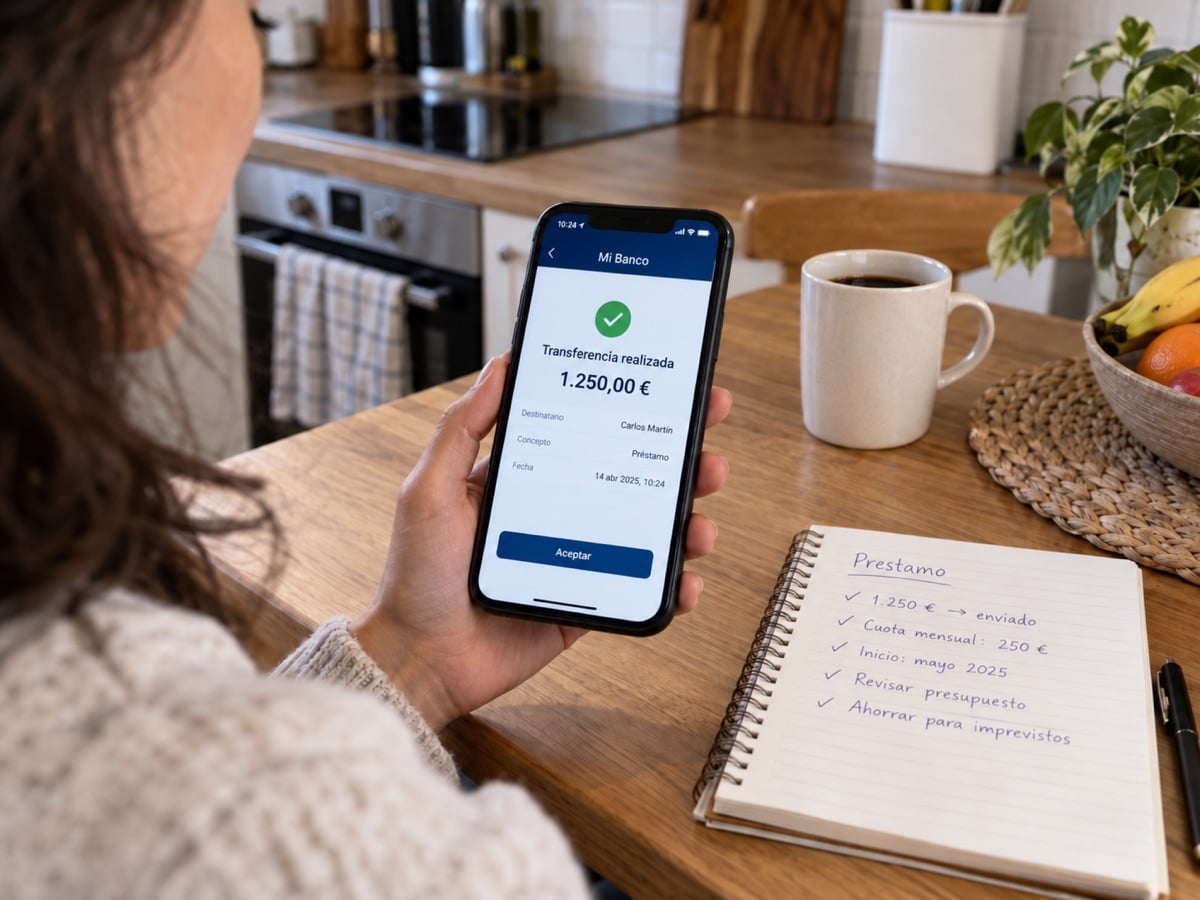
You lent money to a friend, a family member, or a shareholder. Nothing was signed, because at the time no one thought it would be necessary. Now the money has not come back, and the question is whether you can pursue a claim without a contract. You can. A loan exists from the moment the money is handed over with an obligation to repay it, and what determines the outcome of the case is not the missing paperwork, but the evidence you are able to gather.

A loan without a contract exists, but you have to prove it
The Spanish Civil Code defines a money loan in Articles 1740 and 1753: one party transfers money and the other becomes obliged to return an equivalent amount. Neither article requires the agreement to be in writing. A verbal loan, or one agreed by message, is just as valid as one signed before a notary.
The difference lies in proof. The person making the claim must establish two facts, pursuant to Article 217.2 of the Civil Procedure Act: that the money was transferred, and that it was transferred with an expectation of repayment. The first is usually straightforward. The second is where disputes arise, because a bank transfer on its own could be a loan, a payment for something, or a gift.
That is why the work begins well before any court filing. It involves reconstructing the full picture of the transaction using everything that left a trace, and identifying the gaps in that picture before the debtor does.
What counts as evidence when there is no contract
Article 299 of the Civil Procedure Act admits any means of proof, and its second paragraph expressly includes media that reproduce speech, sound and image, as well as instruments that store data. Messaging conversations, emails and bank statements all fall within that category. In practice, the following tend to carry the most weight:
- The transfer and its reference. A payment reference such as "loan" or "I'll pay you back in March" establishes the nature of the transaction at the moment it took place, when no one had any reason to lie. This carries far more weight than any subsequent explanation.
- Messages. Those requesting the money, those promising to repay it, those asking for more time. Equally important are silences: if you made a written demand and the debtor did not deny owing anything, that unanswered message is evidence.
- Partial repayments. Any amount repaid, however small, is an act of acknowledgement of the debt. Nobody pays back a gift.
- Witnesses. People who were present when the agreement was made, or to whom the borrower mentioned the loan. Their evidential value is lower than that of a document, but they help build the overall picture.
- Subsequent conduct. A debtor who proposes a repayment schedule, apologises for the delay, or offers to pay part of the sum is acknowledging the obligation, even if they never put anything in writing.
On the subject of private documents, Article 326 of the Civil Procedure Act provides that they constitute full proof if the party prejudiced by them does not challenge their authenticity. If they do challenge it, expert comparison or any other form of evidence may be used, and the court assesses them according to the rules of reasoned judicial evaluation. In the case of messages, it is advisable to preserve the original device and, if the amount warrants it, to obtain a notarial record or expert report of the conversation before it is lost.
The hardest scenario: cash handed over in person
Without a bank transfer, the handover itself becomes the first hurdle. In these cases, proof is built up indirectly: a bank statement showing a cash withdrawal on the date of the loan, a corresponding deposit or expenditure on the borrower's side, witnesses to the handover, and, above all, subsequent messages in which the debtor refers to the money as something they owe. It is possible to win a case like this, but it requires considerably more groundwork and an honest assessment of the odds before proceedings are issued.
"It was a gift": how this defence is dealt with
This is the most common defence, and simply raising it is not enough. Article 217.3 of the Civil Procedure Act places the burden of proving facts that extinguish or neutralise the claim on the defendant, and a gift is one such fact. The person who says the money was a gift must prove that it was.
The Spanish Civil Code adds a formal requirement. Under Article 632, the gift of a movable asset, and money is one, may be made verbally, but a verbal gift requires simultaneous delivery. If that did not occur, the gift is only valid if it is recorded in writing, with acceptance in the same form. A debtor who claims that money received in several bank transfers, or months after the matter was first discussed, was a gift faces a heavier evidential burden than the creditor does.
What ultimately decides these cases is the conduct of the parties. If the debtor repaid some of the money, asked for more time, or failed to deny the debt when it was first demanded, their version of events, that it was a gift, is weakened by each one of those acts.
Before taking legal action: the formal demand and the mandatory attempt at settlement
Two preliminary steps, and the order matters.
The first is the formal payment demand: a burofax (certified recorded delivery letter) with proof of content, or a notarial demand. This has three effects. It places the debtor in default under Article 1100 of the Spanish Civil Code, meaning interest begins to accrue from that point. It interrupts the limitation period under Article 1973. And it creates a written record that repayment has been formally requested, which, in a loan with no agreed repayment date, marks the first clear milestone in the timeline.
The second is the attempt at settlement, which has been mandatory since 3 April 2025. Article 5 of Organic Law 1/2025 makes recourse to an appropriate dispute resolution mechanism a procedural requirement for any civil claim, and loan recovery claims are not among the exceptions. If this requirement is not met, the court will not accept the claim. The law allows for a wide range of ways to satisfy this requirement: mediation, conciliation, a confidential binding offer, or direct negotiation between the parties or their lawyers, provided it is properly documented. Where the personal relationship still allows for it, one option is to initiate an online out-of-court negotiation that creates a record of the proposal and the response.
This step also carries two consequences that work in the creditor's favour. The request for negotiation interrupts the limitation period under Article 7 of the same law, and if the debtor fails to respond within thirty calendar days, the path to litigation is open. If an agreement is reached, it can be formalised before a notary and enforced directly in the event of breach, without the need for court proceedings.
Which court procedure applies when there is no contract
It depends on two factors: the documents available and the amount claimed.
The payment order procedure (proceso monitorio) is designed for documented monetary debts. Article 812 of the Spanish Civil Procedure Act makes it available for any amount, but requires that the debt be evidenced by documents signed by the debtor, bearing their seal, stamp or mark, or any other physical or electronic identifier, or by documents created by the creditor that are customary in that type of transaction. A signed acknowledgement of debt, even if drawn up after the loan was made, opens the payment order procedure without difficulty. Where only bank transfers and messages are available, admission to the procedure depends on the court and on how clear those messages are, and it is worth assessing this on a case-by-case basis. We explain the full procedure in our guide on the payment order procedure.
If no suitable document exists, the route is a declaratory claim: a summary procedure for amounts up to fifteen thousand euros, and ordinary proceedings above that threshold, in accordance with Articles 249 and 250 of the Civil Procedure Act. For summary claims below two thousand euros, legal representation is not mandatory, though in a case decided on evidence, the absence of a lawyer is most keenly felt.
As a general rule, the competent court is that of the debtor's place of residence.
Interest and time limits for claims
Without an express agreement, a loan does not accrue interest, pursuant to Article 1755 of the Spanish Civil Code. What does accrue is default interest: once the debtor is in default, statutory interest on money becomes due under Article 1108, and from the date of the ruling ordering payment, statutory interest plus two percentage points applies under Article 576 of the Civil Procedure Act. This is why sending a formal demand promptly matters: every month without a demand is a month of interest that cannot be recovered.
The time limit for bringing a claim is five years from the date on which repayment could first have been demanded, under Article 1964.2 of the Spanish Civil Code. The limitation period is interrupted by each documented out-of-court demand, by a request to enter into prior negotiations, and by any act in which the debtor acknowledges the debt, after which it restarts from zero. Loans made before 7 October 2015 are governed by the fifth transitional provision of Law 42/2015: unless the limitation period was interrupted, those debts are now time-barred.
If the loan had no fixed repayment date, determining when the time limit begins to run requires a case-by-case analysis. The practical recommendation is not to wait: sending a written demand as soon as possible establishes the starting point and protects the claim.
If you succeed: enforcement
The ruling, or the court order closing an order-for-payment procedure without opposition, allows enforcement to be requested. The court may order the seizure of bank accounts, wages above the minimum salary in accordance with the scale set out in Article 607 of the Civil Procedure Act, vehicles, and real estate. If the creditor does not know what assets the debtor holds, Article 590 allows a request for the court to investigate through banks, public bodies, and registries.
And if there is nothing to seize today, the debt does not disappear. The right to enforce a ruling lasts five years from the date it becomes final, under Article 518, and once enforcement proceedings are opened they continue until payment is made.
And if someone brings a claim against you for a loan that never existed
The same rules protect the borrower. The party bringing the claim must prove that the money was handed over and that there was an obligation to repay it, if they cannot do so, the claim will be dismissed. There are valid defences where the money was payment for a service or a gift made at the same time, where it has already been repaid, where more than five years have passed without any documented claim, or where the interest being demanded is disproportionate. In summary proceedings, any objection must be filed within twenty days of receiving the payment order; letting that deadline lapse means losing the right to contest the debt.
How we handle these cases
Before filing a claim, we review the available evidence and give you a frank assessment of whether it is sufficient, which legal route is appropriate, and what the matter is likely to cost. From there, we proceed with the payment demand, an attempt at a documented settlement, and, if necessary, the claim and enforcement proceedings. Full details of the service, including the timeframes and figures that determine the outcome of these cases, can be found on our page for lawyers handling private loan claims. If the loan was between family members, it is also worth reviewing how it was documented with the Spanish Tax Authority: we explain this in our guide on family loans and gifts.