

The Labour Minister's statements acknowledging a legislative error (the removal of a ground for nullity from Articles 53 and 54 of the Workers' Statute), along with her warning to companies not to take advantage and carry out dismissals, have caused considerable media stir.
a deal struck behind the scenes:
We believe those statements are largely playing to the gallery, and that behind them lies an intention to soften the nullity risk that arose whenever an employee requested a working hours adjustment (as distinct from a reduction in hours for childcare purposes). We reach this conclusion, and expect the legislator will not correct it, because if every time an employee requested a working hours adjustment the company risked having any resulting dismissal declared null and void, this new right to adjustment would become a shield for the employee and an enormous constraint for employers.
At Conesa Legal, we specialise in employment law. That is why we can see the theatre being performed on stage, while sensing exactly what is happening behind the scenes.
nullity protection removed for working hours adjustment requests:
The fundamental change is that Articles 53 and 54 of the Workers' Statute, which govern the consequences of objective dismissal and unfair dismissal, no longer include as a ground for nullity the protection previously set out in Article 34.8 of the Workers' Statute, under which employees have the right to request adjustments to the length and distribution of their working hours.

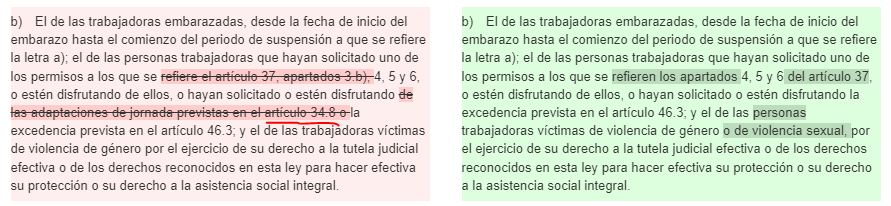
Article 34.8 of the Workers' Statute (see our post on this topic) provides that:
8. Employees have the right to request adjustments to the duration and organisation of their working hours, to the arrangement of working time, and to the manner in which work is performed, including remote working, in order to effectively exercise their right to work-life balance. Such adjustments must be reasonable and proportionate in relation to the needs of the employee and the organisational or operational needs of the company.
Where employees have children, they are entitled to make such a request until the child or children reach the age of twelve.
This right also applies to employees with caring responsibilities for children over the age of twelve, a spouse or civil partner, blood relatives up to the second degree, or other dependent persons who, in the latter case, live in the same household and who, due to age, accident or illness, are unable to care for themselves. Employees must provide justification for the circumstances on which their request is based.
Collective bargaining agreements may, in compliance with the provisions of this section, set out the terms governing the exercise of this right, which must be framed around criteria and mechanisms that guarantee the absence of discrimination, both direct and indirect, on grounds of sex. In the absence of such an agreement, upon receiving a request from an employee, the company must open a negotiation process with the employee, which must be conducted as swiftly as possible and, in any event, within a maximum period of fifteen days; the request shall be deemed granted if no express and reasoned objection is raised within that period.
Once the negotiation process has concluded, the company must notify the employee in writing of its acceptance of the request. If it does not accept, it must either put forward an alternative proposal that accommodates the employee's work-life balance needs, or formally communicate its refusal. Where an alternative proposal is made or the request is refused, the objective reasons underpinning the decision must be set out.
The employee shall have the right to revert to the situation prior to the adjustment once the agreed or anticipated period has ended, or when the circumstances that prompted the request no longer apply.
In all other cases, where a change in circumstances so justifies it, the company may only refuse a requested reversion where there are objective, duly reasoned grounds for doing so.
The foregoing provisions are understood, in all cases, without prejudice to any leave entitlements the employee may have in accordance with Articles 37 and 48 bis.
Any disputes arising between the company's management and the employee shall be resolved by the employment jurisdiction, through the procedure set out in Article 139 of Act 36/2011, of 10 October, regulating employment jurisdiction.
nullity is maintained where a reduction in working hours exists
This right is quite distinct from the one provided under Article 37.6 of the Workers' Statute, which remains unchanged, and continues to be considered null and void by operation of law, and which provides that "anyone who, on grounds of legal guardianship, has direct care of a child under the age of twelve or of a person with a disability who does not carry out a paid activity shall be entitled to a reduction in their daily working hours, with a proportional reduction in salary of between, at least, one eighth and a maximum of one half of its duration."
If you have any questions, please contact our specialists:


Article written by Josep Conesa, employment lawyer