

.jpg)

WE ARE SPECIALISTS:
-1.jpg?width=117&name=shutterstock_1459857380%20(2)-1.jpg)
we recommend the following highlights SUMMARISING THE KEY UPDATES:

information updated as of 29/03/2020:
new covid-19 paid leave scheme:
The following link sets out the conditions for negotiating this scheme through employee representatives, and the deadline of 31/12/2020 by which the hours must be made up:

INFORMATION UPDATED AS OF 24/03/2020
I AM AN company: HOW DO I PROCESS THE Public Employment Service (SEPE) CLAIM?
A specific procedure has been put in place under which it is the company that must submit a collective application to the Public Employment Service (SEPE), listing all employees affected by a contract suspension or temporary reduction of working hours. This application will form the basis for the subsequent recognition and processing of benefits to be carried out swiftly. SEE THE FOLLOWING TWO DOCUMENTS:

INFORMATION UPDATED AS OF 24/03/2020
What can I do if I am self-employed?

What can I do if I run out of liquidity?

Information updated as of 19/03/2020 by our team:
HOW DO WE INTERPRET THE Temporary Layoff Procedure (ERTE) COVID-19?
Deadline for submission:
The regulations do not set a specific deadline beyond which a Temporary Layoff Procedure (ERTE) may no longer be submitted. The law states that it may be filed for as long as the extraordinary situation arising from Covid-19 persists.
SHOULD I SUBMIT A Temporary Layoff Procedure (ERTE) COVID-19?
The law states that:
"Suspensions of contract and reductions in working hours that are directly caused by loss of activity as a result of COVID-19, including the declaration of the state of emergency, entailing the suspension or cancellation of activities, the temporary closure of premises open to the public, restrictions on public transport and, more generally, on the movement of persons and/or goods, shortages of supplies that seriously prevent the normal continuation of business activity, or urgent and extraordinary circumstances arising from contagion among the workforce or the implementation of preventive isolation measures ordered by the health authorities, duly evidenced, shall be regarded as stemming from a situation of force majeure, with the consequences set out in Article 47 of the consolidated text of the Workers' Statute, approved by Royal Legislative Decree 2/2015 of 23 October."
Annex listing activities that justify force majeure under the Royal Decree
Article 10. Containment measures in the areas of commercial activity, cultural venues, establishments and recreational activities, hospitality and catering, and additional measures.
1. The opening of retail premises and establishments to the public is suspended, with the exception of retail outlets selling food, beverages, essential products and goods, pharmacies, healthcare establishments, veterinary centres or clinics, opticians and orthopaedic product suppliers, hygiene products, press and stationery, automotive fuel, tobacconists, technology and telecommunications equipment, pet food, internet, telephone and mail-order retail, dry cleaners, laundries, and the professional practice of hairdressing services provided at the client's home. In any event, any establishment deemed by the competent authority to pose a risk of contagion due to the conditions in which it is operating shall be required to suspend its activity.
2. Customers may only remain on the premises of establishments permitted to remain open for as long as is strictly necessary to complete the purchase of food and essential products. On-site consumption of products within those establishments is suspended.
In all cases, gatherings must be avoided, and customers and staff must be required to maintain a safety distance of at least one metre in order to prevent possible contagion.
3. The opening to the public of museums, archives, libraries, monuments, as well as premises and establishments hosting public performances, sporting activities and leisure activities listed in the annex to this Royal Decree is suspended.
4. Hospitality and catering activities are suspended, with the sole exception of home delivery services.
5. Street festivals, parades and public celebrations are likewise suspended.
WHAT OBLIGATIONS DOES THE Temporary Layoff Procedure (ERTE) COVID-19 IMPOSE ON ME?
The company commits to maintaining employment for a period of 6 months from the resumption of activity.
contact marta soler for assistance:

IF YOU NEED TEMPLATES TO PREPARE A Temporary Layoff Procedure (ERTE) COVID-19 OR Collective Dismissal Procedure (ERE):

DOWNLOAD


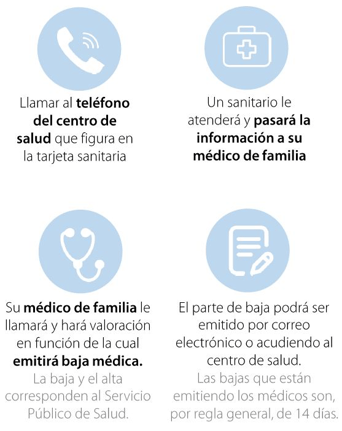
HOW TO PROCESS MEDICAL LEAVE FOR CORONAVIRUS THROUGH Social Security?
information updated as of 18/03/2020 by our team:
BELOW IS THE CONTENT OF THE Royal Decree-Law ON EXTRAORDINARY URGENT MEASURES TO ADDRESS THE ECONOMIC AND SOCIAL IMPACT OF COVID-19:

Click the image to download the Spanish Official Gazette (BOE)
1.- Temporary Layoff Procedure (ERTE) on grounds of force majeure:
MEASURES TO FLEX TEMPORARY ACTIVITY ADJUSTMENT MECHANISMS IN ORDER TO AVOID DISMISSALS: EMPLOYMENT MEASURES RELATING TO Temporary Layoff Procedure (ERTE) PROCEDURES AND DISMISSALS.
when force majeure is recognised in the context of the COVID-19 crisis
- Contract suspensions and working hour reductions that are directly caused by loss of business activity as a result of Covid-19, including those arising from the declaration of a state of alarm, which involve the suspension or cancellation of activities, temporary closure of premises open to the public, restrictions on public transport and, more generally, on the movement of persons and/or goods, or supply shortages that seriously prevent the normal conduct of business, or alternatively situations of an urgent and extraordinary nature arising from contagion among the workforce or the adoption of preventive isolation measures ordered by the health authorities, provided these are duly evidenced, shall be classified as resulting from a situation of force majeure, with the consequences set out in Article 47 of the Workers' Statute.
PROCEDURE FOR PROCESSING APPLICATIONS FOR CONTRACT SUSPENSION AND WORKING HOUR REDUCTIONS:
- a) The procedure shall be initiated by means of an application submitted by the company, accompanied by a report establishing the link between the loss of activity and Covid-19, and, where applicable, the relevant supporting documentation. The company must notify its application to the employees concerned and forward the above report and any supporting documentation to their representatives.
APPROVAL BY THE LABOUR AUTHORITY:
- b) The existence of force majeure as the grounds for contract suspension or working hour reduction under this article must be confirmed by the labour authority, regardless of the number of employees affected.
- c) The labour authority's decision shall be issued within five days of the application being submitted, following a report from the Labour and Social Security Inspectorate where applicable, and shall be limited to confirming the existence, where appropriate, of the force majeure invoked by the relevant company. It shall fall to the company (the company) to decide whether to apply measures of contract suspension or working hour reduction, which shall take effect from the date of the event giving rise to the force majeure.
SOCIAL SECURITY CONTRIBUTIONS DURING THE PERIOD OF SUSPENSION OR REDUCTION OF WORKING HOURS:
In cases of temporary force majeure linked to Covid-19, the General Social Security Treasury (TGSS) shall exempt the company from paying the employer's contribution provided for in Article 273.2 of the Consolidated Text of the General Social Security Act, approved by Royal Legislative Decree 8/2015, of 30 October, as well as from contributions under jointly collected headings, for the duration of the authorised period of contract suspension or working hours reduction on the basis of that ground, where the company, as of 29 February 2020, had fewer than 50 workers registered with Social Security. Where the company had 50 or more workers the exemption from the obligation to contribute shall apply to 75% of the employer's contribution.
2. This exemption shall have no effect on the worker, and the period in question shall continue to be treated as a period of actual contributions for all purposes, with Article 20 of the General Social Security Act not being applicable.
3. The General Social Security Treasury (TGSS) shall apply this exemption at the employer's request, following notification of the identity of the workers concerned and the period of suspension or reduction of working hours. The General Social Security Treasury (TGSS) shall carry out oversight through the Public Employment Service (SEPE) by verifying the periods during which unemployment benefits are being received.
ACCORDINGLY, FOR THE DURATION OF THE force majeure, THE company SHALL ONLY CONTRIBUTE:
- 100% of the employer's contribution in the case of companies with fewer than 50 workers.
- 75% where the company has 50 or more workers.
2.- Temporary Layoff Procedure (ERTE) for suspension or reduction of working hours on economic, technical, organisational and production grounds
Where the company decides to proceed with a suspension or reduction on objective grounds related to COVID-19, trade union oversight is strengthened:
- a) Where there is no existing legal employee representation, the representative committee for the purposes of negotiating the consultation period shall be composed of the most representative trade unions in the sector to which the company belongs and which are entitled to participate in the negotiating committee of the applicable collective bargaining agreement. The committee shall include one representative from each qualifying trade union, with decisions taken by the corresponding representative majorities. If no such representation is formed, the committee shall be composed of three employees of the company itself, elected in accordance with Article 41.4 of the Workers' Statute.
In any of the above scenarios, the representative committee must be constituted within a strict, non-extendable period of 5 days.
PROCEDURE:
- b) The consultation period between the company and the employee representatives or the representative committee referred to above must not exceed a maximum period of seven days.
- c) The report from the Labour and Social Security Inspectorate, which the relevant labour authority may request at its discretion, must be issued within a strict, non-extendable period of seven days.
UNEMPLOYMENT BENEFIT DURING CONTRACT SUSPENSIONS AND WORKING HOURS REDUCTIONS:
- NO MINIMUM CONTRIBUTION PERIOD REQUIRED a) Affected employees are entitled to contributory unemployment benefit even if they have not accumulated the minimum required contribution period.
- BENEFIT ENTITLEMENT IS NOT REDUCED b) Any period during which contributory unemployment benefit is received as a direct consequence of the aforementioned extraordinary circumstances does not count towards the maximum benefit periods established under current legislation.
Do you find this useful?

.svg.png?width=108&name=240px-Facebook_f_logo_(2019).svg.png)
our recommendation is: stay home!
but if you need to travel to work, here is a SAFE-CONDUCT PASS:
information PROVIDED BEFORE THE DECLARATION OF THE STATE OF EMERGENCY, as of 12/03/2020, by our team:

We are watching with growing concern, for both public health and the economy, as the coronavirus begins to affect day-to-day operations and the financial wellbeing of businesses.
At Conesa Legal, we want you to know that we are fully available to assist you with any matter relating to the management of the business consequences of this disease. We would also like to reassure you that Conesa Legal has been operating in the cloud for several years, meaning that all of our staff can work remotely from home without any disruption to our service.
We strongly encourage you to watch the video provided at the end of this communication. We also hope that you will approach this emergency from the standpoint of corporate social responsibility: the measures recommended by the health authorities are aimed at the common good and at preventing the healthcare system from becoming overwhelmed.
Any decisions you take will be assessed in the context of the extraordinary emergency situation we are all facing.

CAN AN employee REFUSE TO WORK DUE TO CORONAVIRUS?
("Note updated as of 19/03/20: Article 316 of the Spanish Criminal Code penalises those who, in breach of occupational health and safety regulations and being legally required to comply, fail to provide the means necessary for workers to carry out their duties with adequate health and safety measures in place, thereby seriously endangering workers' lives, health or physical integrity.
Article 317 (LA LEY 3996/1995) makes this a criminal offence where it results from gross negligence.
Given the known dangers and transmissibility of the disease, and the high risk of infection in the workplace, it is highly debatable whether an employer can lawfully compel an employee to attend the workplace. Depending on the sector and specific circumstances, any disciplinary sanctions imposed on an employee who refuses to attend could even be deemed unlawful. Moreover, we believe the employee could legitimately refuse to attend or report the absence of adequate safety measures to the relevant authorities, given the evident risk of contagion.
Should the company refuse to implement the required health and safety measures, it may face administrative penalties under the Law on Infringements and Sanctions in the Social Order, or even, as noted above, criminal consequences.)
12/03/20: We are facing an exceptional situation. This is a scenario of force majeure requiring employment-related measures to be adopted. At our firm, we have had occasion to handle employment regulation procedures on grounds of force majeure. I recall one case in which both directors of a company were detained indefinitely, and neither the employees nor anyone else could access the workplace because the premises had been shut down. We are waiting for the government to clarify whether the confinement of an entire population constitutes force majeure.
Coronavirus may not affect us through its direct severity, but it can certainly do so through the consequences of potential isolation or confinement.
That said, companys are legally required to provide a safe working environment.
The first priority is therefore to put in place all necessary measures to prevent the risk of contagion by applying occupational health and safety protocols. Staying at home is also one such measure.
We will not go into further detail here, the best guidance is provided by the Spanish Ministry of Health at the link below:
If the risk of infection in the company is evident, and the employee can prove that a risk to their health exists, they may be able to invoke Article 21 of the Occupational Risk Prevention Act, which states that:
"in accordance with the provisions of Article 14(1) of this Act (which grants the employee the right to effective protection in matters of occupational health and safety), the employee shall have the right to interrupt their activity and leave the workplace, where necessary, if they consider that such activity poses a serious and imminent risk to their life or health."
Could this be considered an excessive reaction on the part of the employee? That remains to be seen, but what we are witnessing is an exceptional situation in which the reasons behind such decisions, both by companies and by workers, could well be judged as justified.
The risk of contagion is high, and although it is more debatable whether the illness is severe, given that 80% of cases present with mild symptoms, it is the most vulnerable individuals who face the greatest risk from this disease.
In our view, therefore, the principle of proportionality must always guide these assessments. It is the company that is responsible for organising staff and the means of production, so it should be justifiable for a employee to leave the workplace without facing consequences in certain circumstances. For example: an employee with underlying health conditions would have far stronger grounds for leaving the workplace, and a judge could reasonably consider such a decision proportionate. By contrast: banking services are considered essential services during a state of emergency, and an employee in that sector would not be justified in abandoning their post.
CAN THE company SEND SOMEONE HOME ON SUSPICION OF CORONAVIRUS?
It has always been possible to grant a employee paid leave and send them home for a few days. The difficulty arises when the employee does not accept this, or when the leave extends beyond a reasonable period, since the company has an obligation to provide the employee with effective work.
Many of our clients are choosing to offer remote working as a precautionary measure, particularly when employees return from travel and need to stay home for a minimum of 14 days.
Given the exceptional circumstances, it would be virtually impossible for a employee to bring a claim seeking termination of contract on the grounds that the company had failed to provide effective work, especially since the situation is temporary.
Where the nature of the work allows it, remote working is therefore a viable alternative, as the company can ask the employee to continue providing their services from home.
What options are available in a critical COVID-19 situation?
With agreement, whether individual or collective, anything is possible within the statutory minimums. Article 45.1.a) allows employers and employees to temporarily suspend their employment contract. In that case, both the obligation to pay and the obligation to provide services would cease.
Otherwise, contracts may only be suspended or terminated through the appropriate legal procedure, namely, the employment regulation procedure on grounds of force majeure, which may be initiated by the company or by the employees themselves.
If a company finds itself in difficulty as a result of a coronavirus outbreak, Article 47 of the Workers' Statute provides a legal mechanism allowing the suspension of an employment contract on technical, organisational, economic or production grounds. It is likely that a temporary closure could be justified "on grounds of force majeure".
Given that the company is required to ensure a healthy working environment for the employee, it may be necessary to apply this measure and process an employment regulation procedure suspending one or more employment contracts. We would also recommend citing economic, organisational and production grounds alongside force majeure, as these circumstances are typically present simultaneously.
It should be noted that the Temporary Layoff Procedure (ERTE) procedure for suspending employment contracts is required regardless of the number of employees affected at the company.
PROCEDURE for suspending employment contracts in the context of coronavirus:
We are awaiting the Government's formal declaration of the State of Emergency and the legislation needed to clarify specific scenarios and streamline current procedures. In the meantime, there are three routes available for suspending employment contracts:
1.- MUTUAL AGREEMENT
As discussed above, the parties may agree on any arrangement that does not fall below the statutory minimum standards: flexible working, irregular distribution of working hours, changes to holiday schedules, and so forth.
2.- INDIVIDUAL OR COLLECTIVE SUSPENSION WITHOUT A CONSULTATION PERIOD (negotiation with employees):
Provided for under Article 45.1.i, this route allows the individual suspension of the employment contract on grounds of temporary force majeure, with no obligation to pay remuneration during the suspension. We only recommend this option where the Government has officially ordered a cessation of the relevant activity, as it is subject to interpretation by the labour authority and the courts. In the absence of clear evidence of force majeure, there is a significant risk that the suspension will be deemed unjustified.
For example: a government order closing a school is a clear case of force majeure.
For example: if a football club only requires one third of its workforce due to a sharp drop in spectators, a reduction in working hours or suspension of contracts on grounds of force majeure could be justified.
For example: if a cleaning or catering company is directly affected by such a government decision.
If the labour authority does not approve the force majeure claim within 5 days (and it may not be able to meet that deadline), the employer must initiate a collective redundancy procedure with a formal consultation period. The suspension will take effect from the date of the triggering event, and employees will be entitled to claim unemployment benefit.
If approval is not granted, the employer must proceed under the third route, which is based on objective grounds.
3.- COLLECTIVE SUSPENSION ON objective grounds (ECONOMIC, TECHNICAL, ORGANISATIONAL AND PRODUCTION GROUNDS) REQUIRING A CONSULTATION PERIOD:
This may affect one or more employees and is based on economic, technical, organisational or production grounds as the motivating cause for the collective suspension of employment contracts. The labour authority must be notified, regardless of the number of employees affected, following a procedure conducted as if it were a collective dismissal.
The procedure is initiated by an application from the company, accompanied by any supporting evidence deemed necessary and simultaneous notification to the employees' legal representatives (or to those appointed for this purpose if no representatives have been elected, through the procedure set out in Article 41 of the Workers' Statute). Those representatives shall have the status of an interested party throughout the entire procedure.
The employer takes the decision unilaterally, as no approval from the labour authority is required. However, if the labour authority endorses the measure, the Public Employment Service (SEPE) will grant unemployment benefit. If it does not, the company will proceed with the decision and the courts will ultimately determine whether the grounds are legally justified.
HOW LONG CAN THIS MEASURE BE IMPLEMENTED IN RESPONSE TO CORONAVIRUS?
This is a temporary measure. It may involve confinement (ordered by the labour authority) or isolation (decided voluntarily by the company or the employee). Confinement may constitute a valid basis for a claim of force majeure (which must always be demonstrated before the competent administrative or judicial authority). Isolation, on the other hand, would tend to give rise to economic, technical, organisational or production grounds.
We are seeing that confinement for individuals infected with coronavirus can last approximately one month. In our experience handling contract suspensions during previous periods of economic crisis, these have extended to up to one year, and even up to two years, where the firm has been able to explain to the authority the temporary nature of the circumstances giving rise to the measure.
It is also important to note, and please excuse the apparent contradiction, that even where an employment contract has been suspended, that suspension can itself be suspended. In other words, an employee may be receiving unemployment benefit while their contract is temporarily suspended, and yet the company may call them in to work for one, two or several days whenever a specific operational need arises.
CAN THE employee REQUEST TERMINATION OF THE employment contract?
Given the duration of the virus, it would be more difficult for an employee to successfully claim termination of the employment contract on grounds of employer breach, with entitlement to unfair dismissal compensation. Indeed, unless the employee could prove that the company was exposing them to a clear and evident risk, seeking this form of compensated termination would appear to be a rather bold move.
And proving this seems virtually impossible, since no one can say with certainty when or how a person contracts a virus.
We must therefore look at the specific circumstances of each case and the seriousness of the conduct in question. As a general rule, we would be dealing with a common illness that can be contracted at the cinema, in a restaurant or at a funeral, not necessarily at work. That said, the Government has already recognised the status of work-related accident for any sick leave taken, so that the employee receives temporary disability (IT) benefit from the very first day.
As we noted, it is essential to apply common sense and make decisions proportionate to the situation. A theoretical example: if the company wishes to send an employee to an area close to the affected zone and the employee refuses, the conduct could be subject to disciplinary action by the company, but any sanction imposed must be proportionate to the facts, and a dismissal would likely be deemed unfair. By contrast, a suspension of employment and pay might appear more reasonable, though it would ultimately be for the judge to decide whether such a sanction was justified.
The governing principle in employment law is "solve et repete", comply first, then complain, meaning the employee must follow the instruction and challenge it afterwards. However, given the exceptional nature of the situation, it is highly likely that any such case would be assessed through the well-known principle of "in dubio pro operario" (when in doubt, rule in favour of the worker).
In any event, much will depend on how the legislation evolves now that a state of emergency has been declared.
DOES A WORKING HOURS REDUCTION MAKE SENSE IN THE CONTEXT OF CORONAVIRUS?
In addition to suspension of the employment contract, there is also the option of reducing working hours. Specifically, a company may temporarily reduce an employee's working time by between ten and seventy per cent, calculated on the basis of a daily, weekly, monthly or annual reference period.
During the period of reduced working hours, overtime shall not be permitted except in cases of force majeure
THIS INFORMATION WAS UPDATED IN BARCELONA ON 13/03/20:
Today, with the state of emergency declared, we are awaiting the Council of Ministers' announcement on how these measures will be implemented in practice.
The sensible approach is to follow the Government's recommendations.
If you wish to discuss specific cases, please do not hesitate to contact us.
Yours sincerely,
Josep Conesa Sagrera
RECOMMEND AND SHARE:
DOWNLOAD TEMPLATES TO PROCESS A Temporary Layoff Procedure (ERTE):
Tell us who you are so we can help you:
Consult and download the documents required for a Collective Dismissal Procedure (ERE) or Temporary Layoff Procedure (ERTE)::
APPLICABLE LEGISLATION:
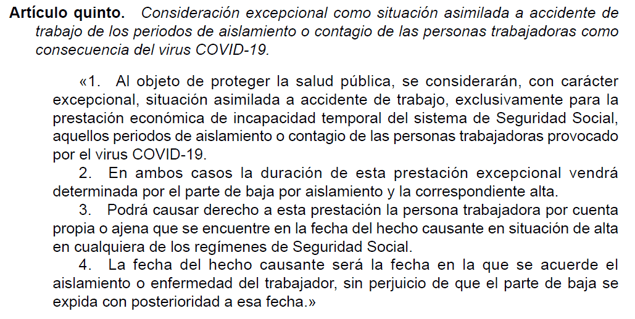
11/03/2020, Sick leave due to isolation is classified as a work-related accident (Royal Decree 6/2020).
OTHER INFORMATION RELATING TO CORONAVIRUS:
Medical and logistical reasons for home isolation.
Still have QUESTIONS?