

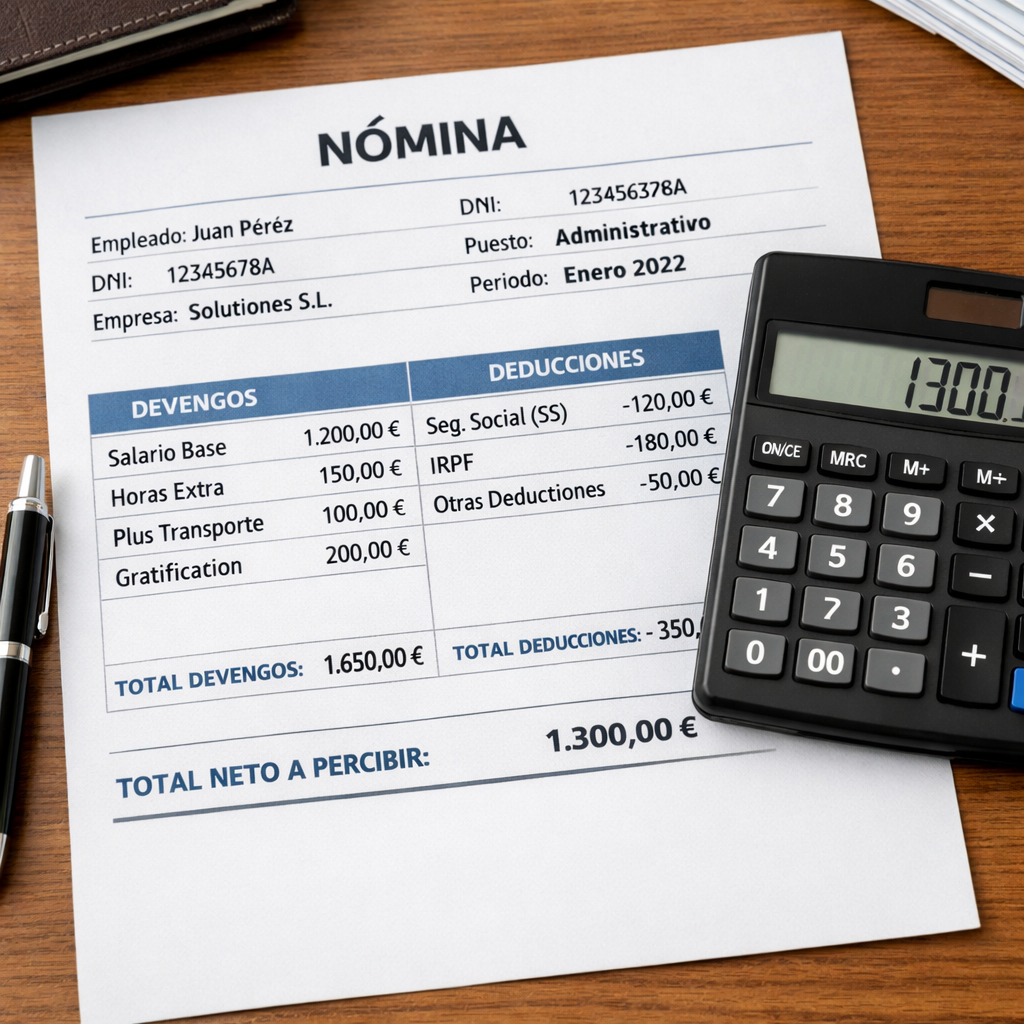
We highlighted in our post on clauses limiting compensation and absorption in collective bargaining agreements that it is possible for a collective bargaining agreement to limit Article 26.5 of the Workers' Statute. We address here the same casuistry in the recently published collective agreement for Offices and Offices for the years 2025, 2026 and 2027.
How payroll increases work in the collective bargaining agreement for offices and firms
In the new wording of the collective bargaining agreement for offices and offices that all payroll professionals need to be aware of, the following wording appears for the first time:
Compensation and absorption
The salaries fixed in annexes 2 (Salary tables year 2025), 4 (Salary tables year 2026) and 6 (Expenses for telecommuting and teleworking) of this Agreement shall be compensable and absorbable in their entirety and in their annual computation by the salaries that are fixed in the companies included in its scope, unless otherwise indicated in the same article.
For the years 2025, 2026 and 2027, the salary increases agreed in this Agreement will not be compensable or absorbable in 75% of gross salaries up to 27,000 euros in global computation, in 50% of gross salaries over 27,000 euros up to 35,000 euros and in 25% of gross salaries over 35,000 euros up to 40,000 euros. These amounts will operate proportionally to the working day of the worker.
In any case, the amounts that have been increased as from January 1, 2025 may be fully compensated and absorbed as payment on account of the increase in the Agreement.

EXPLANATION OF THE FIRST PARAGRAPH
The first paragraph reads as follows:
The salaries fixed in Annexes 2 (Salary tables year 2025), 4 (Salary tables year 2026) and 6 (Remote work and teleworking expenses) of this Agreement shall be compensable and absorbable in full and in their annual computation by the remunerations that are fixed in the companies included in its scope, unless otherwise indicated in the same article.
This paragraph establishes the general rule: the amounts provided for in the wage tables of the collective labor agreement can be offset and absorbed with what the company is already paying.
To put it simply: if a company already pays a worker more than the new salary table of the collective labor agreement, the company can compare the actual annual salary with the annual salary of the collective labor agreement. If the actual salary is already higher, it may not be obliged to raise the full amount provided for in the table.
The key is in the expression "in full and in its annual computation".
This means two things:
- In full: in principle, the company can compensate or absorb the entire difference, not just part of it.
- In annual computation: the comparison is not necessarily made month by month, but by looking at the total salary for the whole year.
Simple example:
- The agreement table sets for 2025 an annual salary of 24,000 euros.
- The company already pays a person 25,000 euros gross per year.
- Since the person is already paid more than the table, the company could argue that it already complies with the agreement and does not have to add an additional increase.
However, the paragraph itself ends with a very important sentence: "unless otherwise stated in the same article".
This means that this general rule may have exceptions within the agreement itself. And precisely the second paragraph introduces a very relevant exception for the years 2025, 2026 and 2027: a part of the agreed salary increases may not be offset or absorbed.
Therefore, the first paragraph says: as a general rule, it can be compensated and absorbed, but it is necessary to review whether the agreement itself establishes any specific protection for certain increases.
EXPLANATION OF THE SECOND PARAGRAPH
The second paragraph reads as follows:
For the years 2025, 2026 and 2027, the salary increases agreed in this Agreement shall not be compensable or absorbable in 75% of the same in gross salaries up to 27,000 euros in global computation, in 50% of the same in gross salaries higher than 27,000 euros up to 35,000 euros and in 25% in gross salaries higher than 35,000 euros up to 40,000 euros. These amounts will operate proportionally to the working day of the employee.
This paragraph introduces a safeguard clause. That is to say, although the general rule allows for compensation and absorption, here the agreement protects a part of the salary increase so that it actually reaches the worker.
To put it simply: during the years 2025, 2026 and 2027, the company will not be able to absorb all of the increase in the collective labor agreement in certain salaries. A part of this increase will have to be paid.
The percentage protected depends on the employee's gross annual salary:
|
Gross annual salary |
Part of the increase that cannot be absorbed |
Part that could be absorbed |
|---|---|---|
|
Up to 27,000 euros |
75% |
25% |
|
More than 27,000 and up to 35,000 euros |
50% |
50% |
|
More than 35,000 and up to 40,000 euros |
25% |
75% |
|
More than 40,000 euros |
The paragraph does not provide express protection |
In principle, the general rule could be applied |
The practical consequence is that, even if a person earns more than the collective agreement, the company cannot simply say: "as you already earn more, I will not apply any of the increase". In those salary brackets, it must respect at least the part of the increase that the agreement declares to be non-compensable and non-absorbable.
A simple example:
- If the increase in the collective agreement were 1,000 euros per year.
- And the person is in the bracket of up to 27,000 euros.
- 75% of this increase, i.e. 750 euros, would have to be paid.
- Only the remaining 25%, i.e. 250 euros, could be absorbed if the person was already paid above the collective labor agreement.
In addition, the paragraph states that these amounts are applied proportionally to the working day. This means that, if the person works part-time, the salary limits and the effects of the clause must be adjusted in proportion to his or her working day.
Example:
- For a full-time person, the first bracket goes up to €27,000.
- For a person working 50% of the working day, the proportional equivalent would be 13,500 euros.
Therefore, the same salary threshold cannot be applied to a full-time employee as to a part-time employee. It must be adapted to the percentage of the working day.
PRACTICAL EXAMPLES FOR EACH SALARY BRACKET
To understand the clause properly, it is important to start from an idea: not the entire salary is protected, but a part of the salary increase agreed in the collective labor agreement.
That is to say, first you have to know what is the increase that should be applied according to the agreement. Then we look at the worker's gross annual salary to find out what part of this increase can be absorbed and what part cannot.
1. Gross salaries up to 27,000 Euros
In this bracket, the agreement protects 75% of the salary increase. That means that the company could only absorb, at most, the remaining 25%.
Example:
- Person's gross annual salary: €25,000.
- Salary increase agreed in the collective labor agreement: 1,200 euros per year.
- Non-absorbable and non-compensable part: 75% of 1,200 euros = 900 euros.
- Potentially absorbable part: 25% of 1,200 euros = 300 euros.
Practical result:
Even if the company already pays above the tables, it would have to apply at least €900 per year increase. It could only try to absorb the remaining 300 euros.
Simply put: in this bracket, most of the increase is protected.
2. Gross salaries above 27,000 euros and up to 35,000 euros
In this bracket, the agreement protects 50% of the salary increase. The other half could be compensated or absorbed if the person already earns above the agreement.
Example:
- Person's gross annual salary: €32,000.
- Salary increase agreed in the collective labor agreement: 1,200 euros per year.
- Non-absorbable and non-compensable part: 50% of 1,200 euros = 600 euros.
- Potentially absorbable part: 50% of 1,200 euros = 600 euros.
Practical result:
The company would have to apply at least 600 euros per year increase. The other 600 euros could be absorbed if the person's actual salary was already above the collective agreement.
To put it simply: in this bracket, the increase is split half and half: one part is protected and the other can be neutralized.
3. Gross salaries above 35,000 euros and up to 40,000 euros
In this bracket, the agreement protects 25% of the salary increase. The remaining 75% could be offset or absorbed.
Example:
- Person's gross annual salary: €38,000.
- Salary increase agreed in the collective labor agreement: 1,200 euros per year.
- Non-absorbable and non-compensable part: 25% of 1,200 euros = 300 euros.
- Potentially absorbable part: 75% of 1,200 euros = 900 euros.
Practical result:
The company would have to apply at least €300 per year increase. The other 900 euros could be absorbed if the actual salary already exceeds that provided for in the collective agreement.
To put it simply: in this bracket, the protection exists, but it is lower.
4. Gross salaries in excess of 40,000 euros.
The second paragraph does not expressly mention salaries above 40,000 euros.
Therefore, for these salaries, the most prudent interpretation is that this specific protection of 75%, 50% or 25% does not apply. In principle, the general rule of the first paragraph would again operate: the wages under the agreement would be compensable and absorbable on an annual computation, unless another part of the agreement says otherwise.
Example:
- Gross annual salary of the person: 45,000 euros.
- Salary increase agreed in the collective labor agreement: 1,200 euros per year.
- As the salary exceeds 40,000 euros, the second paragraph does not fix a protected part.
- The company could try to absorb the increase in full, if the actual annual salary is already above the agreement tables.
Practical result:
In these salaries, the company would have more leeway to apply compensation and absorption, unless there is a contractual or conventional clause protecting the rise.
EXPLANATION OF THE THIRD PARAGRAPH ON THE COLLECTIVE BARGAINING AGREEMENT ACCOUNT
The third paragraph reads as follows:
In any case it will be possible to compensate and absorb in full the amounts that have been increased as of January 1, 2025 as payment on account of the increase in Agreement.
This paragraph regulates what is normally known as payment on account of agreement or agreement account.
It refers to cases in which the company, before the increase in the collective labor agreement is published or definitively applied, has already begun to pay an advance amount on account of that future increase.
Simply put: if the company went ahead and paid an amount thinking about the increase in the collective agreement, it will later be able to discount or offset that advance when the definitive increase arrives.
A simple example:
- From January 2025, the company pays 100 euros per month as a "payment on account of the collective agreement".
- Later, it is confirmed that the increase in the collective agreement is equal to 120 euros per month.
- The company does not have to pay an additional 120 euros on top of the 100 euros already paid.
- It will have to regularize only the difference: 20 euros per month.
In this case, the 100 euros already paid are considered an advance on the increase. This is why the agreement allows them to be offset and absorbed in full.
The expression "in any case" is important. It means that this rule operates even if the second paragraph protects a part of the salary increases. In other words, the 75%, 50% or 25% protection does not prevent the company from deducting what it has already paid specifically as an advance on the collective bargaining agreement increase.
But for this rule to be clear, it is advisable for the amount paid by the company to be identified as something similar to:
- "payment on account of collective bargaining agreement";
- "on account of a collective bargaining agreement increase";
- "agreement advance payment";
- "agreement account".
If the company paid an amount without identifying it as an agreement advance, it could be disputed whether it was really a payment on account or whether it was a different wage increase.
Practical example:
- The employee earns 26,000 euros gross per year.
- The applicable salary increase is 1,200 euros per year.
- Being in the bracket of up to 27,000 euros, 75% of the increase would be protected: 900 euros per year.
- But the company had already been paying since January 2025 a "payment on account agreement" of 600 euros per year.
Result:
- The company can count these 600 euros as part of the protected increase.
- It would not have to pay 900 euros plus another 600 euros.
- It would have to ensure that the person receives, at least, the non-absorbable part that corresponds after deducting what has already been advanced.
Simply put, the settlement account avoids duplicate payments. If the company has already advanced part of the increase, this advance is taken into account when calculating what remains to be paid.
The practical conclusion is that this third paragraph protects the company against duplication, while the second paragraph protects employees against total absorption of the increase. Both paragraphs coexist: the corresponding part of the non-absorbable increase must be paid, but deducting what has already been clearly paid as an advance payment of the agreement.
Payroll specialist and labor lawyer.
We recommend that from the beginning of the employment contract you consult our labor lawyers on how to structure the salary remuneration. Consult here with our payroll specialist and labor lawyer.