


Buying a law firm, an advisory firm, or an accountancy practice is not simply a matter of acquiring a client portfolio. In many cases, it also means taking on the staff who work in the business. Employment transfer (subrogation) is often one of the most surprising aspects for a buyer, and one of the factors that most significantly affects the real price of the transaction. Knowing what you are buying is not enough, it is equally essential to understand which employees you are inheriting, on what terms, and with what length of service. That answer can completely transform the profitability of the deal.

What is employment subrogation and when does it apply to the sale of a professional practice or advisory firm?
Employment subrogation is the legal consequence whereby the new owner of a company, a place of business, or an autonomous productive unit automatically takes on the employment contracts of the staff who were providing services there. It requires neither the buyer's nor the seller's consent, as it operates by operation of law. Its legal basis is found in Article 44 of the Workers' Statute, which governs business succession and provides that, where a company or economic entity that retains its identity is transferred, the new employer steps into the shoes of the previous one with regard to all employment and Social Security rights and obligations.
The practical key, therefore, is not simply whether a sale or business transfer has taken place, but whether the transaction genuinely constitutes a business transfer within the meaning of Article 44 of the Workers' Statute. Not every sale qualifies. Both Directive 2001/23/EC and the case law of the Court of Justice of the EU (CJEU) have established the criteria for identifying when a relevant transfer has occurred, taking into account factors such as whether significant tangible assets are transferred, whether the activity continues in a substantially similar form, whether the majority of the workforce is taken on, and whether the client base is transferred.
In the purchase or sale of a professional practice, whether in law, accountancy, consultancy, architecture, engineering, or business administration, these elements are frequently present. Even where the transaction is initially structured as a civil or commercial deal focused on the client portfolio, the brand, or the premises, in practice it typically includes a clear employment core comprising the workforce, along with a number of ancillary contractual elements such as the lease, supplier contracts, software licences, and maintenance services. Where the activity continues, the client base is transferred, formally or informally, and the staff are taken on, it will generally be found that a business succession has occurred and that, as a consequence, employment subrogation applies, even if the sale agreement makes no express reference to it.
From there, the critical issue is twofold: first, establishing whether a business entity that retains its identity has genuinely been transferred; and second, if the transfer of undertaking rules apply, correctly managing the legal consequences of that succession, including joint and several liability for prior employment-related debts for a period of three years, and the obligations to inform and consult employee representatives. In Catalonia, it is also common for a portion of the administrative staff in these practices to fall under the Catalonia Offices and Professional Practices Collective Agreement, which expressly refers, on matters of business succession, to the provisions of Article 44 of the Workers' Statute.
Our employment and corporate teams work in a coordinated way to assess each transaction and determine whether a business succession is taking place, and how this should be reflected in the contract, the supporting documentation, and the purchase price.
Are you looking for a professional practice for sale? View currently available acquisition opportunities here.
Advisers on the purchase and sale of professional practices
-

Josep Conesa
employment lawyer with over 30 years of experience advising companies. View profile -

Zaida Alvarez
Social Security specialist with extensive experience in contingencies and employer liability. View profile -

Abigail Sked
Corporate law adviser with the ability to advise on transactions in English. View profile -

Maite Garasa
Corporate and contract law specialist with extensive experience in business transactions. View profile
What is meant by staff transfer (subrogation) in the purchase of a professional practice
In the purchase of a professional practice, the term subrogation is commonly used to describe three distinct legal concepts. Distinguishing between them from the outset is essential, as they produce different effects and are governed by different rules.
Employment subrogation
The first is employment subrogation, the most significant from a workforce perspective and what might be called 'hard' subrogation. It occurs when the buyer becomes the employer of the affected employees, taking over their contracts, seniority and employment conditions, provided that a business succession has taken place. In Spain, the legal framework is set out in Article 44 of the Workers' Statute, read in conjunction with Directive 2001/23/EC at EU level.
The central requirement of Article 44 ET is the transfer of an economic entity that retains its identity. Where that requirement is met, the new employer is subrogated into the predecessor's employment and Social Security rights and obligations. In addition, the provision establishes joint and several liability between transferor and transferee for a period of three years in respect of any outstanding prior employment obligations, without prejudice to the specific rule applicable where the transfer constitutes a criminal offence. As regards the collective bargaining agreement, the general rule is that the agreement previously applicable to the transferred unit remains in force until it expires or until a new applicable agreement enters into force, without prejudice to any contrary agreement reached within the legally prescribed terms. Article 44 ET also imposes information obligations on the employees' legal representatives or, in their absence, on the workforce directly, as well as a requirement to open a consultation period where the transfer is accompanied by employment-related measures.
Subrogation of non-employment contracts
The second concept is the subrogation of contracts, a more flexible mechanism which, from a technical standpoint, may take the form of a contract assignment, novation or subrogation, depending on the nature of the relationship in question. Here, the Article 44 ET framework does not apply automatically; instead, the general rules of the law of obligations govern, meaning that not all contracts transfer automatically upon the sale of the practice.
In practice, a transaction of this kind typically involves multiple overlapping contractual relationships, each requiring individual review: the lease of the business premises, particularly significant in Barcelona and its metropolitan area; software contracts, such as ERP systems, accounting software, document management tools, or cybersecurity solutions; outsourced services, including cleaning, maintenance, IT support, compliance, occupational health and safety, and GDPR; utility contracts, covering water, electricity, and telecommunications; and client contracts, which in many professional settings have a strong personal element and can become a source of operational and reputational risk. For this reason, wherever there is any doubt about whether a particular contractual relationship can be transferred, the prudent course is not to assume continuity, each case must be validated individually.
Particular care should be taken with contracts involving self-employed workers: whether they are economically dependent self-employed workers (TRADEs) or bogus self-employed workers, these arrangements deserve especially close scrutiny. In many cases, such relationships survived on the basis of the seller's personal trust; if the buyer then imposes new ways of working, that trust can break down, giving rise to claims and legal proceedings that the buyer, as a newcomer, will struggle to defend for lack of evidence.
There is also a civil law rule that is particularly relevant in this context: where the transaction involves a substitution of the debtor, for example, where the buyer is intended to assume a payment obligation towards a third party, the Spanish Civil Code requires the creditor's consent for that novation by change of debtor to take effect.
Subrogation under a collective bargaining agreement
The third scenario to consider is subrogation under a collective bargaining agreement. In certain sectors, the applicable agreement itself imposes mandatory subrogation, as commonly occurs in cases of contractor changes in labour-intensive activities. Although a professional practice does not always fall within one of those sectors, the issue remains relevant for two reasons.
The first is that a collective bargaining agreement can become a direct source of obligations if it genuinely applies to the activity being carried out or to certain outsourced services delivered by assigned personnel. The second is that case law has refined the analysis and made clear that, even where the assumption of staff is driven by a collective bargaining agreement, what matters is whether there has been a transfer of an economic entity and, consequently, whether Article 44 of the Workers' Statute is engaged. In other words, it is not enough to invoke the label of "contractual subrogation": the transaction must be examined in its full economic and legal reality.
We support the transaction from a comprehensive perspective, employment, corporate and contract law, to ensure that what appears to be a straightforward transfer does not give rise to disputes with employees, landlords, clients or third parties.
Applicable legal framework in Spain and Catalonia
Employment subrogation in the acquisition of a professional practice rests primarily on two legal pillars: Article 44 of the Workers' Statute, which governs business succession, and Directive 2001/23/EC on the safeguarding of employees' rights in the event of transfers of undertakings. Both instruments share the same core concept: the existence of a transfer of an economic entity that retains its identity.
In transactions of this kind, that is precisely the decisive question: whether what is being transferred constitutes a genuine economic entity, or whether the transaction amounts to no more than the acquisition of isolated assets. Article 44 of the Workers' Statute itself defines such an entity as an organised grouping of resources deployed for the pursuit of an economic activity.
Building on this foundation, case law has introduced a nuance of particular relevance for professional practices. In activities where the workforce constitutes the essential element, the group of people assigned to the activity may itself be sufficient to constitute the economic unit being transferred. That said, this conclusion does not follow automatically, it requires an overall assessment of all the circumstances involved.
This idea maps closely onto the reality of many professional firms, where the value of the business rests not so much on premises or tangible assets as on the team, the internal processes, the organisation, the continuity of client relationships, and the ability to continue delivering services smoothly from day one.
Relevant case law from the Supreme Court and the High Court of Justice (TSJ) of Catalonia
The courts have consistently held that the existence of a business succession must be assessed from a substantive perspective, looking at the facts rather than the label the parties choose to attach to the transaction.
In this regard, the Supreme Court has held that, in sectors where labour is the primary asset, a transfer of undertaking requires not only the existence of an economic entity but also a meaningful absorption of staff. At the same time, it has cautioned that the mere taking-on of employees does not, in itself, amount to a business transfer, all the circumstances of the case must be weighed together.
For its part, the High Court of Justice of Catalonia has set out the doctrinal criteria to be considered when assessing a potential business succession, including the subject matter of the transfer, the possible absence of any transfer of tangible assets, and a holistic assessment of factors such as clientele, tangible and intangible elements, the similarity of the activities carried on, and continuity of service delivery. It also confirms that the statutory transfer of undertaking mechanism under Article 44 of the Workers' Statute operates by operation of law (ope legis) once its legal conditions are met.
In practical terms, this means that if the purchaser maintains the activity, the structure and the team, even if only in part, and there is genuine organisational continuity, a business succession is more likely to be found. Conversely, if all that is acquired is a client portfolio with no associated structure, and the seller ceases operations without any effective continuity of the business, the analysis shifts, and the grey areas multiply, along with the risk of dispute, particularly where the seller's cessation of activity is not accompanied by an orderly wind-down (collective dismissals, objective dismissals, insolvency proceedings, orderly liquidation)
collective bargaining agreement and the Catalonia focus
In Catalonia, one of the most commonly applicable collective bargaining agreements for administrative staff in professional firms is the collective bargaining agreement for the offices and professional firms sector in Catalonia 2022–2024, which has a broad functional scope covering office and professional firm activities and general administrative services.
This agreement also includes a specific reference to business succession, expressly referring to the statutory framework set out in Article 44 of the Workers' Statute.
In any acquisition, therefore, it is not enough simply to review payslips or identify job categories. It is equally essential to determine precisely which collective bargaining agreement applies and to check whether it contains express references to the statutory regime, ancillary obligations, or documentary requirements that may affect the transfer.
Social Security: the acquirer's liability and useful certificates
Alongside Article 44 of the Workers' Statute, the General Social Security Act also sets out specific liability rules in business succession scenarios. In particular, Article 168.2 of the General Social Security Act (LGSS) provides that, in cases of succession in the ownership of a business, undertaking or operation, the acquirer is jointly and severally liable with the previous owner or their heirs for the payment of any benefits that arose prior to the succession. The provision further states that, by regulation, the issuance of administrative certificates may be governed, with the effect of providing the acquirer with a guarantee of non-liability.
This issue has clear practical significance in any purchase of a professional firm. The closing should not be confined to corporate and commercial matters; it should also incorporate a robust package of evidence, reviews, and, where appropriate, enquiries or requests addressed to the General Social Security Treasury (TGSS) and the National Social Security Institute (INSS), with a view to reducing contingent liabilities. Where a particular point cannot be confirmed with certainty, the prudent approach is not to assume it away but to flag it as unconfirmed and address it through appropriate contractual warranties.
Relevant case law on succession and employee transfer in the context of firm and service-business transactions
Case law in this area is extensive, and it is worth bearing in mind its most well-established interpretive principles before closing the transaction.
The ruling of the Court of Justice of the European Union of 11 March 1997 in the Süzen case established a key criterion: in labour-intensive service activities, as is frequently the case with professional firms, the assumption of the workforce may be the determining factor in establishing the existence of a business transfer. In other words, Directive 2001/23/EC may apply even where no significant tangible assets are transferred, provided that the purchaser takes on a substantial part of the staff.
Along the same lines, the ruling of the Supreme Court of 23 September 2014, appeal 231/2013, applied the test developed by the Court of Justice of the EU (CJEU) to a firm absorption transaction and concluded that the continuity of the activity and the assumption of the professional team were determinative of a business succession, with all the consequences arising under Article 44 of the Workers' Statute.
Both decisions reinforce a fundamental practical point: when acquiring a professional firm, employment subrogation should not be treated as a merely theoretical possibility, but as a frequent consequence that must be incorporated from the outset into the legal and financial analysis of the transaction.
Obligations and liabilities of buyer and seller
This is, in all likelihood, one of the areas that most clearly distinguishes well-structured transactions from those that end up giving rise to claims for outstanding wages, seniority entitlements, job classification disputes, or undisclosed employment liabilities. Where a business succession exists, the sale of a professional firm is not merely a transfer of assets, it triggers a set of employment and Social Security obligations that both buyer and seller must anticipate and manage with care.
Key employment obligations in a business transfer
Where Article 44 of the Workers' Statute applies, the rules of the game include:
- Continuity of contracts: a change of ownership does not terminate employment relationships; the transferee steps into the transferor's shoes with respect to all employment and Social Security rights and obligations.
- Joint and several liability for prior employment obligations for a period of three years (inter vivos transactions).
- Continuity of the applicable collective bargaining agreement, under the regime set out in Article 44.4 of the Workers' Statute (until it expires).
- Information obligations towards employee representatives or employees directly (covering the date, reasons, consequences and any planned measures).
- Consultation period where employment measures are envisaged in connection with the transfer.
Comparative table of buyer vs seller obligations
| Issue | Seller (transferor) | Buyer (transferee) | Risk if mismanaged |
|---|---|---|---|
| Determining whether a business transfer has occurred | Provide full and accurate information about the transferred unit (workforce, organisation, activity) | Assess whether the transfer involves an economic entity that retains its identity | Unexpected automatic transfer of employees with undiscounted employment liabilities |
| Employment contracts | Maintain well-organised employment records and clear contractual and salary documentation | Assume all employment and Social Security rights and obligations (Article 44 of the Workers' Statute) | Claims relating to seniority, wages or job classification |
| Pre-existing employment debts | Joint and several liability for 3 years (inter vivos transactions) | Joint and several liability for 3 years | Incorrect price adjustment, post-closing disputes |
| Informing the workforce / employee representatives | Provide sufficient advance notice with the minimum legally required content | Inform employees before the transfer takes effect | Legal challenges, nullity claims, internal disputes |
| collective bargaining agreement | Correctly identify the applicable collective bargaining agreement of origin | Maintain the applicable agreement in accordance with Article 44.4 of the Workers' Statute (unless a valid alternative arrangement is agreed) | Incorrect application of terms and conditions, arrears, penalties |
| Third-party contracts (clients/suppliers) | Manage any required consents and notifications | Ensure valid assignment or novation; identify business-critical contracts | Contracts not transferred, loss of revenue or service continuity |
| Lease of business premises | Prepare the assignment or transfer of the lease and notify the landlord | Verify contractual requirements and anticipate any rent adjustments | Loss of premises or unforeseen cost increases |
| Social Security (benefits and contributions) | Risk of joint and several liability depending on the circumstances | Request evidence, carry out checks and obtain certificates where applicable | Transfer of liability and contingencies involving General Social Security Treasury (TGSS)/National Social Security Institute (INSS) |
If you want to turn this framework into a real action plan, the team at Conesa Legal can help you review each of these points before you sign.

Practical tools for closing the deal with confidence
This is where theory gives way to execution. What follows is not merely a summary, it is an operational guide that can be used both in meetings and when preparing pre-completion documentation.
Quick diagnostic for identifying company succession
Before carrying out any in-depth analysis, it is worth asking a first, fundamental question: are we looking at the transfer of a going concern, or simply the purchase of assets?
A useful starting point is the following quick diagnostic. The more affirmative answers, the greater the likelihood that a company succession exists, and therefore that automatic transfer of employment applies:
- Are key business elements being transferred, such as the premises, brand, physical assets, software, telephone numbers, domain name or part of the operational infrastructure?
- Is the buyer continuing the same activity and providing services without any significant interruption?
- Is the workforce being absorbed, in whole or in part, with the working methods or organisational structure remaining in place?
- Is the client base, existing contracts, or at least the effective client portfolio being transferred?
- Does the practice's activity rely essentially on a skilled and organised workforce?
This cumulative factors approach is consistent with established case law, which emphasises the need to assess the full picture, particularly in professional services firms where the human element is decisive.
Checklist for buyer and seller
Buyer
Before signing, and ideally before the price is even agreed, it is advisable to structure the transaction on a sound footing:
- Determine whether the transaction is structured as an asset deal (purchase of a business or productive unit) or a share deal (purchase of shares). In the latter case, the employer is generally the same legal entity; in the former, this is where Article 44 of the Workers' Statute is most commonly triggered. If the case does not clearly fall into either category, it is preferable to treat it as unclassified and subject it to more detailed analysis.
- Identify the applicable collective bargaining agreement. In Catalonia, if the activity falls within the scope of offices and professional practices, this collective agreement should be used as a reference point and its practical application verified.
- Request a complete employment file, covering contracts, length of service, actual salary (including variable components), individual agreements, disciplinary records, leaves of absence, temporary disability (IT) situations, outstanding holiday entitlement, and any other relevant matters. This is not a formality: joint and several liability for pre-existing debts makes this review essential.
- Put in place mechanisms to cover hidden employment liabilities, such as price retentions, escrow arrangements, or post-closing adjustments, to the extent permitted by the transaction structure. The rationale is straightforward: joint and several liability applies for three years.
- Plan communications to the workforce and, where applicable, the consultation period, particularly if organisational changes are anticipated following the acquisition.
- Identify key contracts and define the appropriate transfer mechanism for each (assignment, novation, or new contract). Where a substitution of debtor is involved, creditor consent must be obtained.
- With regard to the lease of business premises, carry out a specific analysis under the Urban Leases Act (LAU): assignment or subletting, formal notification within one month, and the possibility of a rent review.
Seller
Preparation before going to market directly determines the outcome of the transaction:
- Get your employment documentation in order and eliminate any grey areas, such as supplements with no defined basis, off-payroll payments, questionable employment classifications, or informal verbal arrangements. This point is often what determines whether a deal closes at a premium or a discount.
- Clearly define the scope of the sale: whether you are transferring a going concern (with staff and operational structure) or merely a client portfolio or specific assets, and what happens to the employees in each scenario. Where a business transfer occurs, Article 44 of the Workers' Statute will apply regardless of the parties' intentions.
- Prepare the communications to employee representatives or the workforce, including the minimum required content: the transfer date, reasons, consequences, and any measures planned.
- Verify consistency with the applicable collective bargaining agreement. In Catalonia, if the offices and professional practices collective agreement applies, its express reference to the Article 44 regime must be taken into account.
- Review third-party contracts and plan the transfer strategy for each one in advance (assignment, novation, or new engagement), including managing any required consents. In particular, in cases involving a substitution of debtor, creditor consent should be assumed to be necessary.
This initial assessment can serve as a first point of reference, but it does not replace a full legal analysis. At Conesa Legal, we carry out employment and corporate due diligence tailored to law firm acquisition transactions, helping to confirm risks, identify contingencies, and structure the deal correctly.
SPA Clauses and Ancillary Agreements in the Acquisition of a Professional Practice
Model Clauses for SPAs and Ancillary Agreements
The following clauses are model templates that must be adapted to each specific transaction and do not replace specific legal advice. They have been drafted with a clear structure designed to facilitate understanding and practical application.
1. Definition of "Business Unit of the Practice"
For the purposes of this agreement, the Parties acknowledge that the combination of tangible and intangible assets, processes, organisational structure, active client base and assigned personnel being transferred (the "Business Unit") is dedicated to the ongoing provision of professional services as an economic activity.
This definition frames the transaction within the concept of an economic entity that retains its identity, for the purposes of Article 44 of the Workers' Statute and Directive 2001/23/EC.
2. Employee Transfer Clause, Employer Succession
Should Article 44 of the Workers' Statute apply, the Buyer shall assume the role of employer in respect of all employees assigned to the Business Unit as at the Effective Date, being subrogated to all of the Seller's employment and Social Security rights and obligations, in accordance with the applicable statutory provisions.
3. Liability and Price Adjustment Clause
The Parties acknowledge the existence of joint and several liability in respect of certain employment obligations accrued prior to the transfer, in accordance with applicable legislation.
Accordingly, the Parties agree to put in place the following protection mechanisms:
(i) a price retention or escrow arrangement in the amount of [X] euros for a period of [Y] months;
(ii) a price adjustment mechanism based on employment-related contingencies arising prior to the Effective Date and claimed within the applicable statutory limitation period.
The purpose of these mechanisms is to cover the risk arising from the joint and several liability provided for under Article 44 of the Workers' Statute.
4. Information and Consultation Clause
The Transferor and the Transferee undertake to fulfil all legally required information and consultation obligations towards the employees' legal representatives or, where none exist, towards the affected employees directly.
In particular, they undertake to communicate the anticipated date of the transfer, its reasons, its legal, economic and social consequences, and any planned employment measures. Where applicable, they are also required to carry out the relevant consultation period in connection with any employment measures linked to the transaction.
5. Assignment and novation of third-party contracts clause
The Parties agree that the transfer of third-party contracts shall be structured by means of:
(i) contractual assignment, where legally possible,
(ii) subjective novation by change of debtor, where necessary.
The Seller undertakes to cooperate actively in obtaining the consent of third-party creditors where such consent is required under applicable law.
5. Specific clause for premises lease, where the Urban Leases Act applies
In the event that the firm's activities are carried out from leased premises used for professional purposes, the Seller undertakes to cooperate in the assignment of the lease agreement and in giving formal notice to the landlord within the legally established time limit.
The Parties shall bear the economic impact arising from such assignment in accordance with what has been agreed, including, where applicable, any potential increase in rent on the terms provided for under applicable law.
How to identify whether employee transfer obligations apply when acquiring a law firm, a practical framework
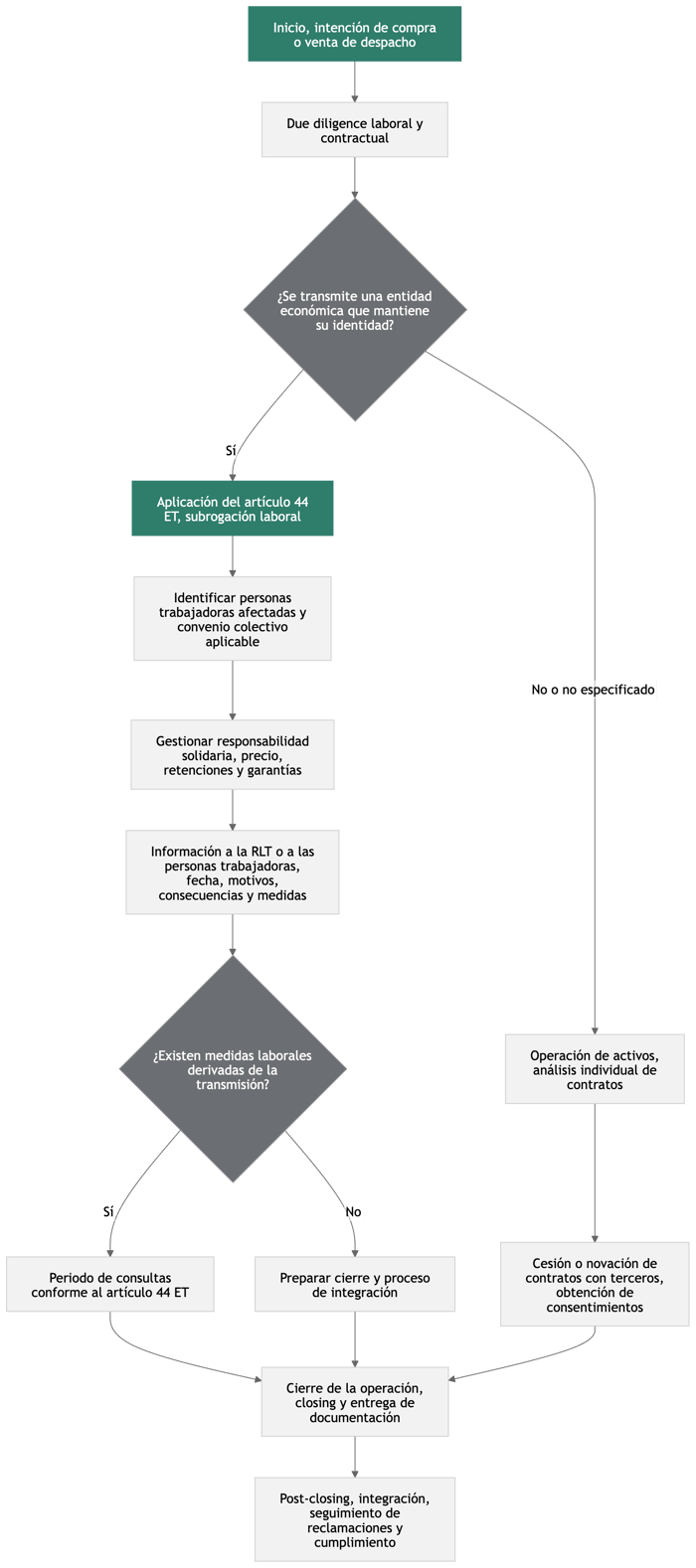
This diagram summarises the complete process for determining whether employee transfer obligations apply and what steps must be followed in each case.
The most common risks in practice
In this type of transaction, certain patterns tend to recur:
- Purchase price not adjusted for employment liabilities
The deal closes without accounting for employment-related contingencies, and back pay, consolidated variable remuneration or incorrect job classifications subsequently come to light. Article 44 of the Workers' Statute not only imposes subrogation but also joint and several liability for three years in respect of pre-existing debts. - Assuming there is no succession because no tangible assets are transferred
Case law has made clear that an economic entity can exist without significant assets, particularly in activities based on organised labour. The decisive factor is an overall assessment of the circumstances, not the existence of physical property. - Confusing contract assignment with automatic transfer
Not all contracts "travel" with the transaction. Many require third-party consent or a valid novation. Substituting the debtor without that consent is not a minor detail, it is a direct source of breach. - Incorrect handling of the premises lease
For premises used for a professional activity, the Urban Leases Act (LAU) permits assignment but requires formal notice within one month and may entail a rent increase. This point tends to be underestimated until it directly affects profitability. - Overlooking the Social Security dimension
The General Social Security Act provides for scenarios of joint and several liability of the acquirer in respect of benefits arising prior to the transfer. In addition, administrative certification mechanisms exist that can mitigate these risks, but they must be applied for and managed correctly. - Improvised or incomplete employee communication
Article 44 of the Workers' Statute imposes clear information obligations with a prescribed minimum content and, where applicable, requires the opening of a consultation period. Leaving these obligations until after completion is one of the most common, and most costly, mistakes.
Conclusion
Employment subrogation is one of the factors that can significantly affect the true cost of acquiring a professional practice, particularly when the inherited workforce does not match the skills and expertise the buyer actually needs. Failing to address this issue, or doing so too late, can turn what appeared to be a sound deal into a source of employment disputes and liabilities, as well as unwanted workforce obligations.
For this reason, a rigorous employment due diligence process, coordinated with the commercial analysis of the transaction and completed before signing, is an investment, not merely a cost. It protects the real value of what is being acquired, allows risks to be identified in advance, and enables the parties to structure price, warranties and responsibilities correctly.
If you are considering the purchase or sale of a professional practice, or the acquisition of a professional services company, and need a precise assessment of the employment obligations the transaction may entail, Conesa Legal can help. Our team specialises in both employment law and corporate law, and can support you at every stage of the process, from the initial analysis through to closing.